
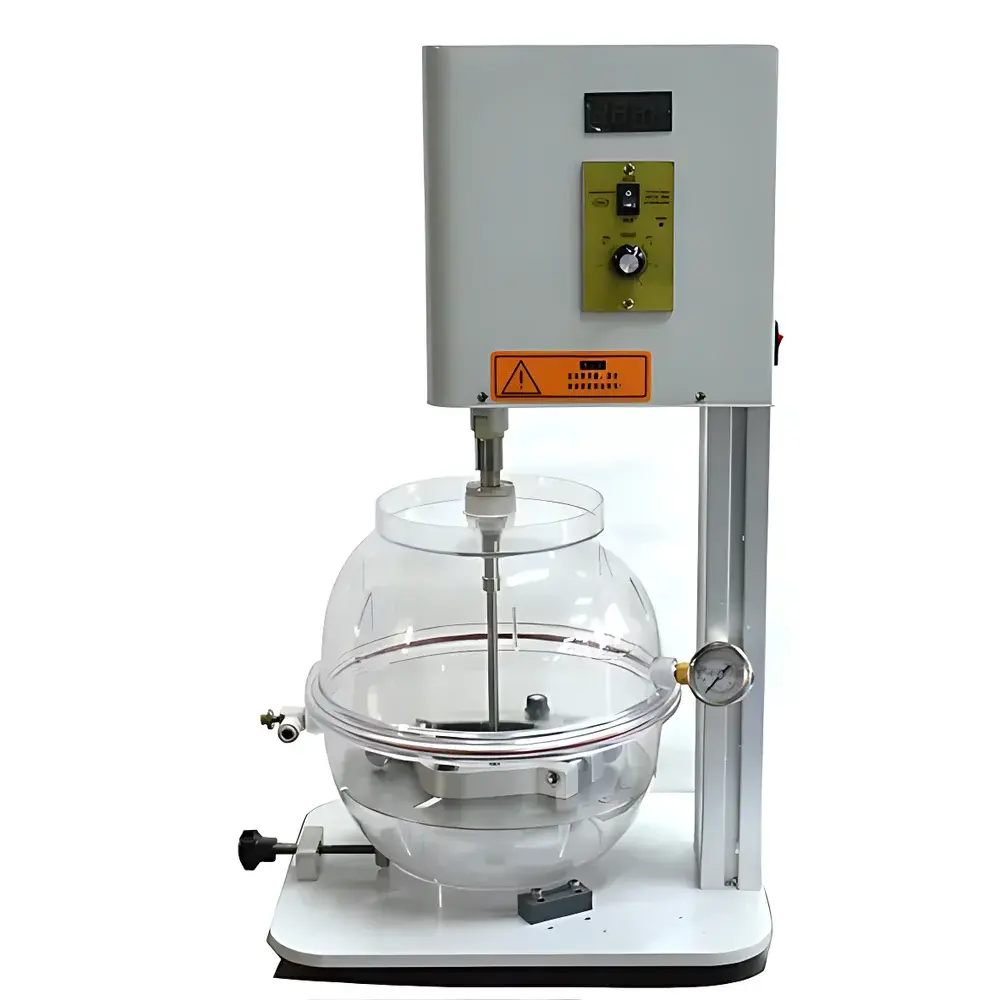
KJ GROUP SFM-4 Benchtop Vacuum Mixing System
| Brand | KJ GROUP |
|---|---|
| Origin | Liaoning, China |
| Manufacturer | KJ Group (Shenyang Kejing Automation Equipment Co., Ltd.) |
| Model | SFM-4 |
| Voltage | AC 220 V ±10% |
| Power | 90 W |
| Vacuum Chamber Material | Polycarbonate |
| Chamber Volume Range | 50–1000 mL |
| Ultimate Vacuum Level | –0.09 MPa (maintained continuously) |
| Stirring Speed | 54–187 ±10 rpm |
| Timer Range | 0–300 h |
| Dimensions (W×D×H) | 380 × 290 × 580 mm |
| Weight | 15 kg |
| Certifications | CE compliant |
| Standard Accessories | Magnetic stirrer head, vacuum chamber, sample support plate |
| Optional Accessories | Custom stirrer heads and sample holders available upon request |
Overview
The KJ GROUP SFM-4 Benchtop Vacuum Mixing System is an engineered solution for controlled, oxidation-sensitive material blending under sustained vacuum conditions. Designed around a sealed polycarbonate vacuum chamber and precision-adjustable magnetic stirring mechanism, the system operates on the principle of mechanical agitation within a low-pressure environment—eliminating atmospheric oxygen and moisture to prevent degradation of air-sensitive formulations. Unlike ambient-pressure mixers, the SFM-4 maintains a stable vacuum level of –0.09 MPa throughout operation, enabling reproducible homogenization of slurries, pastes, electrolyte precursors, and suspension-based active materials without thermal or oxidative side reactions. Its compact footprint and quiet operation make it suitable for integration into ISO-classified cleanrooms, battery R&D labs, and GLP-compliant formulation workstations where spatial efficiency and environmental control are critical.
Key Features
- Stable long-term vacuum maintenance at –0.09 MPa, verified via integrated pressure monitoring and leak-tight polycarbonate chamber construction
- Adjustable rotational speed range from 54 to 187 ±10 rpm, calibrated for consistent torque delivery across viscosity ranges typical of cathode slurries (e.g., NMC/LFP in NMP), polymer dispersions, and pharmaceutical suspensions
- Programmable digital timer with 0–300 h range, supporting unattended extended-duration mixing protocols required for solvent evaporation equilibration or particle wetting kinetics studies
- CE-certified electrical architecture compliant with EN 61000-6-3 (EMC) and EN 61000-6-2 (immunity), ensuring safe deployment in shared laboratory infrastructure
- Benchtop form factor (380 × 290 × 580 mm; 15 kg) optimized for fume hood compatibility and modular lab layout planning
- Chemically resistant polycarbonate vacuum chamber rated for repeated exposure to polar aprotic solvents (e.g., N-methyl-2-pyrrolidone, dimethyl sulfoxide) and mild aqueous formulations
Sample Compatibility & Compliance
The SFM-4 accommodates sample volumes from 50 mL to 1000 mL using standardized cylindrical polycarbonate chambers—compatible with common laboratory glassware adapters and optional custom-fit liners. It supports mixing of shear-thinning non-Newtonian fluids, high-solid-content battery electrode slurries (up to 70 wt% solids), hydrophilic/hydrophobic nanocomposites, and sterile-filtered ointment bases. The system meets CE marking requirements for electromagnetic compatibility and basic safety (EN 61010-1). While not intrinsically rated for ATEX or IECEx environments, its non-sparking stirrer design and absence of internal electronics in the vacuum zone render it appropriate for Class 1, Division 2 (C1D2) adjacent use when installed per NFPA 70E guidelines. Documentation packages include factory calibration records and material compatibility data sheets aligned with USP analytical instrument qualification principles.
Software & Data Management
The SFM-4 operates via a dedicated front-panel controller with tactile push-button interface and LED status indicators—no external PC or proprietary software required. All operational parameters (timer setting, speed selection, vacuum status) are retained in non-volatile memory during power cycling. For laboratories implementing 21 CFR Part 11 compliance, optional RS-232 or USB-to-serial interface modules enable timestamped event logging (start/stop/vacuum breach alerts) into validated LIMS or ELN platforms. Audit trail functionality—including user ID tagging and parameter change history—is supported when integrated with third-party data acquisition systems meeting ALCOA+ data integrity standards.
Applications
- Battery R&D: Homogenization of Li-ion cathode/anode slurries under inert conditions to suppress transition metal dissolution and binder oxidation
- Advanced Materials: Dispersion of graphene, MXenes, or metal-organic frameworks (MOFs) in vacuum-stabilized solvents to minimize agglomeration
- Pharmaceutical Development: Preparation of ophthalmic suspensions and topical gels requiring oxygen-free processing to preserve API stability
- Fine Chemical Synthesis: Controlled mixing of moisture-sensitive Grignard reagents or organolithium intermediates prior to transfer
- Academic Research: Teaching platform for vacuum process engineering fundamentals, including vapor pressure–temperature relationships and mass transfer limitations in reduced-pressure systems
FAQ
What vacuum level can the SFM-4 sustain during continuous operation?
The system maintains a stable ultimate vacuum of –0.09 MPa (equivalent to ~10 mbar absolute) over indefinite periods, confirmed by built-in analog vacuum gauge and validated per ISO 2859-1 sampling plans.
Is the vacuum chamber autoclavable?
No—polycarbonate is incompatible with steam sterilization. Cleaning is performed using IPA wipe-downs or ultrasonic baths with neutral pH detergents per manufacturer’s chemical resistance chart.
Can the SFM-4 be used with corrosive halogenated solvents such as chloroform or carbon tetrachloride?
Polycarbonate exhibits limited resistance to chlorinated hydrocarbons; extended exposure may cause stress cracking. Alternative chamber materials (e.g., borosilicate glass with O-ring sealing) are available as custom-engineered options.
Does the timer support multi-stage programming (e.g., ramped speed profiles)?
The standard timer provides single-interval countdown only. Multi-step protocols require external programmable logic controllers (PLCs) interfaced via dry-contact relay outputs.
What documentation is provided for IQ/OQ validation?
Factory test reports include as-delivered vacuum decay rate, speed accuracy verification at three setpoints (60/120/180 rpm), and electrical safety certification—sufficient for baseline installation and operational qualification per GAMP 5 Annex 15.
Related Products



