
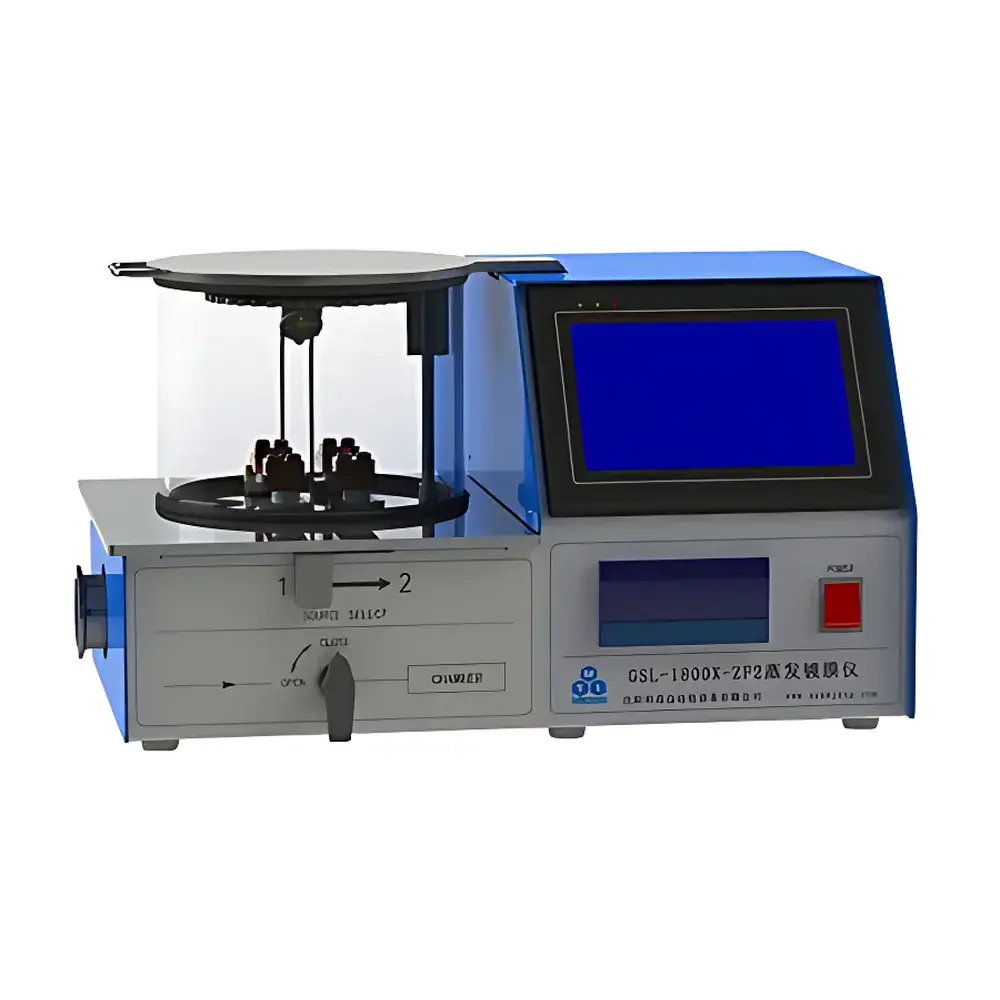
KJ GROUP GSL-1800X-ZF2 Desktop High-Vacuum Thermal Evaporation Coater
| Brand | KJ GROUP |
|---|---|
| Origin | Liaoning, China |
| Model | GSL-1800X-ZF2 |
| Vacuum Base Pressure | 3.0×10⁻⁴ torr (with turbomolecular pump) |
| Maximum Evaporation Power | 1000 W (5 V / 200 A) |
| Sample Stage Diameter | Ø120 mm, Motorized Rotation |
| Evaporation Source Configuration | Dual Resistive Sources (Tungsten Boat + Tungsten Wire Basket) |
| Control Interface | 7-inch TFT Touchscreen (Graphical UI) |
| Film Thickness Resolution | 0.1 Å (standard), 0.01 Å (optional QCM upgrade) |
| Power Supply | AC 220 V, 50 Hz, 1500 W Total |
| Dimensions (W×D×H) | 440 × 240 × 260 mm |
| Weight | ~47 kg |
Overview
The KJ GROUP GSL-1800X-ZF2 is a compact, benchtop high-vacuum thermal evaporation coater engineered for precision thin-film deposition in academic research laboratories, R&D centers, and pilot-scale production environments. It operates on the principle of resistive thermal evaporation under controlled high vacuum—where solid source materials (e.g., metals, oxides, or organic compounds) are heated to vaporization temperatures via tungsten-based resistive elements, and the resulting vapor condenses uniformly onto substrates mounted on a rotating stage. Designed for reproducible nanoscale film growth, the system achieves a base pressure of 3.0×10⁻⁴ torr using an optional turbomolecular pumping station (e.g., GZK-101 or GZK-103D), enabling low-background deposition critical for optical coatings, electrode fabrication, and fundamental surface science studies.
Key Features
- Integrated benchtop architecture: All core subsystems—including vacuum chamber, dual resistive evaporation sources, power supply, and control electronics—are housed within a footprint comparable to an A3-format printer (440 × 240 × 260 mm), minimizing laboratory space requirements.
- Dual-source evaporation configuration: Equipped with two independent evaporation electrodes—one fitted with a tungsten boat (optimized for powder-form materials such as Al, Cr, or SiO₂) and one with a tungsten wire basket (suited for wire, rod, or chip-shaped targets like Au, Ag, or Ni).
- Precision evaporation control: Features a 1000 W, 5 V / 200 A DC power supply with 0.1% current regulation accuracy and constant-current output mode, ensuring stable thermal profiles and extended source lifetime.
- Rotating sample stage: Ø120 mm motor-driven substrate holder rotates during deposition to enhance lateral thickness uniformity across planar samples—critical for quantitative optical and electrical characterization.
- Intuitive human-machine interface: 7-inch TFT touchscreen delivers full graphical operation, real-time parameter monitoring, recipe storage, and step-by-step procedural guidance without external PC dependency.
- Modular design philosophy: Functional blocks—including vacuum feedthroughs, evaporation modules, and thickness monitoring interfaces—are standardized for field serviceability, component-level replacement, and future functional expansion.
Sample Compatibility & Compliance
The GSL-1800X-ZF2 accommodates rigid, flat substrates up to Ø120 mm (e.g., silicon wafers, glass slides, quartz crystals, ITO-coated PET, and ceramic coupons). Substrate heating is not integrated but may be added via third-party stage upgrades. The system complies with general laboratory safety standards for Class I electrical equipment (IEC 61010-1) and supports GLP-aligned documentation practices when paired with optional quartz crystal microbalance (QCM) thickness monitors featuring audit-trail-capable data logging. While not certified to ISO 13485 or FDA 21 CFR Part 11 out-of-the-box, its modular architecture allows integration into validated workflows through user-defined SOPs, electronic logbooks, and U盘-based data export (FAT32 formatted USB drives).
Software & Data Management
Operation is fully embedded—no host PC required. The touchscreen firmware supports multi-step deposition recipes, real-time display of vacuum pressure (via Pirani/cold cathode gauges), evaporation current/voltage, and (when equipped) QCM-derived deposition rate (Å/s) and cumulative thickness (Å). All operational logs—including timestamps, setpoints, alarms, and final thickness values—can be exported in CSV format to USB storage for offline analysis in MATLAB, Python, or Excel. Firmware updates are delivered via USB stick, ensuring long-term maintainability without cloud connectivity or vendor lock-in.
Applications
- Preparation of metal electrodes (Au, Al, Ti, Cr) for organic photovoltaics (OPV) and perovskite solar cells.
- Deposition of transparent conductive layers (e.g., ITO analogs) and anti-reflection coatings on optical components.
- Fabrication of reference films for calibration of ellipsometers, spectrophotometers, and X-ray reflectometers.
- Model studies of nucleation and growth kinetics in ultra-thin metallic and dielectric films under controlled vacuum conditions.
- Prototyping of sensor architectures requiring sub-10 nm metal layers (e.g., plasmonic biosensors, MEMS contact electrodes).
- Teaching laboratories: Demonstrating vacuum physics, thin-film interference, and stoichiometric control in binary alloy evaporation (e.g., NiCr).
FAQ
What vacuum pumping options are compatible with the GSL-1800X-ZF2?
The system is designed for KF40 vacuum flanges and supports integration with turbomolecular pump stations (e.g., GZK-101 or GZK-103D) to achieve ≤3.0×10⁻⁴ torr base pressure. A mechanical backing pump is required upstream of the turbo pump.
Can the system deposit multilayer structures sequentially?
Yes—dual independent evaporation sources allow sequential deposition of two different materials without breaking vacuum, provided source cross-contamination is mitigated via shutter control and optimized source spacing (44 mm electrode-to-substrate distance).
Is remote monitoring or automation possible?
The unit does not include Ethernet/RS232 ports by default; however, analog voltage outputs (0–10 V) are available for external process controllers, and USB data export enables post-hoc correlation with external instrumentation.
What maintenance intervals are recommended for the tungsten evaporation sources?
Tungsten boats and baskets are consumables—expected lifetime depends on material purity, evaporation rate, and peak temperature. Routine visual inspection before each run and replacement after visible deformation or arcing is advised.
Does the system support substrate temperature control?
No built-in heating or cooling is provided. Substrate temperature remains near ambient unless externally regulated (e.g., via thermoelectric coolers or resistive heaters mounted beneath the stage).



