
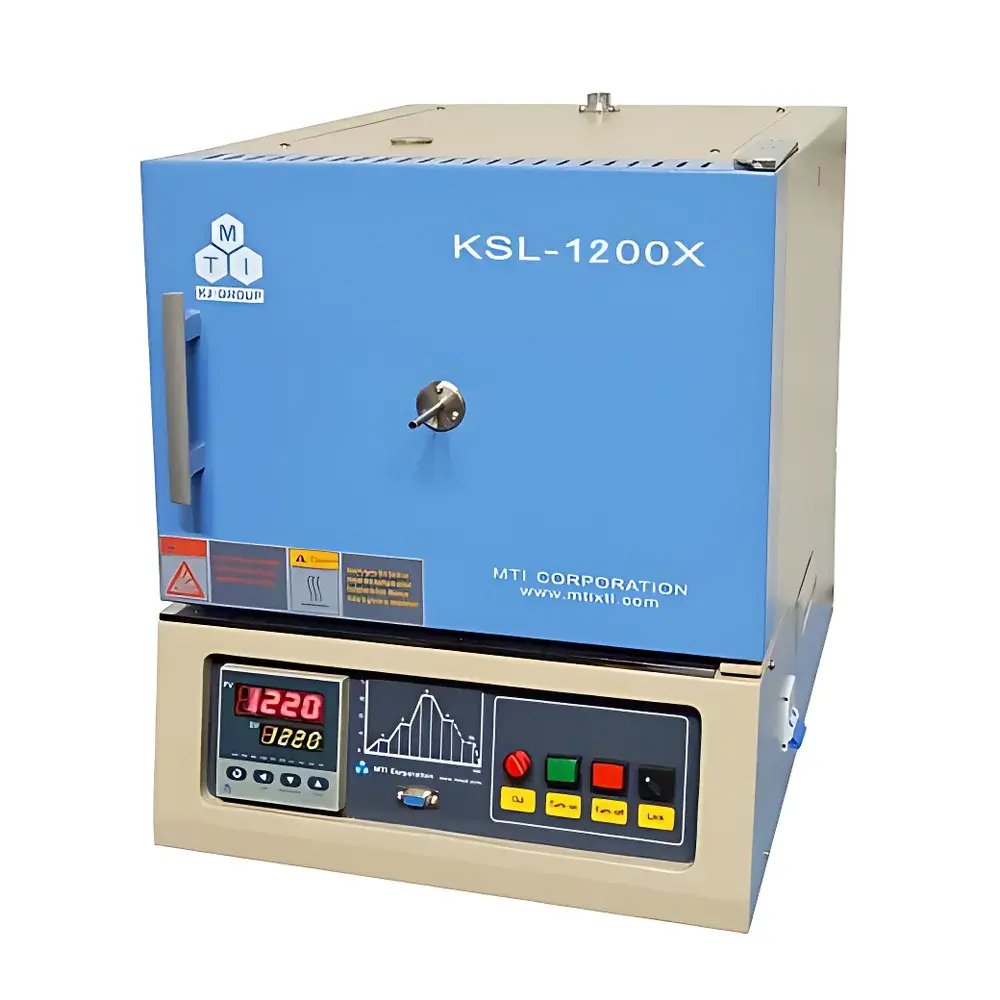
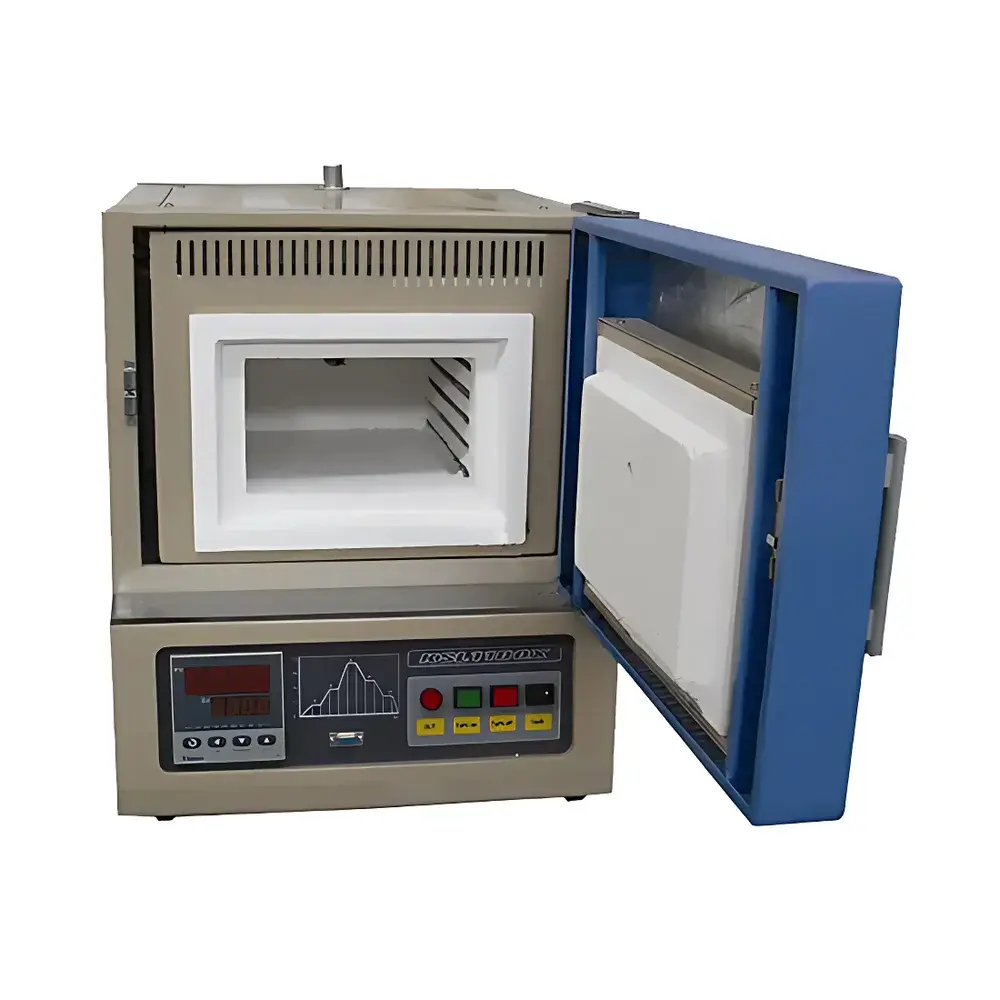
KJ GROUP KSL-1200X Desktop Muffle Furnace (7.2 L, with Gas Venting Port and Viewing Window)
| Brand | KJ GROUP |
|---|---|
| Origin | Anhui, China |
| Model | KSL-1200X |
| Max Operating Temperature | 1200 °C (continuous at ≤1100 °C) |
| Temperature Uniformity | ±1 °C |
| Power Supply | AC 220 V, 50/60 Hz, 3.5 kW |
| Heating Rate | Up to 10 °C/min |
| Heating Element | Kanthal® A1 Resistance Wire (3-sided heating) |
| Internal Chamber Dimensions | 200 mm × 300 mm × 120 mm (7.2 L) |
| Chamber Material | Alumina Microcrystalline Fiber with US-imported Al₂O₃ Reflective Coating |
| Control System | PID-based 30-segment Programmable Controller |
| Certification | CE-compliant |
| External Dimensions | 430 mm × 530 mm × 500 mm |
| Net Weight | 30 kg |
Overview
The KJ GROUP KSL-1200X Desktop Muffle Furnace is a precision-engineered laboratory furnace designed for controlled high-temperature thermal processing in research and quality assurance environments. Operating on the principle of resistive heating via Kanthal® A1 alloy wire—mounted on three internal chamber walls—the furnace delivers uniform radial and axial temperature distribution across its 7.2 L alumina fiber insulation chamber. Its maximum rated temperature of 1200 °C supports applications such as ceramic sintering, metal annealing, ash content determination (per ASTM E1755), and thermal stability testing (ISO 11358). Continuous operation up to 1100 °C ensures long-term reliability under sustained thermal load, while the dual-layer steel housing with forced-air cooling maintains external surface temperatures below 55 °C during full-power operation—reducing ambient heat gain and improving operator safety.
Key Features
- Dual-shell construction with integrated air-cooling ducts minimizes thermal leakage and enhances energy efficiency.
- Alumina microcrystalline fiber insulation (density ≥128 kg/m³) combined with a proprietary US-sourced Al₂O₃ reflective coating improves thermal reflectivity (>92% at 1000 °C) and extends furnace life by reducing fiber degradation.
- Side-opening door with high-temperature ceramic gasket ensures repeatable sealing performance and easy sample loading/unloading.
- Integrated viewing window (quartz glass, rated to 1200 °C) and optional gas venting port enable real-time visual monitoring and controlled atmosphere purging (e.g., N₂, Ar, or forming gas)—subject to user-provided gas regulation and flow control systems.
- PID-controlled 30-segment programmable temperature profile system supports complex thermal cycles including ramp-hold-cool sequences, with adjustable ramp rates (0.1–10 °C/min) and hold times (1 min–99 h 59 min).
- K-type thermocouple (IEC 60584 compliant) embedded in the chamber wall provides direct feedback for closed-loop temperature regulation with ±1 °C accuracy over the full operating range.
Sample Compatibility & Compliance
The KSL-1200X accommodates standard crucibles (including alumina, quartz, and silicon carbide) up to Ø80 mm × H60 mm. Its non-vacuum design prohibits use with flammable, explosive, or highly reactive gases (e.g., H₂ without dilution or O₂ above 21% partial pressure). For corrosive atmospheres containing sulfur or alkali vapors (e.g., Na, K), pre-treatment of the chamber lining with corrosion-resistant alumina slurry is available upon request. The furnace complies with CE marking requirements under the EU Machinery Directive 2006/42/EC and Low Voltage Directive 2014/35/EU. While not inherently GLP/GMP-validated, its programmable controller supports audit-ready data logging when interfaced with external recording systems compliant with FDA 21 CFR Part 11 (electronic records and signatures).
Software & Data Management
The onboard controller features RS485 communication (Modbus RTU protocol) for integration into centralized lab automation platforms. Optional PC software enables remote parameter configuration, real-time temperature graphing, and export of time-stamped CSV logs—including setpoint, actual temperature, power output, and alarm status. All profiles are stored with timestamped version history, supporting traceability in ISO/IEC 17025-accredited laboratories. No proprietary drivers are required; standard USB-to-RS485 adapters suffice for connection to Windows/Linux hosts.
Applications
- Thermal treatment of advanced ceramics and composite precursors (e.g., sintering of ZrO₂, SiC, or hydroxyapatite powders)
- Metallurgical annealing and stress-relief heat treatments per ASTM E112 and ISO 643
- Residue and ash analysis in food, pharmaceutical, and environmental samples (AOAC 923.03, USP <281>)
- Calibration of thermocouples and reference materials using fixed-point cells (e.g., Ag, Cu, Al)
- Pre-oxidation of catalyst supports and electrode materials prior to electrochemical characterization
- Thermogravimetric screening in conjunction with standalone TGA systems
FAQ
Can this furnace be used under vacuum or inert gas purge?
No—it lacks vacuum-tight seals or gas inlet/outlet fittings as standard. Optional gas ports may be installed, but users must supply external mass flow controllers, pressure regulators, and exhaust scrubbing systems.
What is the expected service life of the heating elements and insulation?
Under continuous operation at ≤1100 °C with proper thermal cycling (≤10 °C/min ramp rate), Kanthal® A1 elements typically exceed 3,000 hours; alumina fiber insulation retains structural integrity for ≥5 years with routine inspection.
Is the viewing window suitable for optical pyrometry?
Yes—the fused quartz viewport transmits wavelengths from 200 nm to 2.2 µm, enabling non-contact temperature measurement using narrow-band infrared pyrometers calibrated for blackbody emissivity correction.
Does the furnace support Ethernet or Wi-Fi connectivity?
Not natively. Communication is limited to RS485 Modbus RTU; Ethernet/Wi-Fi gateways may be added externally via third-party industrial protocol converters.
Are calibration certificates provided with shipment?
A factory-as-tested temperature uniformity report (at 800 °C and 1100 °C) is included. NIST-traceable calibration certificates require separate purchase and on-site verification by an accredited metrology provider.



