
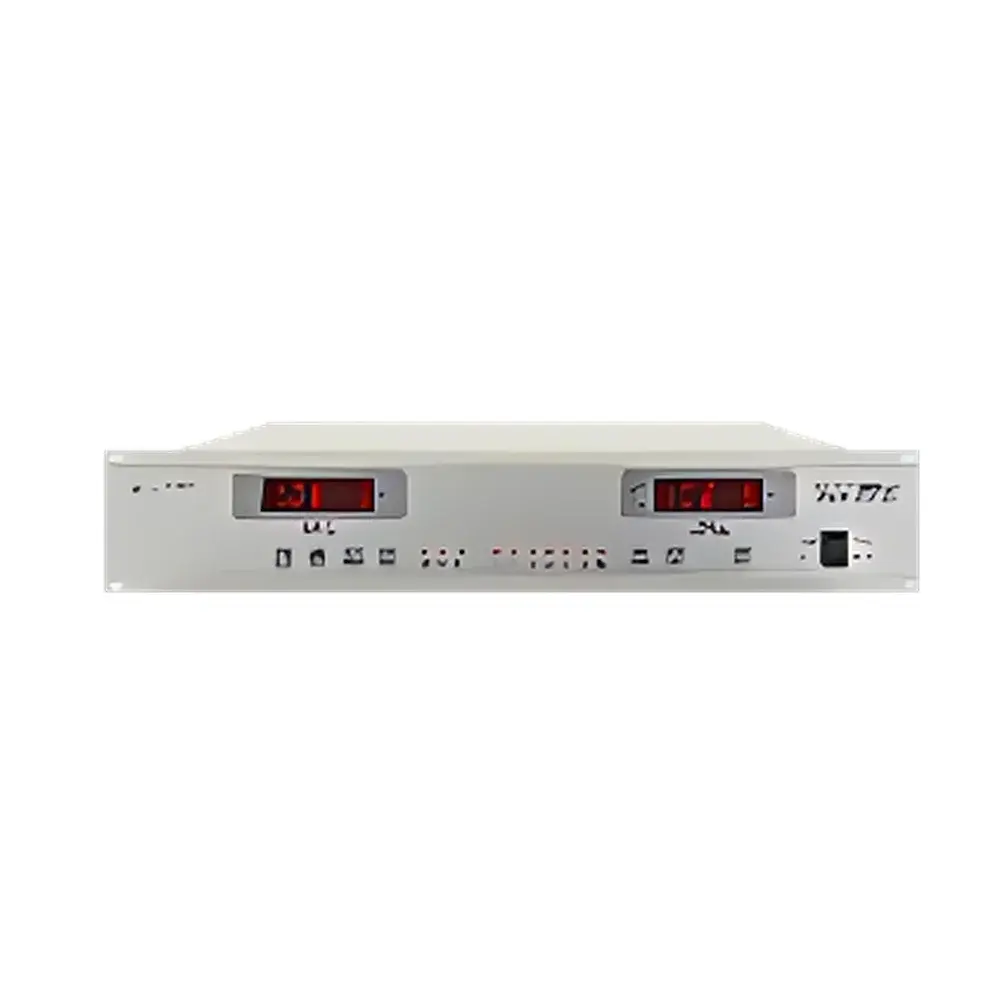
KJ GROUP ZDF-5227 Dual-Sensor Composite Vacuum Gauge
| Brand | KJ GROUP |
|---|---|
| Origin | Liaoning, China |
| Manufacturer Type | Authorized Distributor |
| Country of Origin | China |
| Model | ZDF-5227 |
| Pricing | Available Upon Request |
| Measurement Principle | Combined Pirani (thermal conductivity) and Hot-Cathode Ionization (electron impact ionization) |
| Full Range | 1.0×10⁵ to 1×10⁻⁵ Pa |
| Effective Measurement Range | 3×10³ to 1×10⁻⁵ Pa |
| Reference Range (Pirani only) | 1.0×10⁵ to 3×10³ Pa |
| Compatible Gauges | ZJ-52T (Pirani), ZJ-27 (Hot-Cathode Ionization) |
| Sensor Channels | 2 independent measurement channels |
| Display | Dual 5-digit LED, scientific notation (e.g., 1.2E−1 = 1.2×10⁻¹ Pa) |
| Control Outputs | 4 relay channels (expandable to 6), AC220V/3A or DC28V/10A per channel |
| Control Modes | Setpoint (point) or band (region) control with power-loss memory |
| Analog Output Options | 0–5 V or 4–20 mA (optional) |
| Communication Interfaces | RS-232 / RS-485 (optional) |
| Gauge Cable Length | Standard 5 m (custom lengths available) |
| Gauge Flange Options | ZJ-52T — Glass, metal direct-insert, DN16/DN25/DN35 CF, DN10/DN16/DN25/DN40 KF |
| Operating Power | AC 220 V ±10 %, 50 Hz, 45 W |
| Net Weight | ~4 kg |
| Enclosure Dimensions | 480 mm (W) × 88 mm (H) × 260 mm (D) |
| Panel Cutout | 440 mm × 80 mm |
Overview
The KJ GROUP ZDF-5227 Dual-Sensor Composite Vacuum Gauge is an engineered solution for wide-range, high-reliability vacuum monitoring in industrial vacuum systems, research chambers, thin-film deposition equipment, and vacuum heat treatment furnaces. It integrates two physically distinct vacuum sensing principles—Pirani thermal conductivity measurement (ZJ-52T gauge) and hot-cathode electron-impact ionization (ZJ-27 gauge)—into a single, synchronized instrument. This dual-sensor architecture enables continuous, gap-free pressure coverage from atmospheric conditions (1.0×10⁵ Pa) down to high vacuum (1×10⁻⁵ Pa), with optimal accuracy maintained across the effective range of 3×10³ to 1×10⁻⁵ Pa. The system employs an embedded microcontroller-based signal processing unit that applies real-time non-linear calibration correction, temperature compensation, and sensor-specific error modeling—ensuring repeatable readings, fast response times (<1 s typical for Pirani, <3 s for ionization), and robust immunity to electromagnetic interference common in industrial environments.
Key Features
- Hybrid sensing architecture combining Pirani and hot-cathode ionization technologies for seamless full-range vacuum measurement
- Dual independent 5-digit LED displays with scientific notation—each channel shows real-time pressure in Pa with automatic exponent scaling
- Four programmable relay outputs (expandable to six) supporting both setpoint-triggered and band-based control logic, with non-volatile memory retention during power interruption
- Configurable analog output (0–5 V or 4–20 mA) and digital communication interfaces (RS-232/RS-485) for integration into SCADA, PLC, or centralized process control systems
- Modular gauge interface support—including glass-sealed, metal direct-insert, and standard vacuum flanges (CF and KF series: DN10 to DN40)—enabling flexible installation across diverse chamber geometries and vacuum line configurations
- Microprocessor-driven linearization and cross-sensitivity compensation algorithms, calibrated against traceable NIST-traceable reference standards during factory verification
Sample Compatibility & Compliance
The ZDF-5227 is designed for use with clean, dry, non-corrosive gases—primarily air and nitrogen—within its specified operational envelope. The ZJ-52T Pirani sensor operates on thermal conductivity principles and exhibits gas-dependent sensitivity; therefore, accurate absolute pressure readings require calibration for the target gas species. For inert or specialty process gases (e.g., Ar, He, H₂), optional gas-specific calibration coefficients may be loaded via firmware update. The ZJ-27 hot-cathode gauge provides superior accuracy below 10⁻² Pa but requires stable filament operation and is not recommended for reactive or oxidizing atmospheres without protective measures. The instrument complies with IEC 61000-6-2 (immunity) and IEC 61000-6-4 (emissions) for industrial electromagnetic compatibility. While not certified to ISO/IEC 17025 for metrological traceability, its factory calibration documentation supports GLP-aligned recordkeeping and audit readiness in regulated manufacturing settings.
Software & Data Management
The ZDF-5227 supports ASCII protocol over RS-232/RS-485 for bidirectional communication, enabling remote configuration of control thresholds, display units, analog output scaling, and relay behavior. Optional PC-based configuration utility (Windows-compatible) allows batch parameter setup, firmware updates, and export of calibration logs in CSV format. All control events—including relay activation timestamps, pressure excursions beyond user-defined bands, and power-cycle recovery status—are internally timestamped and retained in non-volatile memory for up to 1,000 event records. When integrated into FDA-regulated environments (e.g., vacuum drying in pharmaceutical manufacturing), the device’s deterministic relay behavior, persistent memory, and deterministic communication timing support alignment with 21 CFR Part 11 requirements when paired with compliant host software implementing electronic signatures and audit trails.
Applications
- Monitoring and controlling base pressure and process pressure in PVD/CVD coating systems
- Real-time vacuum supervision in electron beam welding and brazing chambers
- Leak detection pre-checks and bake-out validation in UHV research systems
- Automated pressure sequencing in vacuum impregnation and degassing of composites
- Quality assurance in vacuum packaging lines for food, electronics, and medical devices
- Process validation in semiconductor front-end tooling where multi-stage vacuum ramping is required
FAQ
What gases can the ZDF-5227 measure accurately?
The ZJ-52T Pirani sensor is factory-calibrated for air and nitrogen. For other gases—including argon, helium, or hydrogen—measurement deviation must be corrected using known relative thermal conductivity factors; optional gas-specific calibration tables are available upon request.
Can the ZJ-27 ionization gauge operate continuously at atmospheric pressure?
No. The ZJ-27 gauge must be protected by interlock logic or mechanical valve isolation when chamber pressure exceeds 1×10⁻¹ Pa to prevent filament burnout and grid contamination.
Is the analog output isolated from the main power supply?
Yes—the optional 0–5 V or 4–20 mA output features galvanic isolation rated to 500 VDC, preventing ground-loop interference in distributed control networks.
How is calibration traceability documented?
Each unit ships with a factory calibration report listing pressure points, measured values, uncertainties, environmental conditions, and reference standard IDs—all traceable to national metrology institutes per ISO/IEC 17025 guidelines.
Does the ZDF-5227 support Modbus RTU protocol?
Not natively—but the ASCII command set is easily mapped to Modbus RTU via third-party protocol converters compatible with RS-485 physical layer signaling.



