
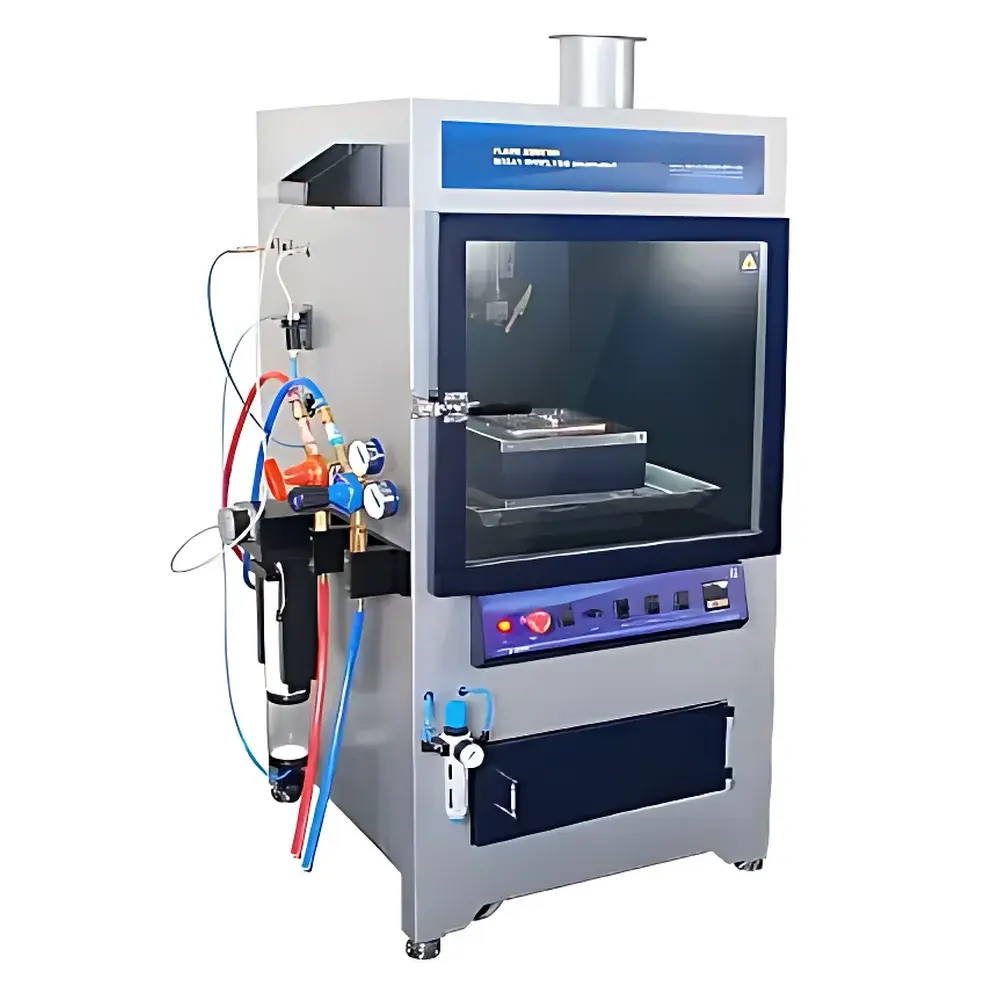
KJ GROUP MSK-SP-04-LD Ultrasonic Spray Pyrolysis Thin-Film Coater
| Brand | KJ GROUP |
|---|---|
| Origin | Liaoning, China |
| Manufacturer Type | Authorized Distributor |
| Country of Origin | China |
| Model | MSK-SP-04-LD |
| Pricing | Upon Request |
| Input Power | 208–240 V AC, 50/60 Hz |
| Stepper Motor Supply | 24 V DC |
| Ultrasonic Nebulizer | 40 kHz, 130 W |
| Reservoir Volumes | 50 mL & 250 mL |
| Flow Rate | 1–20 mL/s |
| Droplet Size | ~50 µm |
| X-Y Translation Range | 200 mm (X), 200 mm (Y) |
| Translation Speed | X-axis 10–800 mm/s, Y-axis 1–12 mm/s |
| Substrate Stage | 150 mm × 150 mm |
| Max Substrate Temperature | 500 °C |
| Temperature Control | Digital PID controller with 7-segment ramp-soak program |
| Dimensions (W×D×H) | 840 × 920 × 1400 mm |
| Operating Altitude | ≤1000 m |
| Ambient Temp. | 25 °C ±15 °C |
| Relative Humidity | 55 %RH ±10 %RH |
| Grounding | Mandatory |
| Ventilation | Required |
| Footprint | ≥1 m² |
| Compressed Air | Required for Y-axis actuation |
Overview
The KJ GROUP MSK-SP-04-LD Ultrasonic Spray Pyrolysis Thin-Film Coater is a precision-engineered platform for the deposition of uniform, stoichiometrically controlled inorganic thin films via aerosol-assisted thermal decomposition. It operates on the principle of ultrasonic nebulization—where precursor solutions are atomized into monodisperse microdroplets (mean diameter ~50 µm) using a high-frequency (40 kHz) piezoelectric transducer—followed by directed transport and thermally induced pyrolysis on a heated substrate. This process enables conformal, pinhole-free film formation without vacuum infrastructure, making it particularly suitable for scalable lab-scale synthesis of metal oxides (e.g., SnO₂, TiO₂, NiO), perovskite absorbers (e.g., MAPbI₃), and transparent conducting oxides (TCOs) used in optoelectronic devices. Unlike spin coating or evaporation methods, spray pyrolysis preserves solution-phase stoichiometry and allows real-time modulation of film thickness, crystallinity, and morphology through coordinated control of droplet flux, carrier gas dynamics, and thermal gradient profiles.
Key Features
- Ultrasonic nebulization system (130 W, 40 kHz) delivering consistent droplet size distribution (~50 µm) for high reproducibility in film nucleation and growth.
- Computer-controlled X-Y translation stage with dual-axis stepper motor actuation: 200 mm travel range in both axes; programmable linear speeds from 1 mm/s (Y) to 800 mm/s (X), enabling precise raster scanning over substrates up to 150 mm × 150 mm.
- Integrated digital PID temperature controller with 7-segment ramp-soak capability, supporting substrate heating up to 500 °C with ±1.5 °C stability—critical for phase-pure oxide crystallization and perovskite annealing.
- Dual-volume solvent reservoirs (50 mL and 250 mL) with volumetric peristaltic pumping, calibrated for flow rates between 1–20 mL/s—ensuring accurate precursor delivery across varying viscosity and volatility regimes.
- Compressed-air-assisted Y-axis motion (no internal compressor included) ensures low-vibration, repeatable lateral displacement synchronized with spray timing and thermal history.
- Robust stainless-steel frame and modular chamber design comply with standard laboratory safety protocols; grounding terminal and ventilation interface included per IEC 61000-6-3 EMC requirements.
Sample Compatibility & Compliance
The MSK-SP-04-LD accommodates rigid planar substrates including silicon wafers, glass slides (e.g., FTO, ITO-coated), ceramic plates, and metallic foils—provided dimensional compatibility with the 150 mm × 150 mm stage. It supports aqueous and organic precursor solutions (e.g., nitrate, chloride, or acetylacetonate complexes) commonly used in sol-gel-derived oxide synthesis. The system meets general electrical safety standards for Class I laboratory equipment (IEC 61010-1) and is designed for operation under ISO 14644-1 Class 8 cleanroom-adjacent environments when coupled with appropriate exhaust ducting. While not certified for GMP production, its programmable thermal profiles and traceable parameter logging support GLP-aligned experimental documentation for academic and preclinical materials development.
Software & Data Management
Operation is managed via front-panel keypad and LED display, with all critical parameters—including flow rate, XY position, temperature setpoints, and dwell time—manually configurable and retained in non-volatile memory. Though no proprietary PC software is bundled, the device provides analog voltage outputs (0–10 V) for external data acquisition systems, allowing integration with LabVIEW, MATLAB, or custom SCADA platforms for time-synchronized logging of temperature, position, and pump status. All thermal programs adhere to ASTM E2070-22 guidelines for thermal process validation, and timestamped operational logs can be exported manually for audit readiness in university core facility or contract research settings.
Applications
- Preparation of electron/hole transport layers (e.g., NiOₓ, SnO₂) for perovskite solar cells (PSCs), with demonstrated compatibility for roll-to-plate R&D workflows.
- Synthesis of photoanodes and electrocatalysts (e.g., Fe₂O₃, BiVO₄) for photoelectrochemical water splitting studies.
- Deposition of dielectric interlayers (e.g., Al₂O₃, ZrO₂) in solid-state battery prototype fabrication.
- Rapid screening of composition–structure–property relationships in multicomponent oxide libraries via combinatorial spray patterning.
- Teaching laboratories for hands-on instruction in thin-film physics, aerosol science, and thermal decomposition kinetics.
FAQ
Does the MSK-SP-04-LD include an integrated compressed air source?
No. A clean, oil-free external compressed air supply (regulated to 0.3–0.6 MPa) is required for Y-axis actuation and droplet transport. Users must provide compatible tubing and pressure regulators.
What substrate heating uniformity can be expected across the 150 mm × 150 mm stage?
Measured radial temperature deviation is ≤±3.5 °C at 400 °C under steady-state conditions, verified using calibrated thermocouple mapping per ASTM C1045-18.
Can the system operate with corrosive precursors such as HF-containing etchants or HCl-based solutions?
Only with optional chemically resistant fluid path upgrades (e.g., PTFE-lined reservoirs, Hastelloy pump heads). Standard configuration uses borosilicate glass and stainless steel wetted parts rated for pH 2–12.
Is remote monitoring or Ethernet connectivity supported?
Not natively. Communication is limited to front-panel interface and analog output signals. RS-485 or Ethernet modules may be added via third-party industrial I/O adapters.
What maintenance intervals are recommended for the ultrasonic transducer and peristaltic pump?
Transducer performance should be verified quarterly using acoustic power meter calibration; pump tubing requires replacement every 500 operating hours or after exposure to abrasive suspensions.



