
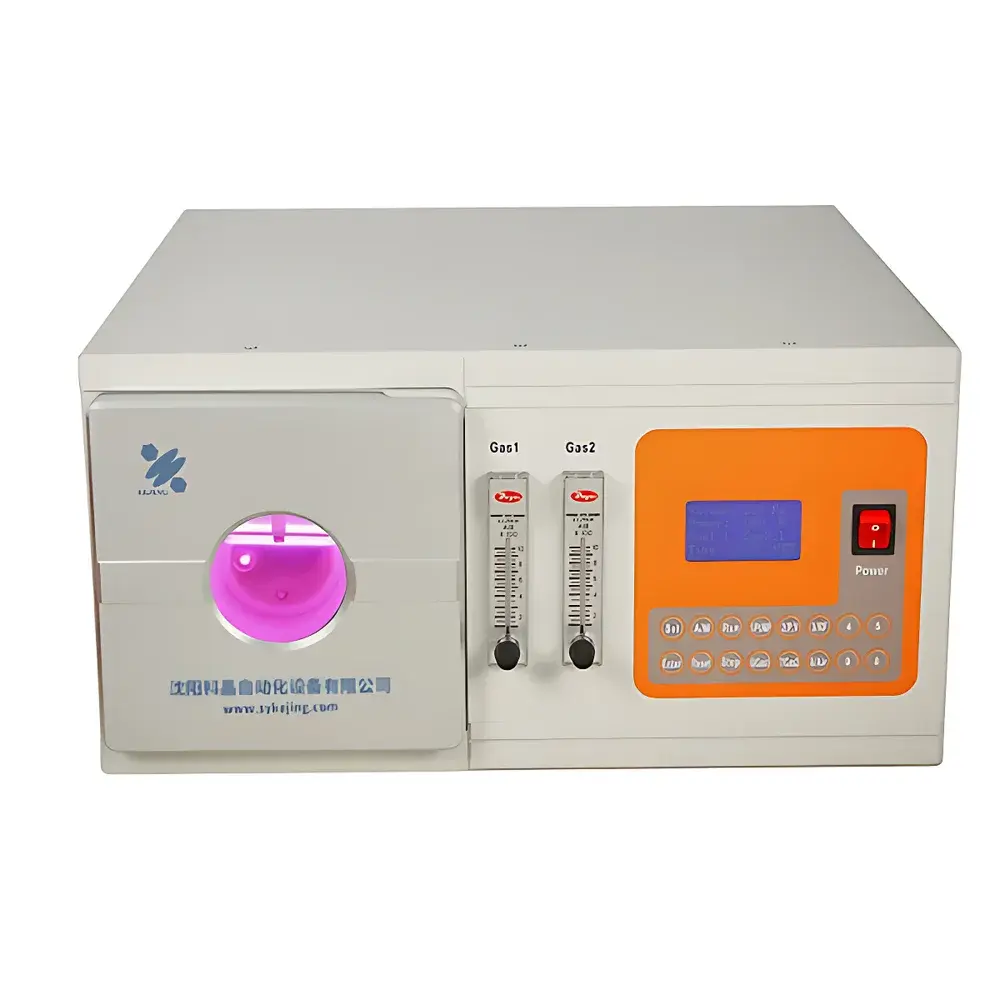
KJ GROUP PCE-6S Series Rotating-Bottle Plasma Cleaner
| Brand | KJ GROUP (Shenyang Kejing) |
|---|---|
| Origin | Liaoning, China |
| Manufacturer Type | Authorized Distributor |
| Country of Origin | China |
| Model | PCE-6S |
| Quotation | Available Upon Request |
| Chamber Material | Fused Quartz |
| Rotation Mechanism | Motorized Horizontal Bottle Rotation |
| RF Excitation | Capacitive Coupling |
| Vacuum System | Integrated Mechanical Pump |
| Compliance | CE-marked per IEC 61000-6-3/6-4 |
Overview
The KJ GROUP PCE-6S Series Rotating-Bottle Plasma Cleaner is an engineered solution for surface modification and contamination removal from particulate and powdered materials—addressing a longstanding limitation of conventional planar or static-chamber plasma systems. Unlike standard parallel-plate or barrel-type plasma reactors that rely on uniform electric field distribution across flat substrates, the PCE-6S employs a dynamically rotating fused quartz bottle as both sample carrier and plasma reaction vessel. This architecture enables homogeneous exposure of irregular, low-density, or electrostatically cohesive powders—including metal oxides, pharmaceutical excipients, ceramic precursors, and polymer microspheres—to low-temperature, non-thermal plasma generated via capacitive RF coupling. The system operates under controlled vacuum (≤100 Pa), supporting reactive gas chemistries (e.g., O₂, Ar, N₂, air, or O₂/H₂ mixtures) to achieve surface cleaning, functional group introduction (e.g., –OH, –COOH), oxide reduction, organic residue ablation, and pre-deposition activation—without thermal degradation or agglomeration. Its dual-frequency configuration (40 kHz and 13.56 MHz options) allows process optimization for both high-ion-density bulk treatment (low-frequency) and precise surface-selective reactions (high-frequency).
Key Features
- Fused quartz rotating bottle (60 × 60 × 120 mm) with precision DC motor drive, adjustable rotation speed from 1–15 rpm for uniform powder tumbling and plasma exposure
- Dual-frequency RF generator options: 40 kHz (high-power, high-ion-flux mode) or 13.56 MHz (standard industrial ISM band, improved electron energy control)
- Continuously adjustable RF power output: 10–200 W (PCE-6S40) or 10–150 W (PCE-6S13), enabling fine-tuned process scalability from lab-scale R&D to pilot batch processing
- Integrated mechanical vacuum pump with ≤100 Pa base pressure capability and programmable gas stabilization delay (1 min default)
- Digitally programmable timer with resolution down to 1 second (range: 00:01–99:59 min:sec), supporting repeatable, SOP-compliant operation
- Capacitively coupled electrode configuration ensuring stable plasma ignition and minimal arcing risk during powder agitation
- Compact benchtop footprint (550 × 520 × 285 mm) with reinforced steel frame and quartz chamber rated for repeated thermal cycling (−20 °C to +120 °C operational range)
Sample Compatibility & Compliance
The PCE-6S accommodates diverse sample forms without hardware reconfiguration: free-flowing or cohesive powders (particle size range: 10 nm–500 µm), granules, flakes, thin films, wafers up to Φ100 mm, and irregularly shaped components. Its rotating-bottle geometry eliminates shadowing effects and ensures statistically representative surface treatment—critical for QC/QA in battery cathode material processing, catalyst regeneration, and biomaterial functionalization. The system supports ISO 14644-1 Class 5 cleanroom-compatible operation when used with filtered gas lines and external exhaust scrubbing. All electrical subsystems conform to IEC 61000-6-3 (EMI emission) and IEC 61000-6-4 (immunity) standards. While not certified for GMP manufacturing environments out-of-box, its time-stamped operation log, fixed process parameters, and absence of software-based user-editable recipes make it suitable for GLP-aligned laboratories conducting ASTM D726-17 (surface wettability), ISO 8501-1 (surface cleanliness), or USP (plasma sterilization validation studies).
Software & Data Management
The PCE-6S operates via embedded microcontroller-based interface with no proprietary PC software dependency—ensuring long-term maintainability and cybersecurity resilience. All operational parameters (power, time, rotation speed, gas type if externally regulated) are set manually and retained in non-volatile memory across power cycles. The front-panel LED display provides real-time feedback on RF status, vacuum level (via analog gauge input), and elapsed time. For traceability, users may document process logs manually or integrate optional RS-232/USB data-logging modules (sold separately) to capture timestamped event records compatible with LIMS or electronic lab notebook (ELN) platforms. No FDA 21 CFR Part 11 compliance is natively implemented; however, the deterministic behavior and absence of user-modifiable firmware align with ALCOA+ principles for raw data integrity in analytical development workflows.
Applications
- Surface decontamination of nanoparticle batches prior to dispersion or colloidal stability testing
- Oxide layer reduction on Cu/Ni nanopowders for conductive ink formulation
- Hydrophilization of polymeric microspheres for drug encapsulation efficiency enhancement
- Resist stripping and photoresist ashing on silicon wafers and flexible PET substrates
- Plasma activation of carbon black or graphene oxide powders prior to composite matrix integration
- Removal of adventitious hydrocarbons from TEM grid substrates and AFM calibration samples
- Controlled surface etching of PMMA microbeads for microfluidic valve fabrication
FAQ
Can the PCE-6S handle moisture-sensitive hygroscopic powders?
Yes—provided samples are loaded under inert atmosphere (e.g., glovebox) and processed using dry Ar or N₂; residual moisture content must be <500 ppm to avoid plasma quenching.
Is quartz bottle replacement required after extended use?
Fused quartz exhibits excellent plasma erosion resistance; typical service life exceeds 2,000 hours at 150 W; visual inspection for clouding or microcracking is recommended every 500 operating hours.
Does the system support reactive gas mixing (e.g., O₂ + CF₄)?
The base configuration includes a single gas inlet; optional dual-gas manifold kits (with mass flow controllers) are available for precise binary gas ratio control.
What vacuum pump oil maintenance schedule is recommended?
With continuous use, rotary vane pump oil should be replaced every 200 hours or quarterly—whichever occurs first—to maintain ≤100 Pa performance and prevent backstreaming contamination.
Can the rotation speed be synchronized with RF pulsing?
No—rotation and RF generation operate independently; however, empirical optimization shows optimal uniformity at 6–10 rpm under continuous 13.56 MHz excitation.



