
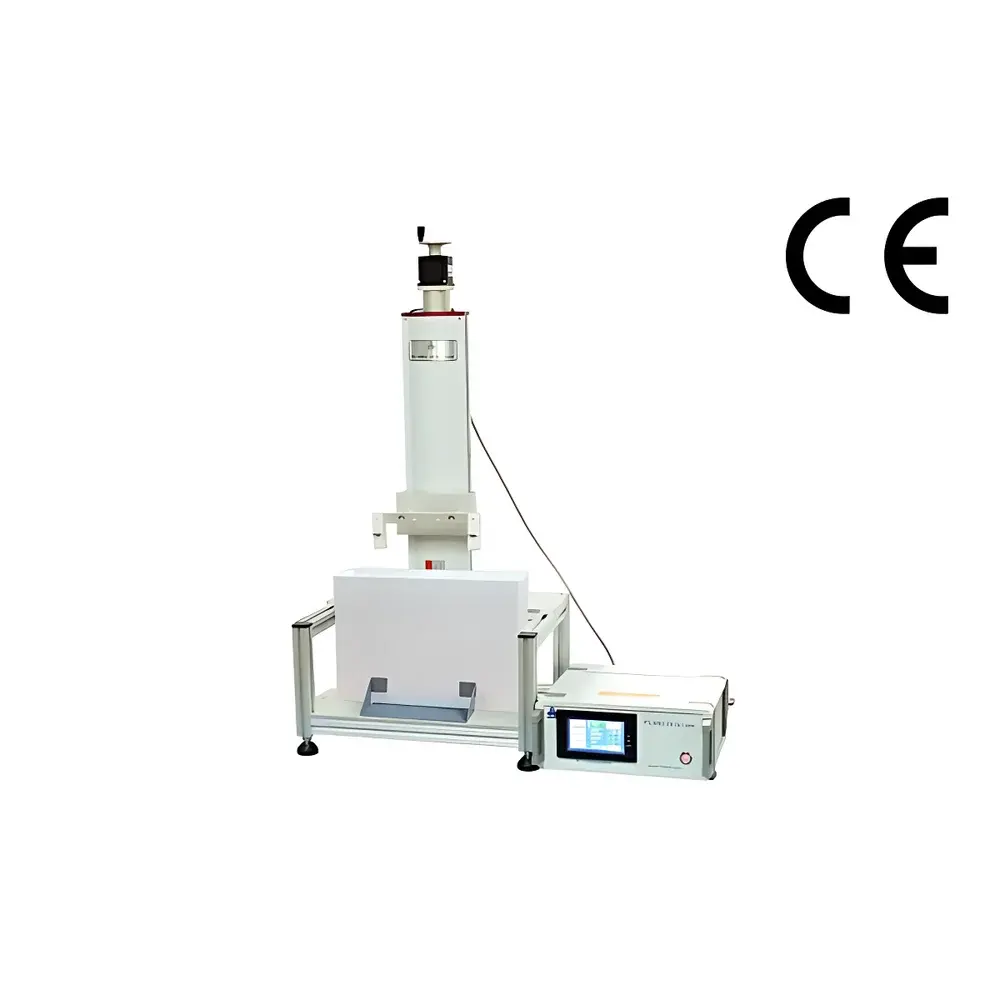
KJ GROUP PTL-MM02-200 Programmable Vertical Dip Coater
| Brand | KJ GROUP |
|---|---|
| Origin | Liaoning, China |
| Manufacturer Type | Authorized Distributor |
| Country of Origin | China |
| Model | PTL-MM02-200 |
| Power Supply | AC 220 V, 50 Hz |
| Speed Range | 1–200 mm/min |
| Stroke | 270 mm |
| Max Sample Dimensions | 310 × 260 × 5 mm |
| Load Capacity | ≤5.5 kg |
| Immersion/Drying Time Setting | 1–999 s |
| Cycle Count | 1–20 cycles |
| Motor | Two-phase hybrid stepper motor with microstepping driver |
| Certifications | CE compliant |
| Footprint | 455 × 330 × 890 mm (L×W×H) |
| Working Table Requirement | ≥800 × 600 × 700 mm, ≥200 kg load capacity |
| Environmental Operating Range | Altitude <1000 m, Temperature 10–40 °C, Relative Humidity 45–65 % RH |
Overview
The KJ GROUP PTL-MM02-200 Programmable Vertical Dip Coater is an engineered solution for controlled thin-film deposition via vertical dip-coating—a technique rooted in colloidal and sol-gel science. It operates on the principle of controlled withdrawal from a precursor solution, where film thickness is governed by the balance between viscous drag, capillary forces, and gravitational drainage, as described by the Landau-Levich-Derjaguin (LLD) model. Designed for reproducible fabrication of uniform coatings—including metal oxides (e.g., TiO₂, SiO₂), perovskites, polymers, and functional nanocomposites—the system enables precise manipulation of interfacial kinetics during immersion, dwell, withdrawal, and ambient drying phases. Its rigid mechanical architecture, linear motion guidance, and closed-loop speed regulation ensure minimal velocity fluctuation (<±0.5% over full range), critical for achieving thickness repeatability across large-area substrates.
Key Features
- Programmable multi-stage motion control: independent adjustment of immersion speed, dwell time in solution (1–999 s), withdrawal speed (1–200 mm/min), post-withdrawal drying interval (1–999 s), and total coating cycles (1–20)
- High-resolution motion system: two-phase hybrid stepper motor with microstepping driver ensures smooth, jitter-free vertical translation over 270 mm stroke; position resolution <0.01 mm
- Intuitive HMI interface: 7-inch resistive touchscreen with real-time parameter feedback, preset recipe storage, and on-screen error logging
- Modular sample handling: accommodates single substrates up to 310 × 260 × 5 mm or multiple smaller specimens using custom fixture kits (not included)
- CE-certified electrical design: conforms to EN 61000-6-2 (immunity) and EN 61000-6-4 (emission); includes overcurrent protection, emergency stop, and grounded chassis
- Compact footprint and benchtop integration: unit dimensions 455 × 330 × 890 mm; compatible with standard laboratory workbenches (min. 800 × 600 × 700 mm, ≥200 kg static load rating)
Sample Compatibility & Compliance
The PTL-MM02-200 supports rigid, flat substrates including silicon wafers, glass slides, ITO/PET films, stainless steel plates, and ceramic tiles. Substrate thickness tolerance (1–5 mm) allows compatibility with mechanically robust carriers used in photovoltaic, optical filter, and corrosion-resistant coating development. The system does not require compressed air, water, or exhaust ventilation—making it suitable for ISO Class 7 cleanrooms or general-purpose labs. While not intrinsically rated for hazardous environments, its CE marking confirms compliance with EU Machinery Directive 2006/42/EC and Low Voltage Directive 2014/35/EU. For GLP/GMP-aligned workflows, audit trails may be maintained manually via timestamped parameter logs; optional RS-232/USB data export enables integration with LIMS or electronic lab notebooks.
Software & Data Management
The embedded firmware provides non-volatile storage for up to 20 user-defined coating protocols, each retaining full parameter sets (immersion speed, dwell duration, withdrawal profile, cycle count, drying delay). All settings are entered directly via the touchscreen interface—no external PC or proprietary software required. Real-time status indicators display current phase (immersion/hold/withdraw/dry), elapsed time, and motor load feedback. Parameter changes during active operation are permitted only at designated pause points to prevent mechanical shock or meniscus disruption. Export functionality (via USB flash drive) captures session metadata—including date/time stamp, operator ID field, and final motor position—for traceability in method validation studies. No cloud connectivity or remote access is implemented, preserving data sovereignty per institutional IT policies.
Applications
This dip coater serves research and pilot-scale applications in materials science, surface engineering, and optoelectronics. Typical use cases include: preparation of antireflective and photocatalytic TiO₂ layers on float glass; fabrication of mesoporous ZnO electron transport layers for perovskite solar cells; deposition of chitosan-based bioactive films on medical-grade substrates; and gradient-thickness polymer films for sensor calibration standards. Its ability to process oversized substrates (up to 310 × 260 mm) makes it particularly valuable for prototyping architectural glazing coatings, large-area flexible electronics, and textured optical diffusers—where edge uniformity and macroscopic homogeneity are essential performance criteria.
FAQ
What is the maximum substrate weight the PTL-MM02-200 can handle during vertical withdrawal?
The system supports a maximum load of 5.5 kg under continuous motion, verified across the full speed range (1–200 mm/min) and stroke length (270 mm).
Is the immersion bath included, and what are its material specifications?
Yes, one standard immersion trough is supplied; it is constructed from chemically resistant polypropylene (PP), with internal dimensions of 330 × 280 × 60 mm (L×W×H) and compatible with aqueous, alcoholic, and moderately polar organic solvents.
Can the system perform bidirectional motion (e.g., oscillatory dipping)?
No—this model implements unidirectional vertical translation only (down → hold → up → hold). Oscillatory or multi-pass immersion requires external automation integration.
Does the unit support temperature-controlled substrate or bath environments?
No built-in thermal control is provided; however, the open-frame design permits integration with external environmental chambers or heated/cooled sample stages (user-supplied and validated separately).
How is calibration performed, and is NIST-traceable documentation available?
Speed calibration is factory-verified using laser Doppler velocimetry; a certificate of conformance (CoC) is included. End-user recalibration is not supported—speed accuracy is maintained through stepper motor step-angle stability and encoderless open-loop precision design.



