
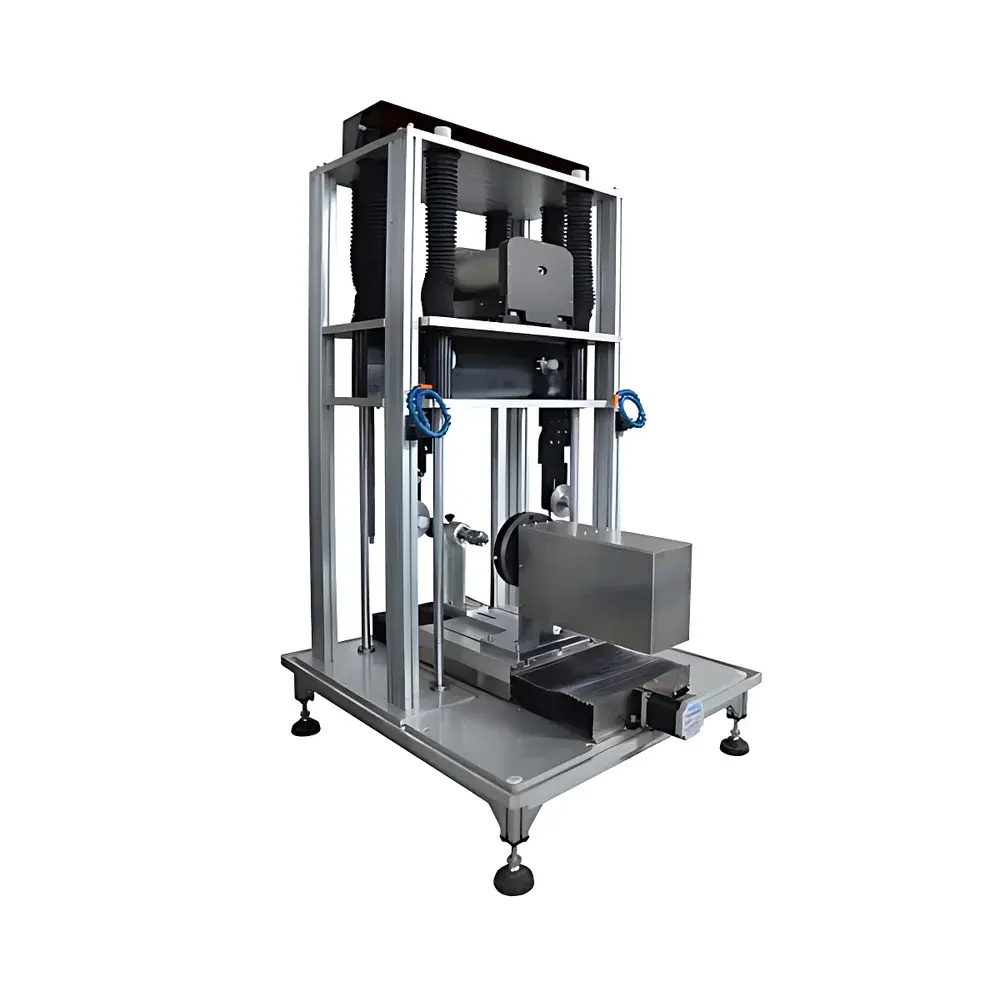
KJ GROUP STX-1200-A Axial Oscillating & Rotational Sample Mounting Stage
| Brand | KJ GROUP |
|---|---|
| Origin | Liaoning, China |
| Manufacturer Type | Authorized Distributor |
| Country of Origin | China |
| Model | STX-1200-A |
| Pricing | Available Upon Request |
| Rated Load Capacity | ≤30 kg |
| A-Axis Rotation Speed | 0–30 rpm (adjustable) |
| A-Axis Oscillation Angle | ±5° to ±23° (adjustable) |
| A-Axis Oscillation Frequency | 20 cycles/min |
| Rotary Platform Diameter | Ø200 mm / Ø400 mm |
| Max. Rotary Cutting Diameter | Ø380 mm |
| Max. Oscillating Cutting Envelope | 180 mm (Y) × 260 mm (X) × 260 mm (Z) |
| Operating Ambient | Altitude ≤1000 m |
| Structural Material | Anodized Aluminum Alloy |
| Noise Level | Low |
| Power Consumption | Low |
| Positional Stability | High Reproducibility |
| Compliance | Designed for integration with STX-1203 Fully Automated Diamond Wire Saws |
Overview
The KJ GROUP STX-1200-A Axial Oscillating & Rotational Sample Mounting Stage is an engineered motion control module designed exclusively for integration with the STX-1203 Fully Automated Diamond Wire Saw system. It introduces dual-mode sample manipulation—simultaneous axial oscillation and synchronized rotational motion—enabling precise, low-stress material removal from both ultra-hard and soft brittle materials. Its operational principle relies on coordinated angular displacement (oscillation) and continuous or stepwise rotation about the A-axis, which modulates wire–sample interaction geometry in real time. This kinematic strategy reduces localized thermal buildup, minimizes diamond wire deflection, and distributes mechanical loading more uniformly across the cutting interface—critical for preserving crystal integrity in sapphire, SiC, Al₂O₃, ZrO₂, and optical-grade fluorides (e.g., BaF₂, KDP), as well as layered graphite and natural gemstone specimens. The stage operates under open-loop motion control with calibrated encoder feedback, ensuring repeatable positioning accuracy within ±0.1° over its full angular range.
Key Features
- Modular A-axis architecture supporting two distinct cutting modalities: oscillating sawing (±5°–±23° amplitude, 20 cycles/min) and counter-directional rotational cutting (0–30 rpm, continuously adjustable)
- Anodized aluminum alloy frame providing structural rigidity, inherent vibration damping, and long-term corrosion resistance in laboratory environments
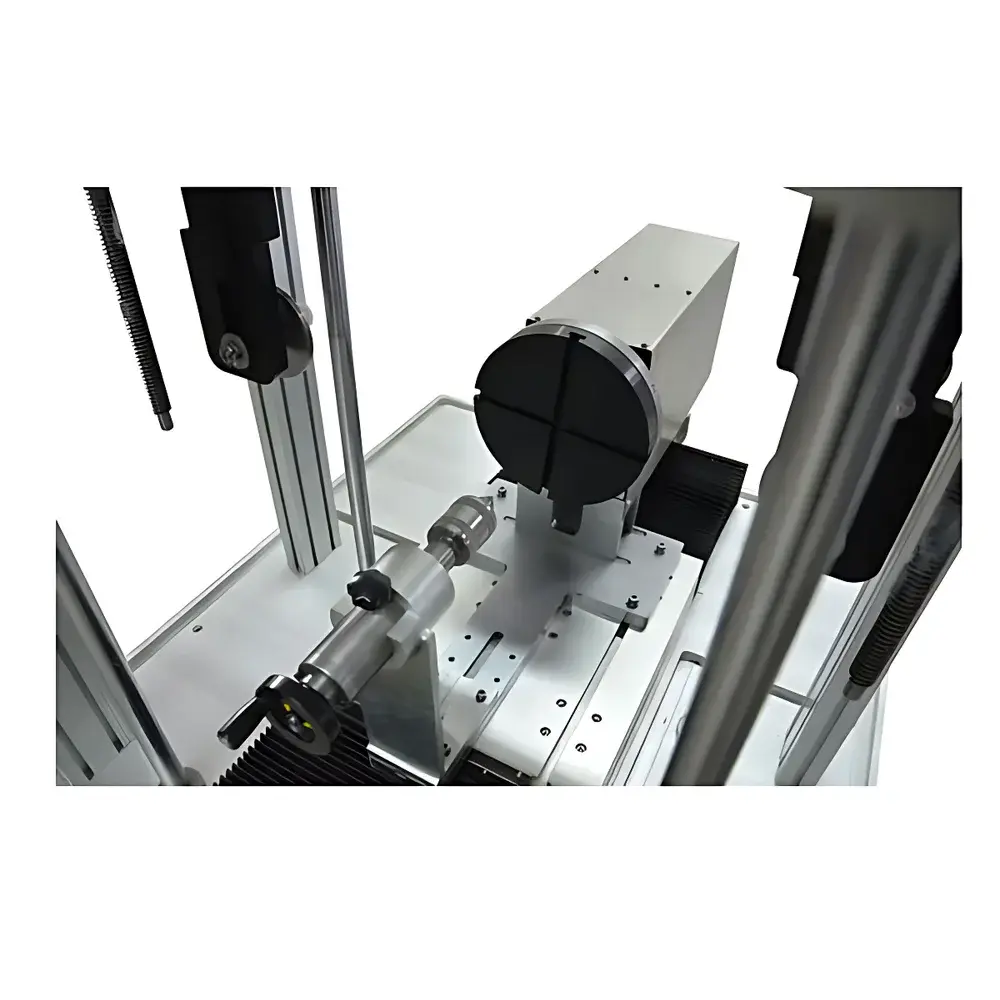
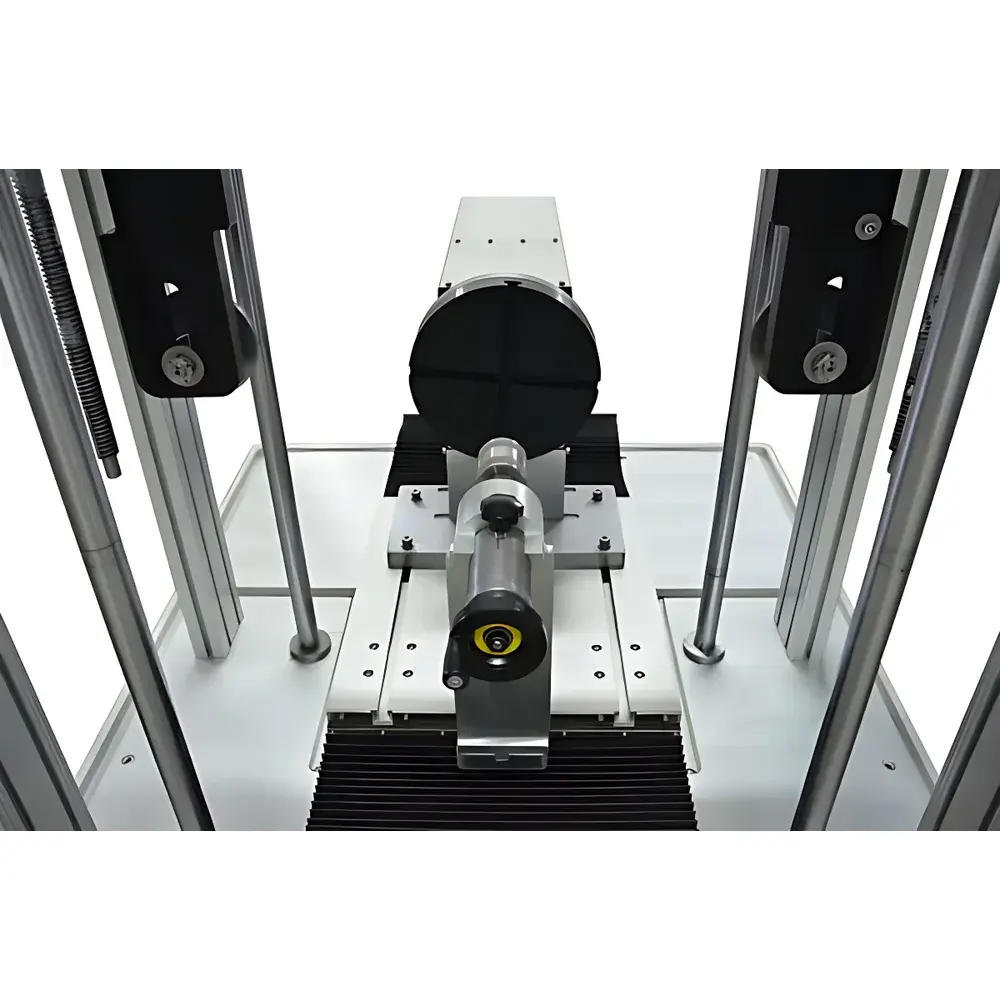
- Dual-diameter rotary platform (Ø200 mm and Ø400 mm) with precision-machined T-slots and standardized M6 mounting threads for universal fixture compatibility
- Integrated centering spindle and adjustable sample顶尖 (live center) enabling secure clamping of high-mass specimens up to 30 kg while maintaining coaxial rotation synchronization
- Low-noise, low-power stepper-servo hybrid drive system delivering smooth torque transmission and minimal positional drift during extended cutting cycles
- Thermally stable base design compliant with ISO 230-2 for geometric accuracy under ambient fluctuations (10–40 °C, 45–65 % RH)
Sample Compatibility & Compliance
The STX-1200-A accommodates a broad spectrum of crystalline, ceramic, and composite substrates requiring damage-free sectioning prior to SEM, XRD, or TEM preparation. It is routinely deployed for wafer-level slicing of 4H-SiC ingots, orientation-specific cleavage of single-crystal sapphire wafers, and controlled kerf-loss reduction in optical KDP crystals. All mechanical interfaces conform to ISO 841 (numerical control axes nomenclature) and align with ASTM F2795-19 standards for diamond wire saw performance evaluation. While the stage itself does not carry CE or UL certification, it is engineered to meet electromagnetic compatibility (EMC) Class B requirements when installed per KJ GROUP’s STX-1203 system integration guidelines. Its mechanical design supports GLP-compliant documentation workflows through traceable setup logs and reproducible parameter recall.
Software & Data Management
The STX-1200-A operates via native command protocol embedded in the STX-1203’s proprietary CNC controller (v4.2+ firmware). Motion parameters—including oscillation angle, frequency, rotation speed, dwell time, and directional polarity—are programmable through ASCII-based G-code extensions (e.g., G123 for oscillation enable, G124 for rotation reversal). All executed motion sequences are timestamped and logged in non-volatile memory with audit-trail capability, satisfying basic FDA 21 CFR Part 11 data integrity expectations for lab notebooks. Optional Ethernet/IP interface enables remote parameter upload/download and real-time status monitoring via KJ GROUP’s LabControl Suite™—a Windows-based application supporting CSV export, batch recipe management, and I/O event logging for QA/QC traceability.
Applications
- Precision cross-sectioning of semiconductor-grade silicon carbide boules for defect mapping and dopant profiling
- Orientation-controlled slicing of sapphire substrates used in GaN-on-sapphire LED epitaxy
- Low-kerf slicing of zirconia-toughened alumina biomedical implants to minimize post-cut grinding
- Sectioning of large-diameter optical fluoride crystals (BaF₂, CaF₂) where thermal shock sensitivity prohibits conventional abrasive methods
- Preparation of thin, flat lamellae from heterogeneous geological samples (e.g., jade, nephrite) for microstructural analysis
- Rotational profiling of anisotropic graphite blocks to evaluate interlayer shear strength distribution
FAQ
Is the STX-1200-A compatible with third-party diamond wire saw systems?
No—it is mechanically and electrically optimized for direct integration only with the KJ GROUP STX-1203 platform. Mounting interface dimensions, signal protocols, and safety interlocks are proprietary.
What is the maximum recommended specimen height for oscillating mode?
260 mm vertical clearance is specified; however, for optimal wire tension stability and surface finish consistency, specimens exceeding 180 mm in height should be secured using the live center and counterpoint assembly.
Does the stage support automated multi-angle sequential cutting?
Yes—via G-code macro scripting, users can define up to 99 discrete oscillation angle steps with independent speed and dwell settings per step.
Can the rotary platform be reconfigured for vacuum or inert-gas environments?
The standard unit is rated for ambient air operation only; vacuum-compatible variants (with sealed bearings and stainless steel hardware) are available under custom order code STX-1200-A-VAC.
How is calibration verified after long-term use?
KJ GROUP provides a downloadable calibration verification routine (STX-CAL-01) that uses optical encoder self-test signals and reference angular targets; annual recalibration by authorized service centers is recommended.



