
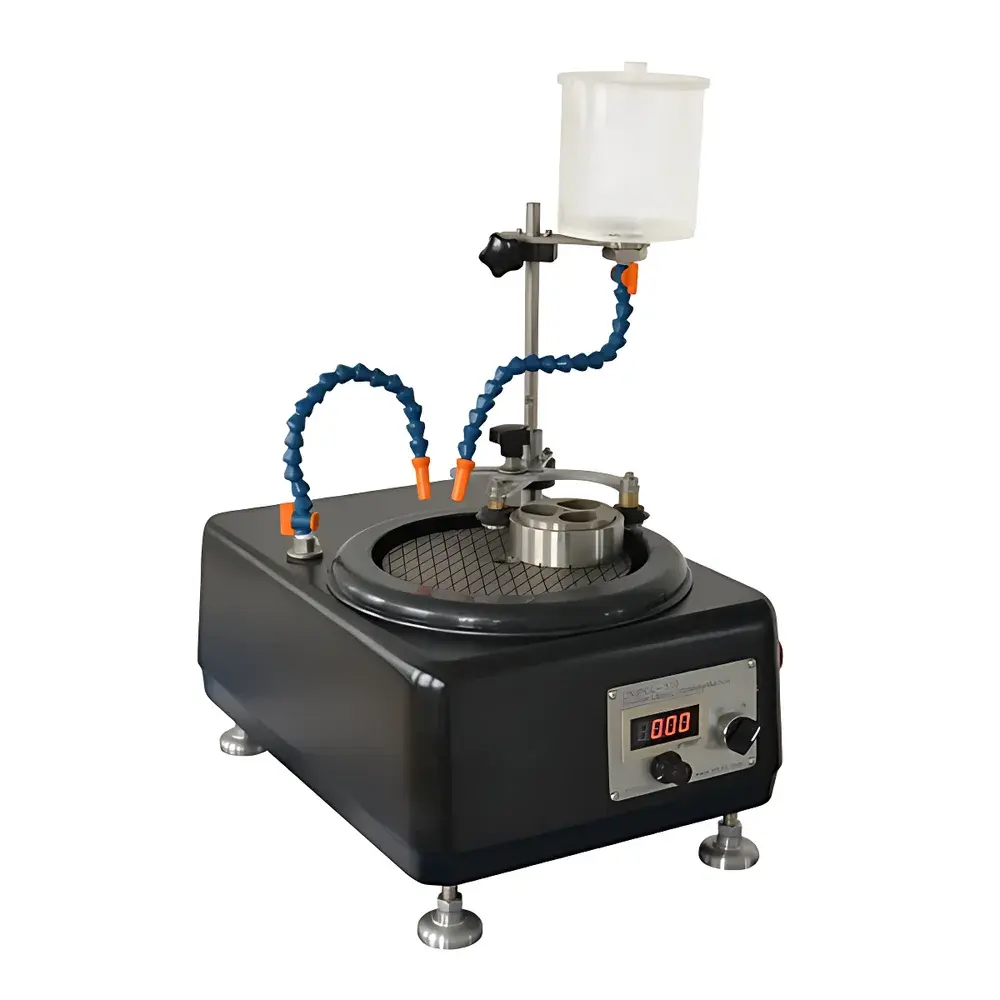
KJ GROUP UNIPOL-810 Precision Grinding and Polishing System
| Brand | KJ GROUP |
|---|---|
| Origin | Liaoning, China |
| Model | UNIPOL-810 |
| Dimensions (L×W×D) | 500 mm × 440 mm × 550 mm |
| Number of Grinding/Polishing Plates | 1 |
| Plate Diameter | Ø203 mm |
| Rotational Speed Range | 20–600 rpm (infinitely variable, digital display) |
| Power Supply | AC 110/220 V, 50/60 Hz |
| Total Power Consumption | 175 W |
| Net Weight | ≈35 kg |
| Operating Temperature | 0–45 °C |
| Relative Humidity | 10–85 % RH (non-condensing at 25 °C) |
| Sample Holder Type | Peach-shaped aperture carrier plate (Ø80 mm, 3×Ø26 mm apertures) and flat carrier plate (Ø80 mm) |
| Drip Reservoir Capacity | 1 L |
| Motor | DC 110 V, 165 W |
| Cooling | Tap water inlet/outlet ports provided |
| Mounting Requirement | Stable bench with ≥100 kg load capacity and proper grounding |
Overview
The KJ GROUP UNIPOL-810 Precision Grinding and Polishing System is an engineered platform for controlled, reproducible planar surface preparation of hard and brittle materials used in materials science, semiconductor fabrication, optical component manufacturing, and geological sample analysis. It operates on the principle of rotational mechanical abrasion—where a rotating Ø203 mm platen applies uniform shear and compressive forces to specimens mounted on a carrier plate, enabling progressive material removal via abrasive particles (e.g., alumina, diamond suspensions) or bonded abrasives (e.g., silicon carbide or aluminum oxide sandpapers). Unlike oscillatory or vibratory polishers, the UNIPOL-810 maintains constant rotational axis alignment and fixed specimen orientation relative to the platen, minimizing edge rounding and preserving crystallographic or microstructural integrity—critical for TEM lamella preparation, XRD substrate polishing, and high-precision optical surface finishing.
Key Features
- Precisely regulated rotational speed control from 20 to 600 rpm, digitally displayed and continuously adjustable via front-panel interface—enabling optimization for coarse grinding (high rpm, aggressive abrasives) through fine polishing (low rpm, colloidal suspensions).
- Dual-mode operation: supports both slurry-based grinding using liquid-distributed abrasives and dry-bonded abrasive methods via magnetic attachment of sandpaper or polishing pads—facilitating rapid tooling changeover without mechanical fasteners.
- Integrated 1 L drip reservoir with programmable peristaltic delivery system ensures consistent, metered application of coolant or abrasive suspension during extended runs—reducing thermal drift and improving surface uniformity.
- Modular carrier plate system includes both a flat Ø80 mm disc and a peach-shaped aperture plate with three Ø26 mm slots—designed to accommodate standard metallographic mounts (e.g., 25 mm and 30 mm diameter), irregularly shaped geological specimens, and multi-sample arrays without repositioning.
- Robust cast-iron base and precision-machined aluminum platen assembly provide dimensional stability and vibration damping under sustained 165 W DC motor torque—ensuring sub-micron thickness repeatability across batches.
- Compliant electrical architecture: dual-voltage input (AC 110/220 V, 50/60 Hz), grounded 3-pin connector, and internal thermal cutoff—certified for laboratory use in accordance with IEC 61010-1 safety standards.
Sample Compatibility & Compliance
The UNIPOL-810 accommodates a broad spectrum of rigid, non-ductile substrates including single-crystal wafers (Si, Ge, ZnSe, ZnS, LiNbO₃, GaAs), sapphire and YVO₄ optics, ceramic substrates (Al₂O₃, AlN, Si₃N₄), refractory metals (Mo, W), geological thin sections (quartz, feldspar, basalt), PCB laminates, and composite sealants. Its open-platform design permits integration with optional accessories such as the GPC-50A robotic arm for automated multi-step protocols compliant with ASTM E3–22 (Standard Guide for Preparation of Metallographic Specimens) and ISO 14487:2021 (Geological thin section preparation). All wet-process configurations meet GLP documentation requirements when paired with SKZD-series programmable dispensers and audit-trail-enabled data loggers.
Software & Data Management
While the UNIPOL-810 operates as a standalone electromechanical instrument, its analog control signals and digital RPM feedback are compatible with third-party process monitoring systems via 0–10 V analog output and RS-485 Modbus RTU interface (optional module). When integrated with the GPC-50A Precision Polishing Controller, users gain access to time-stamped protocol logging, stepwise parameter sequencing (speed, dwell time, slurry flow rate), and exportable CSV reports traceable to ISO/IEC 17025 calibration records. Firmware updates and configuration backups are performed via USB port—supporting 21 CFR Part 11-compliant electronic signatures when deployed within validated QA/QC environments.
Applications
- Preparation of electron-transparent TEM foils from compound semiconductors and ceramic composites.
- Flatness-critical lapping of infrared optical windows prior to coating deposition.
- Controlled thickness reduction of geological thin sections for petrographic microscopy.
- Surface planarization of sapphire and lithium niobate wafers for photonic device fabrication.
- Routine metallographic sample preparation per ASTM E3–22, including embedded alloys, superalloys, and additive-manufactured components.
- Quality assurance grinding of sealing surfaces in aerospace-grade ceramic-to-metal joints.
FAQ
What types of abrasives are compatible with the UNIPOL-810?
The system supports both liquid-based slurries (e.g., diamond paste, alumina micro-powder in water/glycol) and dry-bonded abrasives—including SiC and Al₂O₃ sandpapers (P80–P2000), synthetic leather, polyurethane, and suede polishing pads—all secured magnetically to the Ø203 mm platen.
Can the UNIPOL-810 be integrated into automated lab workflows?
Yes—via optional GPC-50A robotic arm controller and SKZD-4 programmable dispenser, the system supports unattended multi-stage protocols with full parameter logging and external PLC synchronization.
Is cooling water mandatory for operation?
Cooling water is not required for short-duration operations (30 min runs to maintain thermal stability of both platen and specimen—especially for high-rpm grinding of thermally sensitive IR crystals.
Does the UNIPOL-810 comply with international electrical safety standards?
The unit conforms to IEC 61010-1:2010 for laboratory equipment, featuring reinforced insulation, earth leakage protection, and CE-marked power supply modules—valid for use in EU, North America, and APAC markets upon local voltage configuration.
What maintenance intervals are recommended?
Platen surface flatness should be verified quarterly using optical flats; magnetic pad adhesion strength tested monthly; drip tubing flushed biweekly; and motor brushes inspected annually—per KJ GROUP’s Maintenance Log Template (Rev. 3.1, included with shipment).



