
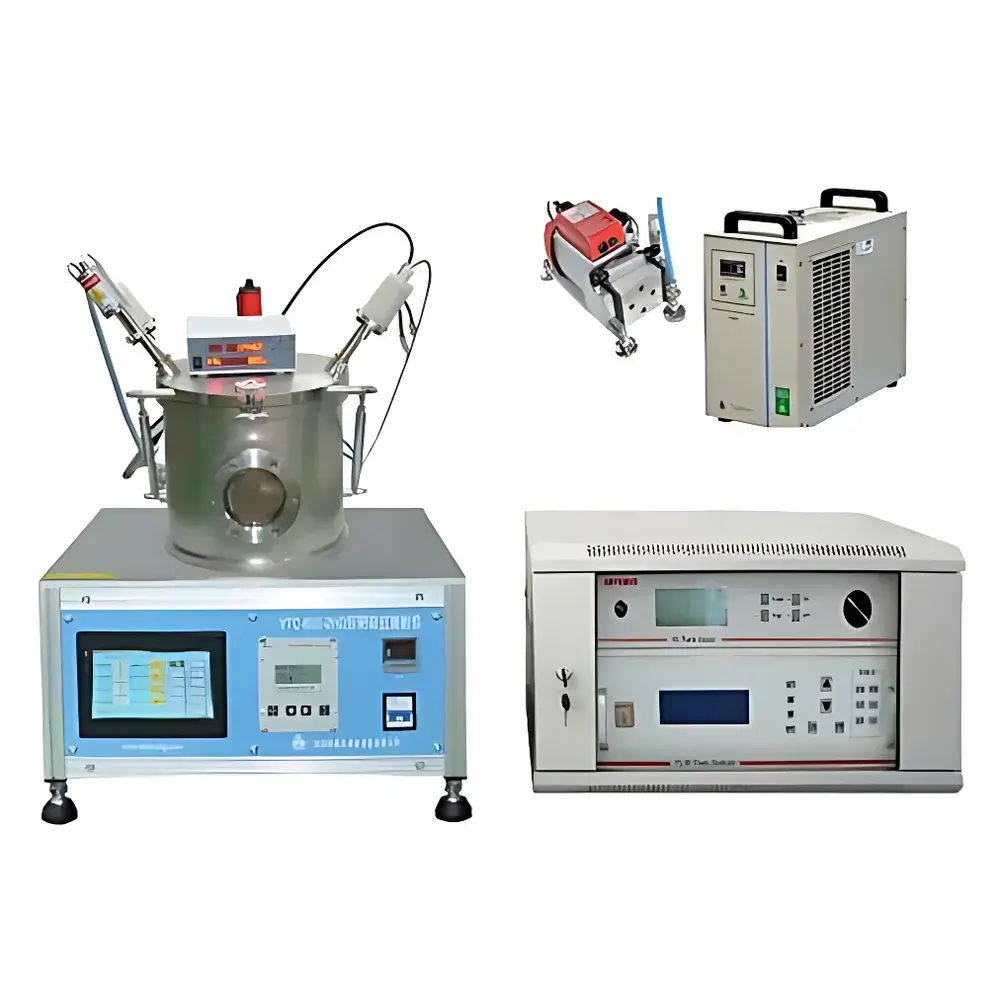
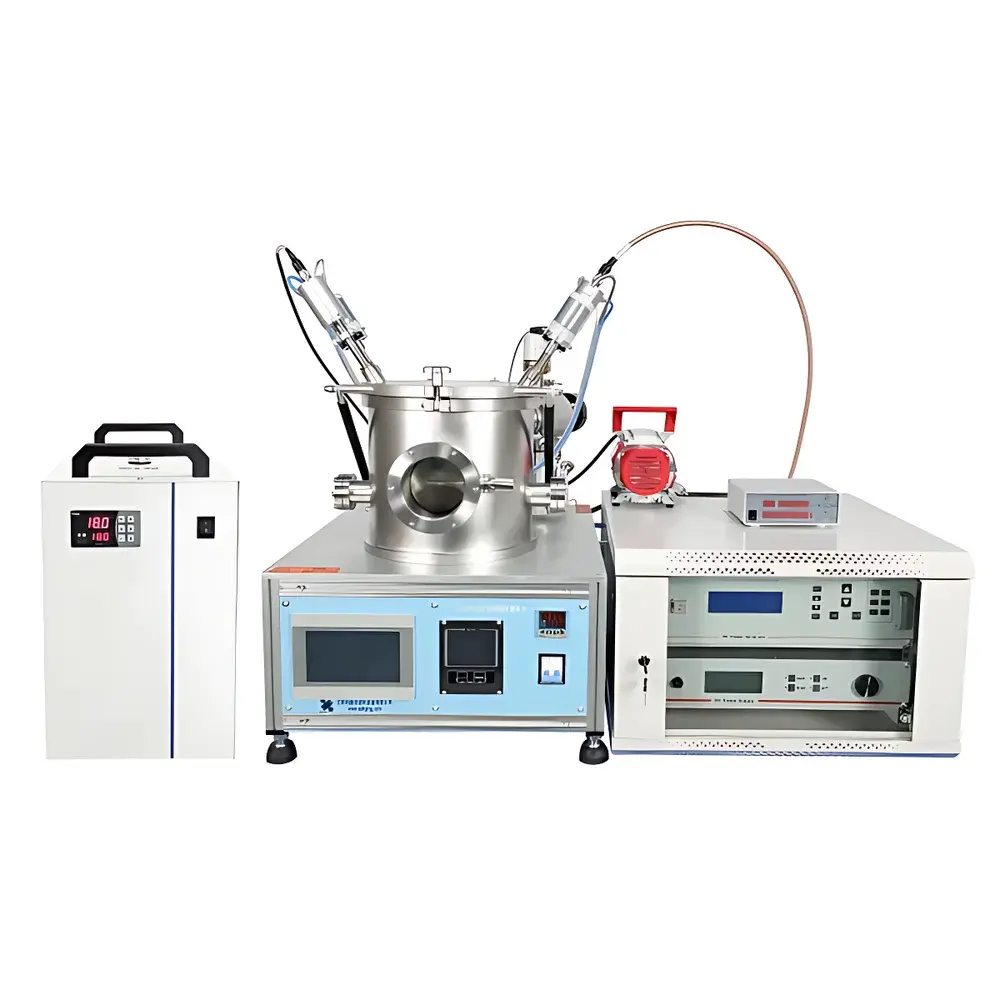
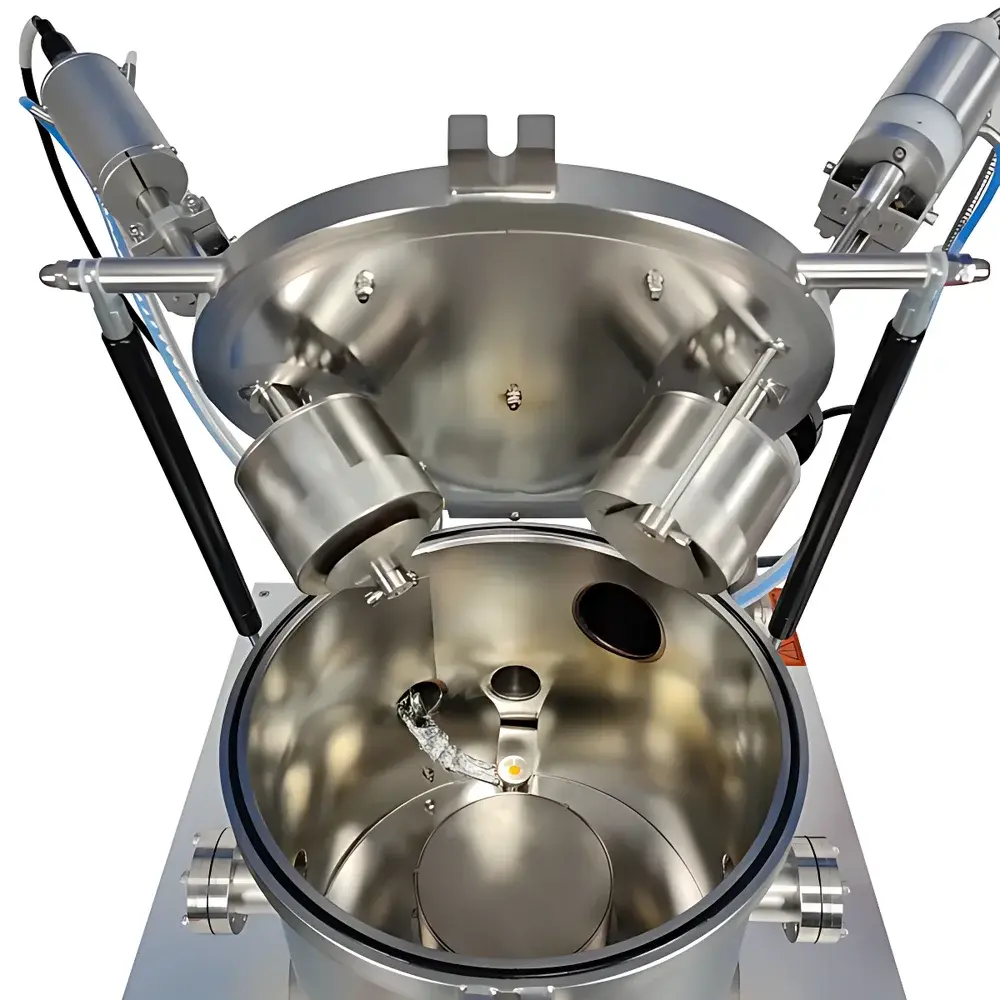
KJ GROUP VTC-600-2HD Dual-Target Magnetron Sputtering System
| Brand | KJ GROUP |
|---|---|
| Origin | Liaoning, China |
| Model | VTC-600-2HD |
| Target Configuration | 2 independent magnetron cathodes (1 × DC + 1 × RF) |
| Base Pressure | ≤5.0×10⁻³ Pa |
| Ultimate Vacuum | ≤5.0×10⁻⁴ Pa |
| Operating Pressure Range | 0.1–5 Pa |
| DC Power Supply | 0–500 W |
| RF Power Supply | 0–300 W |
| Substrate Heater | RT to 500 °C (±1 °C stability) |
| Rotating Sample Stage | Ø132 mm, 1–20 rpm |
| Adjustable Target-to-Substrate Distance | 85–115 mm |
| Film Uniformity | ±5% over Ø100 mm substrate |
| Gas Control | Dual-channel mass flow controllers (1–100 sccm & 1–200 sccm, Ar only |
| Cooling | Integrated recirculating chiller (KJ-5000, deionized water) |
| Vacuum Pumping System | Pfeiffer Hipace 80 turbomolecular pump + MVP015-2DC diaphragm backing pump |
Overview
The KJ GROUP VTC-600-2HD Dual-Target Magnetron Sputtering System is a compact, high-vacuum thin-film deposition platform engineered for reproducible, laboratory-scale physical vapor deposition (PVD) of functional and structural coatings. Based on the principle of magnetron-enhanced glow discharge plasma, the system utilizes crossed electric and magnetic fields to confine electrons near the target surface—increasing ionization efficiency and enabling stable sputtering at relatively low operating pressures (0.1–5 Pa). Its dual-cathode architecture supports simultaneous or sequential deposition from two distinct materials, facilitating co-sputtering, bilayer formation, and compositional gradient studies. Designed for academic research labs and R&D centers, the VTC-600-2HD accommodates both conductive (via DC power) and insulating (via 13.56 MHz RF power) target materials without requiring conductive bonding layers—eliminating interfacial contamination risks common in thermal evaporation or e-beam systems.
Key Features
- Dual independent magnetron sources: One DC-powered cathode (0–500 W) optimized for metals, alloys, and semiconductors; one RF-powered cathode (0–300 W, 50 Ω impedance-matched) compatible with oxides, nitrides, fluorides, and other dielectric targets.
- High-stability substrate heating: Precision-controlled resistive heater integrated into the rotating stage enables uniform thermal treatment up to 500 °C (±1 °C), critical for crystallinity development in ferroelectric, piezoelectric, and high-k dielectric films.
- Optimized film uniformity: Motorized 1–20 rpm rotation combined with adjustable target-to-substrate distance (85–115 mm) ensures ±5% thickness variation across Ø100 mm substrates—validated using in situ quartz crystal microbalance (QCM) monitoring.
- Robust vacuum architecture: German-imported Pfeiffer Hipace 80 turbo-molecular pump (67 L/s) paired with MVP015-2DC diaphragm backing pump achieves base pressure ≤5.0×10⁻³ Pa and ultimate vacuum ≤5.0×10⁻⁴ Pa—meeting ASTM F1439-22 requirements for clean PVD environments.
- Gas delivery fidelity: Two calibrated mass flow controllers (MFCs) deliver argon with ±1% full-scale accuracy; optional reactive gas inlet ports support controlled O₂, N₂, or CH₄ introduction for reactive sputtering of TiO₂, AlN, or SiC films.
- Modular expandability: Standard interfaces allow integration of optional strong-magnet sputter heads (for Fe, Co, Ni-based targets), dual-layer rotating fixtures, and additional QCM or optical emission spectroscopy (OES) ports.
Sample Compatibility & Compliance
The VTC-600-2HD accepts standard wafer formats (up to Ø132 mm) and custom planar substrates including silicon, fused silica, alumina, stainless steel, and flexible polyimide foils. It supports deposition of metallic (e.g., Au, Pt, Cr), semiconductor (e.g., Si, Ge, MoS₂), ceramic (e.g., BaTiO₃, ZnO), optical (e.g., MgF₂, Ta₂O₅), and hard-coating (e.g., TiN, DLC) thin films. All electrical subsystems comply with IEC 61000-6-3 (EMC emissions) and IEC 61000-6-2 (immunity). The vacuum chamber conforms to ISO 10110-7 surface finish standards for internal components. While not certified for GMP production, its hardware design—including traceable power logging, sealed coolant loops, and non-outgassing internal materials—supports GLP-aligned documentation protocols required for preclinical material qualification under ISO 13485 or FDA 21 CFR Part 11-compliant data management add-ons.
Software & Data Management
The system operates via an embedded industrial PLC with local HMI touchscreen interface, supporting manual parameter entry and stepwise recipe execution. All process parameters—including voltage, current, pressure, temperature, rotation speed, and gas flow—are logged at 1 Hz resolution to internal SD card storage. Export formats include CSV and XML for post-processing in MATLAB, Python (Pandas), or OriginLab. Optional Ethernet/IP connectivity enables remote monitoring and integration with LabVIEW-based central control systems. For regulated environments, third-party audit-trail modules can be deployed to satisfy ALCOA+ principles (Attributable, Legible, Contemporaneous, Original, Accurate, Complete, Consistent, Enduring, Available) per Annex 11 guidelines.
Applications
- Ferroelectric and multiferroic thin-film synthesis (e.g., Pb(Zr,Ti)O₃, BiFeO₃) requiring stoichiometric transfer and low-temperature crystallization.
- Transparent conductive oxide (TCO) development (e.g., ITO, AZO) for photovoltaic and display applications.
- Hard protective coatings (e.g., CrN, TiAlN) on micro-electromechanical systems (MEMS) components.
- Optical interference stacks (e.g., anti-reflection, high-reflectance mirrors) fabricated via alternating oxide/fluoride layers.
- Model catalyst studies involving bimetallic nanoparticle arrays deposited by sequential sputtering and annealing.
- Surface functionalization of biomedical implants (e.g., hydroxyapatite coatings on titanium substrates).
FAQ
What vacuum level is required before initiating sputtering?
Base pressure must reach ≤5.0×10⁻³ Pa prior to gas introduction; deposition begins only after achieving ≤5.0×10⁻⁴ Pa under dynamic pumping conditions.
Can the system deposit insulating films without RF power?
No—RF excitation (13.56 MHz) is mandatory for dielectric target sputtering due to charge accumulation mitigation; DC-only operation is restricted to conductive materials.
Is the sample stage rotation synchronized with shutter actuation?
Yes—rotational phase is programmable and can be gated with source shutter timing to enable angular-selective deposition or shadow-mask patterning.
What maintenance intervals are recommended for the turbomolecular pump?
Pfeiffer Hipace 80 requires annual bearing inspection and rotor cleaning; full service every 12,000 operational hours or per manufacturer’s logbook protocol.
Does the system support reactive sputtering with oxygen or nitrogen?
Standard configuration includes argon-only MFCs; reactive gas inlets and corrosion-resistant stainless-steel lines are available as factory-installed options.



