
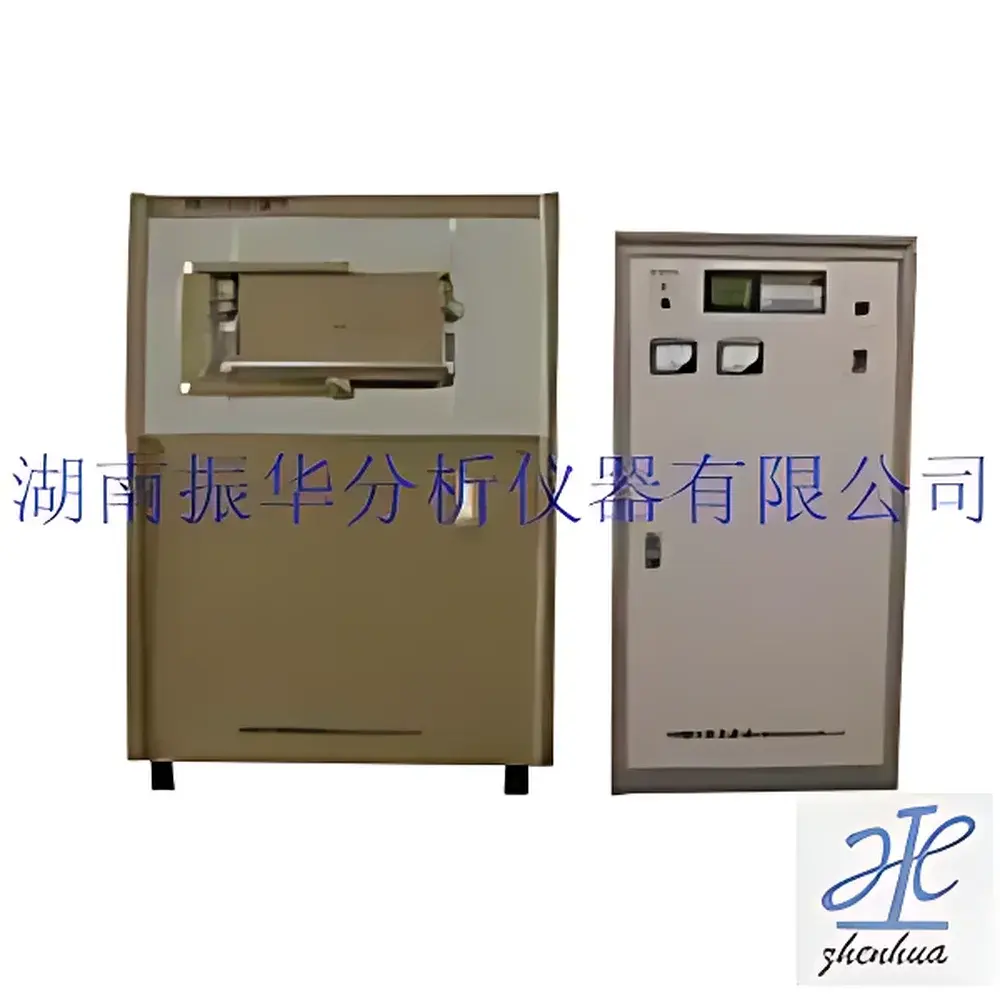
KJY-A Alkali Resistance Testing Furnace
| Origin | Hunan, China |
|---|---|
| Manufacturer Type | Authorized Distributor |
| Origin Category | Domestic (China) |
| Model | KJY-A |
| Pricing | Available Upon Request |
| Max Operating Temperature | 1650 °C |
| Short-Term Peak Temperature | 1700 °C |
| Chamber Dimensions (L×W×H) | 320 mm × 210 mm × 190 mm |
| Heating Rate | 0–15 °C/min |
| Temperature Uniformity (at Setpoint) | ±2 °C |
| Transformer Capacity | 12 kVA |
| Rated Power | 12 kW |
| Input Supply | Dual-Voltage Configuration — 380 V AC, 50 A, 50 Hz (single-phase) or 220 V AC, 5 A, 50 Hz (single-phase) |
| Overall Dimensions (L×W×H) | Furnace Unit: 0.8 m × 0.7 m × 1.7 m |
| Control Cabinet | 0.55 m × 0.55 m × 1.6 m |
| Net Weight | 600 kg |
Overview
The KJY-A Alkali Resistance Testing Furnace is a high-temperature laboratory furnace engineered for standardized evaluation of alkali resistance in alumino-silicate refractory castables and monolithic refractories. It operates in strict accordance with the test conditions specified in GB 14983–1994, “Test Method for Alkali Resistance of Refractory Materials,” which defines thermal exposure protocols, specimen geometry, alkali agent introduction methods (typically Na2CO3 or K2CO3), and post-test assessment criteria including dimensional change, spalling behavior, and phase transformation analysis via XRD or SEM. The furnace employs a robust dual-zone heating architecture with high-purity silicon carbide (SiC) heating elements and multi-layered alumina-fiber insulation to ensure stable temperature distribution across the 320 × 210 × 190 mm working chamber. Its maximum continuous operating temperature of 1650 °C—extendable to 1700 °C for short-term qualification cycles—enables simulation of aggressive industrial environments such as cement kiln transition zones, waste incinerator linings, and biomass-fired boiler refractory beds.
Key Features
- Intelligent digital temperature controller with PID algorithm and auto-tuning capability, delivering ±2 °C thermal stability at setpoints up to 1650 °C
- High-resolution color LCD interface supporting real-time monitoring of ramp/soak profiles, thermocouple inputs (Type S or B), and system status alerts
- Dual-voltage input compatibility (380 V / 220 V, single-phase, 50 Hz) for flexible integration into diverse laboratory power infrastructures
- Integrated RS485/RS232 communication port and optional USB interface for direct connection to host PCs running custom data acquisition software
- Modular control cabinet (0.55 × 0.55 × 1.6 m) with electromagnetic interference (EMI)-shielded wiring, circuit breakers, and isolation transformers meeting IEC 61000-4-5 surge immunity standards
- Refractory chamber lined with low-bio-persistence ceramic fiber and reinforced SiC support shelves, rated for repeated thermal cycling between ambient and 1700 °C
Sample Compatibility & Compliance
The KJY-A accommodates standard refractory test specimens per GB 14983–1994: prismatic bars (25 × 25 × 125 mm) or cylindrical cores (Ø50 × 50 mm), placed on inert alumina setters above alkali salt trays. It supports both static immersion and vapor-phase alkali exposure configurations. The furnace design complies with national metrological verification requirements for high-temperature testing equipment (JJG 229–2010). While not certified to ISO/IEC 17025, its control architecture—including timestamped temperature logs, user-accessible calibration offsets, and audit-trail-capable firmware—facilitates internal GLP-aligned documentation for quality assurance departments. All electrical components meet CE marking directives (2014/30/EU EMC, 2014/35/EU LVD) and RoHS 2011/65/EU material restrictions.
Software & Data Management
The furnace ships with Windows-compatible PC software (Windows 10/11, x64) enabling full remote operation: program definition (multi-step ramps, dwells, cooling profiles), live graphing of thermocouple channels, automated CSV export of time-temperature-data arrays, and configurable alarm thresholds. Raw data files include embedded metadata (operator ID, sample ID, test date, furnace serial number) to support traceability under ISO 9001:2015 Clause 8.5.2. Optional upgrade includes 21 CFR Part 11-compliant software modules featuring electronic signatures, role-based access control, and immutable audit trails—suitable for regulated refractory R&D labs serving pharmaceutical or nuclear-grade material suppliers.
Applications
- Evaluation of alkali corrosion mechanisms in calcium-aluminate-bonded castables exposed to Na2O/K2O-rich slags
- Qualification of low-cement refractories for use in clinker cooler throat sections and precalciner riser ducts
- Comparative lifetime modeling of SiC- and spinel-containing monolithics under cyclic alkali loading
- Supporting ASTM C1283–17 (Standard Test Method for Determining the Resistance of Refractories to Alkali Attack) via equivalent thermal protocol adaptation
- Research into alkali-induced mullitization kinetics and secondary phase formation (e.g., nepheline, kalsilite) in kaolin-based systems
FAQ
What thermocouple types are supported for temperature measurement and control?
Type S (Platinum/Rhodium 10%) and Type B (Platinum/Rhodium 30/6%) thermocouples are factory-configured and calibrated; Type K is supported in auxiliary monitoring channels only.
Can the furnace be integrated into a centralized lab automation network?
Yes—via Modbus RTU over RS485, the unit supports read/write register access for temperature setpoint, current reading, fault status, and soak timer; OEM SDKs available upon NDA.
Is third-party calibration certification included with delivery?
A factory-as-built temperature uniformity report (per GB/T 10066.1–2005) is provided; UKAS or DAkkS-accredited calibration requires separate service engagement.
What maintenance intervals are recommended for sustained 1650 °C operation?
Heating element resistance checks every 200 operational hours; ceramic fiber integrity inspection and thermocouple recalibration every 6 months or 500 cycles, whichever occurs first.
Does the system support programmable cooling rates?
Yes—controlled cooling from 1650 °C to 200 °C at user-defined rates (0.1–10 °C/min) is achievable using adaptive power modulation; natural cooling is also selectable.



