
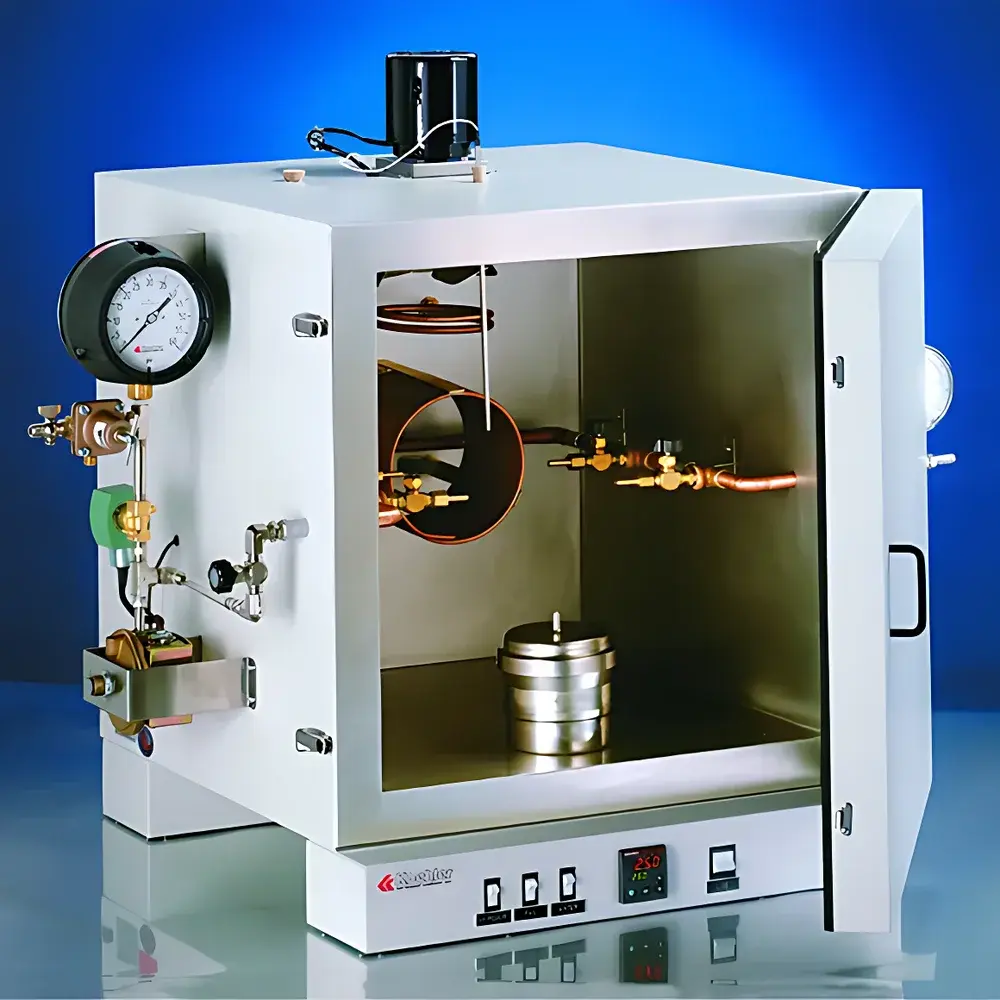
Koehler K18919 Static Oil Separation Tester for Greases
| Brand | Koehler |
|---|---|
| Origin | USA |
| Model | K18919 |
| Test Capacity | 4 samples |
| Test Conditions | 25 °C, 1.72 kPa, 24 h |
| Temperature Control Accuracy | ±0.5 °C |
| Dimensions | 119 × 60 × 79 cm |
| Weight | 64.9 kg |
| Power Supply | 220–240 V, 50/60 Hz, Single-phase, 1.5 A |
| Compliance | ASTM D1742, FTM 791-322 |
Overview
The Koehler K18919 Static Oil Separation Tester is a precision-engineered laboratory instrument designed to quantify the tendency of lubricating greases to release oil under static, pressurized conditions—a critical indicator of structural stability and long-term storage performance. Based on the fundamental principle of gravity-driven oil migration through a defined stainless-steel mesh under controlled pneumatic pressure, the system replicates real-world storage scenarios where grease may be subjected to minimal but sustained compressive stress over extended periods. Unlike dynamic or centrifugal separation methods, this apparatus measures static bleed—oil exuded from the grease matrix without mechanical agitation—providing data directly relevant to shelf-life prediction, formulation robustness, and compatibility with sealing materials in sealed systems.
Key Features
- Integrated constant-temperature air bath chamber engineered to maintain 25 °C with ±0.5 °C stability across all four test positions, ensuring high inter-sample reproducibility.
- Four independent pressure-release test cells accommodated simultaneously, each comprising a calibrated funnel, sample support base, precision-machined top cover, and standardized 200-mesh (74 µm) stainless-steel filter screen per ASTM D1742 specifications.
- Pneumatic pressure regulation system delivering and sustaining a uniform 1.72 kPa (25 psi) differential across all test cells, equipped with a calibrated pressure relief valve to suppress transient fluctuations and ensure compliance with method-defined pressure tolerances.
- Dual-layer cellulose nitrate (guncotton) insulated enclosure providing thermal inertia and minimizing ambient heat exchange, thereby reducing temperature drift during 24-hour uninterrupted operation.
- Modular, service-accessible architecture with front-panel pressure gauge, quick-connect fittings, and tool-free cell removal—designed for routine calibration verification and GLP-aligned maintenance logging.
Sample Compatibility & Compliance
The K18919 supports standard 10 g grease specimens prepared per ASTM D217 or equivalent cone penetration procedures. It accommodates both NLGI grade 000–6 greases and specialty formulations containing thickeners such as lithium, calcium, polyurea, bentonite, or clay-based systems. All mechanical and thermal operating parameters align explicitly with ASTM D1742 “Standard Test Method for Oil Separation from Lubricating Grease (Static Method)” and U.S. Department of Defense specification FTM 791-322. The instrument’s thermal uniformity, pressure fidelity, and filtration geometry are validated against NIST-traceable reference standards, supporting audit readiness for ISO/IEC 17025-accredited laboratories and FDA-regulated manufacturing environments where grease stability data informs material release documentation.
Software & Data Management
The K18919 operates as a stand-alone benchtop system without embedded microprocessor control; however, its design facilitates full integration into digital lab workflows. Weights of separated oil—recorded manually or via optional analytical balance interfacing—are entered into Koehler’s compliant data capture templates, which auto-generate ASTM-formatted reports including sample ID, test duration, ambient barometric correction (if applied), and percent oil bleed calculation. These templates comply with 21 CFR Part 11 requirements when deployed on validated LIMS or ELN platforms, supporting electronic signatures, audit trails, and version-controlled report archiving. Calibration certificates, preventive maintenance logs, and operator training records can be linked directly to individual test batches to satisfy GLP and GMP traceability mandates.
Applications
- Formulation development and comparative screening of thickener-oil interactions in new grease products.
- Quality control release testing for batch-to-batch consistency of commercial lubricating greases.
- Stability assessment of greases exposed to elevated temperatures prior to packaging or transport.
- Failure analysis of field-failed bearings where excessive oil bleed correlates with loss of film integrity and premature wear.
- Regulatory submission support for automotive OEMs requiring documented static bleed performance per SAE J310 or OEM-specific grease specifications.
FAQ
What is the primary purpose of static oil separation testing?
It quantifies the inherent ability of a grease to retain its base oil under zero-shear, low-pressure storage conditions—directly informing predictions of pumpability loss, seal compatibility, and long-term structural integrity.
Can the K18919 be used for non-ASTM test protocols?
Yes—while optimized for ASTM D1742, its adjustable pressure range (via external regulator) and stable thermal environment allow adaptation to internal or customer-specific protocols requiring alternative pressures or durations, provided validation is performed per ISO/IEC 17025 clause 5.4.2.
Is the 200-mesh screen supplied with the instrument certified?
Each stainless-steel screen is laser-etched with lot traceability and supplied with a certificate of conformance verifying mesh count and wire diameter per ASTM E11, with optional NIST-traceable calibration available upon order.
Does the instrument require compressed air or vacuum sources?
It operates using shop-grade compressed air (40–100 psi supply) regulated down to 1.72 kPa; no vacuum source is required—the system uses positive-pressure gas displacement to accelerate oil migration through the filter medium.
How often should temperature uniformity mapping be performed?
Per ISO/IEC 17025 and ASTM D1742 Annex A1, quarterly mapping using at least nine thermocouple probes distributed across the chamber volume is recommended, with deviation limits not exceeding ±0.5 °C at any location.







