
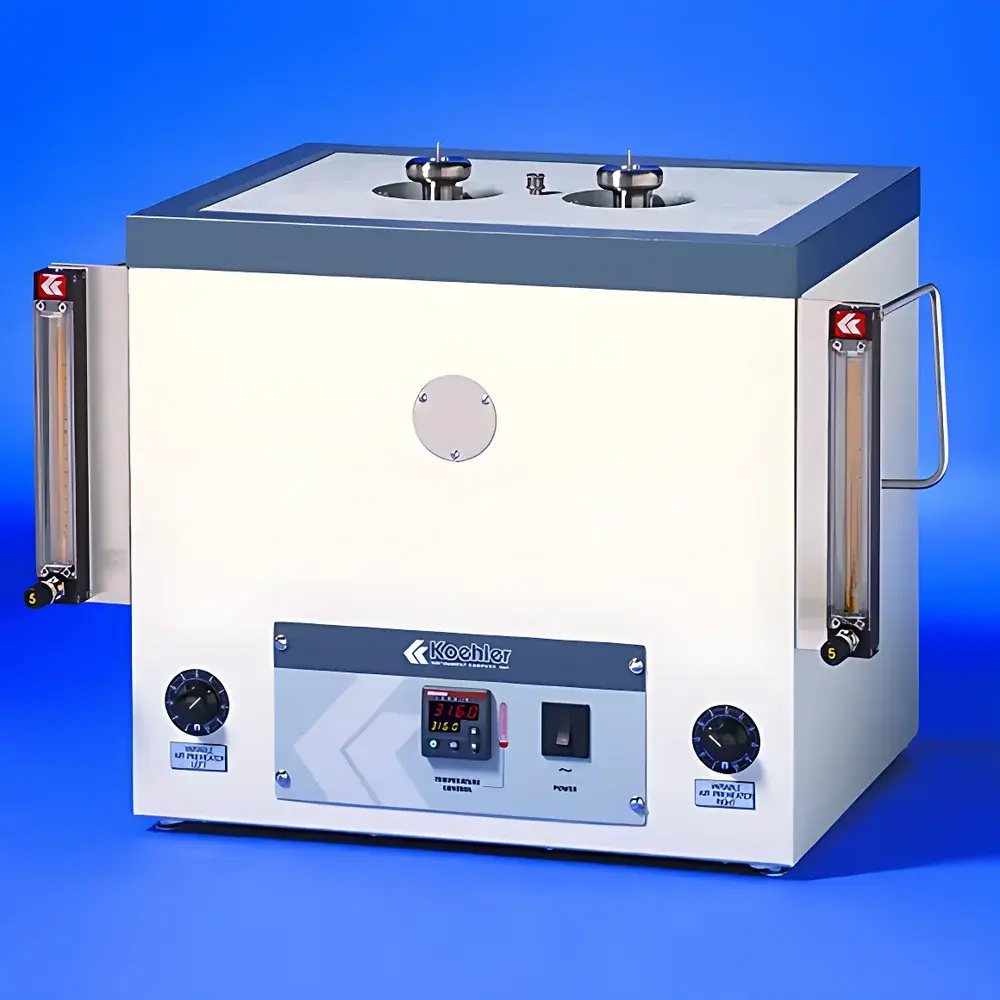
Koehler K29300 Wide-Temperature Evaporation Loss Tester
| Brand | Koehler |
|---|---|
| Origin | USA |
| Manufacturer Status | Authorized Distributor |
| Origin Category | Imported |
| Model | K29300 |
| Product Type | Laboratory Instrument |
| Test Parameter | Evaporation Loss |
| Test Capacity | 2 samples |
| Temperature Range | 93–316 °C (digital display) |
| Temperature Control Accuracy | ±0.5 °C |
| Temperature Stability | ±0.1 °C at setpoint |
| Heating System | Dual 0–500 W variable power controllers with K-type thermocouples |
| Air Flow Control | 2.0 L/min at STP (Standard Temperature and Pressure), independently regulated via dedicated preheater and rotameter |
| Display | Dual LED — setpoint & actual temperature |
| Heating Chamber | Aluminum-block furnace with integrated sample-zone and air-stream thermal management |
| Safety Systems | Overtemperature cutoff, overpressure protection circuit, PID-based microprocessor temperature controller with fail-safe logic |
| Power Requirement | 220–240 V AC, 50/60 Hz, single-phase, 10.4 A |
| Dimensions | 64 × 41 × 43 cm |
| Weight | 79.4 kg |
| Compliance | ASTM D2595, ASTM D2878 |
| Optional Accessory | K29310 Digital Thermometer (sold separately) |
Overview
The Koehler K29300 Wide-Temperature Evaporation Loss Tester is a precision-engineered laboratory instrument designed for the quantitative determination of evaporation loss in lubricating oils, base stocks, and related petroleum products under controlled thermal and aerodynamic conditions. It operates on the principle of gravimetric mass loss measurement: a weighed sample is exposed to a precisely regulated stream of heated air at elevated temperatures for a defined duration, after which the residual mass is measured to calculate evaporation loss as a mass percentage. Unlike conventional low-temperature evaporation testers, the K29300 extends operational capability up to 316 °C—enabling evaluation of high-temperature stability critical for modern engine oils, turbine fluids, and synthetic lubricants used in demanding industrial applications. Its design adheres strictly to ASTM D2595 (Standard Test Method for Evaporation Loss of Lubricating Oils by the Noack Method) and ASTM D2878 (Standard Test Method for Evaporation Loss of Lubricating Oils by the Modified Noack Method), ensuring regulatory acceptability for quality control, product development, and third-party certification laboratories.
Key Features
- Aluminum-block heating furnace with dual-zone thermal architecture: one zone maintains precise sample temperature; the other regulates inlet air temperature and flow profile independently.
- Microprocessor-based PID temperature controller with dual LED display—simultaneously showing setpoint and real-time measured temperature—with stability maintained within ±0.1 °C at operating setpoints.
- Dual 0–500 W adjustable heating elements, each paired with a calibrated K-type thermocouple, enabling fine-grained thermal ramping and uniform heat distribution across both test positions.
- Integrated safety architecture including hardware-based overtemperature cutoff, overpressure sensing circuitry, and automatic shutdown upon deviation beyond user-defined thresholds.
- Independent air preheating module and calibrated rotameter ensure consistent 2.0 L/min airflow delivery at Standard Temperature and Pressure (STP: 0 °C, 101.325 kPa), eliminating ambient dependency and enhancing inter-laboratory reproducibility.
- Robust mechanical construction with vibration-damped base and thermal shielding minimizes external interference and supports long-term calibration integrity.
Sample Compatibility & Compliance
The K29300 accommodates two standard ASTM Noack crucibles per test cycle, supporting routine parallel analysis for improved statistical confidence. It is validated for use with mineral, semi-synthetic, and fully synthetic lubricants—including polyalphaolefins (PAO), esters, and polyglycols—as well as base oils (Group I–V) and greases (after solvent dilution). All operational parameters—including temperature ramp rate, dwell time, airflow calibration, and mass measurement protocol—are aligned with ASTM D2595 and D2878 requirements. The system’s traceable thermal control, documented safety interlocks, and deterministic airflow regulation support compliance with GLP (Good Laboratory Practice) and internal QA/QC audit protocols. While the instrument itself does not include data archiving functionality, its stable analog outputs and repeatable endpoint behavior make it compatible with externally validated LIMS or ELN systems meeting FDA 21 CFR Part 11 requirements when paired with appropriate electronic balance integration.
Software & Data Management
The K29300 operates as a standalone benchtop instrument without embedded software or touchscreen interface. Temperature setpoints, run duration, and airflow verification are configured manually via front-panel controls. Data acquisition relies on external analytical balances (e.g., METTLER TOLEDO XSR series or Sartorius Entris II) compliant with ISO/IEC 17025 weighing protocols. Users record initial mass, final mass, and environmental conditions (barometric pressure, ambient humidity) in laboratory notebooks or electronic lab notebooks (ELNs). For automated reporting, the K29300 can be interfaced—via RS-232 or analog voltage output—with third-party data acquisition platforms that support ASTM-compliant calculation templates for evaporation loss (% w/w), repeatability (r), and reproducibility (R) per ASTM D2595 Annex A1. Optional K29310 digital thermometer provides traceable secondary temperature validation during method qualification.
Applications
- Quality assurance of finished lubricants against OEM specifications (e.g., API SP, ACEA C6, JASO DL-1).
- Formulation screening of volatility-sensitive additives such as VI improvers, pour point depressants, and anti-foam agents.
- Base oil selection and blending optimization for high-temperature applications including aviation turbine oils (MIL-PRF-23699) and heavy-duty diesel engine oils (API CK-4).
- Regulatory submission testing for REACH, TSCA, and EPA Tier 3 fuel/lubricant registration dossiers.
- Root-cause analysis of field failures linked to excessive oil consumption or deposit formation in turbocharged engines and gearboxes.
- Interlaboratory round-robin studies requiring strict adherence to Noack methodology under ISO/IEC 17025-accredited conditions.
FAQ
Does the K29300 include an integrated balance or mass measurement system?
No. The instrument does not incorporate a built-in balance. Gravimetric measurement must be performed using an external analytical balance with ≥0.1 mg readability and ISO/IEC 17025 traceability.
Is the K29310 Digital Thermometer required for ASTM D2595 compliance?
Not required, but strongly recommended for method qualification and periodic verification of furnace temperature uniformity and probe placement accuracy.
Can the K29300 be operated at temperatures below 93 °C?
No. The minimum specified operating temperature is 93 °C, consistent with the lower boundary of ASTM D2595 and D2878 scope.
What maintenance intervals are recommended for the air flow control system?
Rotameter calibration should be verified annually using NIST-traceable flow standards; preheater element resistance should be checked quarterly for drift exceeding ±5% of nominal value.
Is the K29300 suitable for testing greases?
Yes—when diluted to ≤5% w/w in a volatile solvent (e.g., n-heptane) per ASTM D6300 practice, followed by full solvent removal prior to test initiation.





