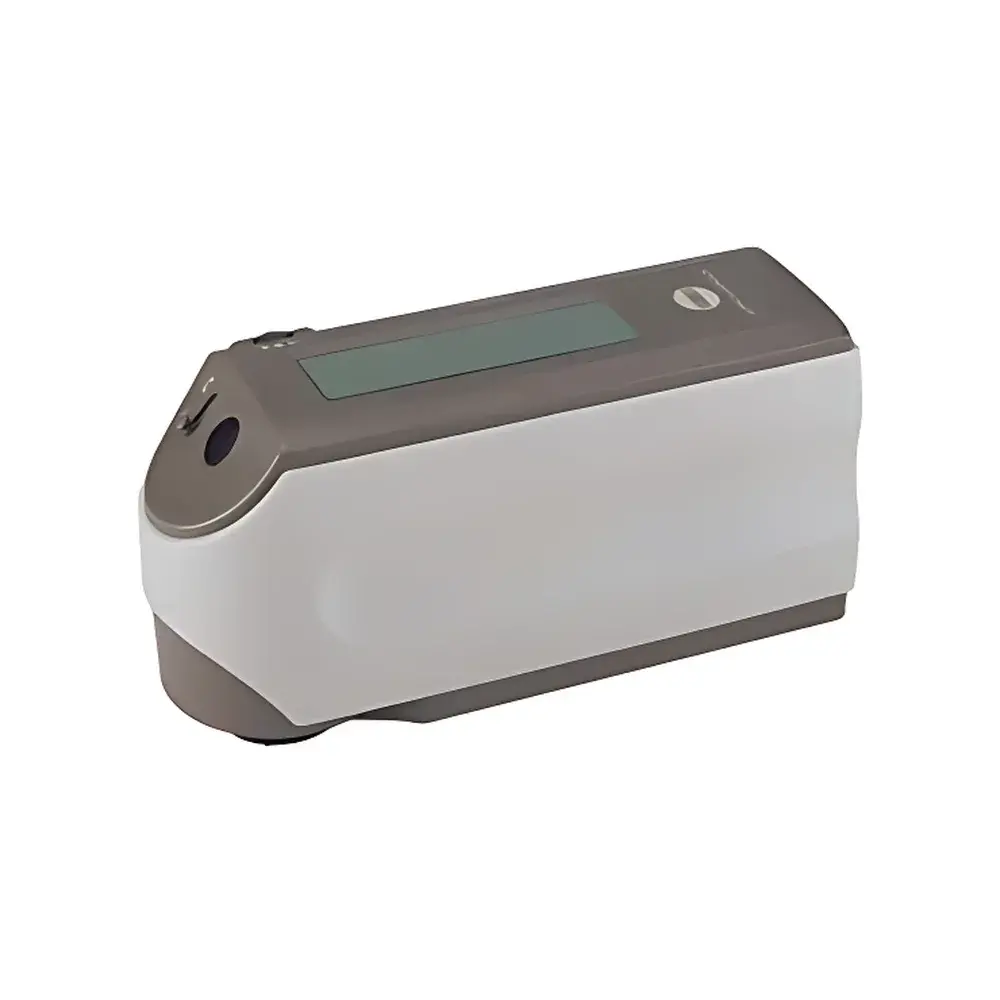
Konica Minolta CM-2300d Portable Spectrophotometer
| Brand | Konica Minolta |
|---|---|
| Origin | Japan |
| Model | CM-2300d |
| Type | Portable Spectrophotometer |
| Optical Geometry | 0°/45° (d/8° with SCI/SCE simultaneous measurement) |
| Light Source | Dual pulsed xenon lamps |
| Spectral Range | 360–740 nm |
| Wavelength Interval | 10 nm |
| Spectral Bandwidth | ~10 nm |
| Reflectance Range | 0–175% |
| Repeatability | σ ≤ 0.2% (360–740 nm), σ ≤ 0.4% (360–380 nm) |
| Inter-instrument Agreement | ΔE*ab ≤ 0.4 (SCI, based on BCRA Series II) |
| Measurement Time | ~1.5 s (SCI & SCE simultaneously) |
| Minimum Measurement Interval | 3 s (at 23°C) |
| Data Storage | 1,700 sets (each set = paired SCI/SCE data) |
| Observer Angle | 2° and 10° |
| Illuminants | A, C, D50, D65, F2, F6, F7, F8, F10, F11, F12 (dual-illuminant calculation supported) |
| Color Spaces | L*a*b*, L*C*h, Yxy, XYZ, MI, CMC (1:1 & 2:1), CIE94, CIE DE2000, WI (ASTM E313), YI (ASTM D1925) |
| Display | LCD with spectral graph, color difference, pass/fail judgment, and relative gloss value |
| Interface | RS-232C (RJ-45 port), USB 2.0 via included IF-A24 adapter |
| Power | 4 × AA batteries or AC adapter |
| Dimensions | 69 × 96 × 193 mm |
| Weight | ~670 g (excluding batteries, including measurement stage) |
Overview
The Konica Minolta CM-2300d is a portable spectrophotometer engineered for high-precision color measurement in industrial quality control environments. It operates on the d/8° optical geometry (diffuse illumination, 8° viewing angle) with integrated sphere optics, enabling simultaneous measurement of both Specular Component Included (SCI) and Specular Component Excluded (SCE) reflectance values within a single 1.5-second acquisition cycle. This dual-mode capability eliminates mechanical mode switching—ensuring consistent measurement area, improved repeatability, and reduced operator-induced variability. The instrument employs a dual-pulsed xenon lamp system, delivering stable, flash-based illumination across the full visible spectrum (360–740 nm) without thermal drift or lamp aging effects common in tungsten-halogen sources. Spectral separation is achieved via a diffraction grating, coupled with a dual-row 40-element silicon photodiode array for high signal-to-noise ratio and robust spectral fidelity. Designed to comply with ISO 7724-1, CIE Publication No. 15, ASTM E1164, DIN 5033 Teil 7, and JIS Z8722 Condition C, the CM-2300d supports traceable, standards-aligned color evaluation across global manufacturing and regulatory frameworks.
Key Features
- Simultaneous SCI/SCE measurement in one exposure—no manual mode selection required, preserving spatial consistency and minimizing measurement uncertainty.
- Dual-pulsed xenon light source ensures spectral stability, long-term calibration integrity, and immunity to ambient light interference during field use.
- High-resolution spectral data acquisition at 10 nm intervals across 360–740 nm, with spectral bandwidth of approximately 10 nm and reflectance resolution of 0.01%.
- Compact, ergonomic design weighing only 670 g (without batteries), optimized for handheld operation in production lines, warehouses, and supplier audits.
- Integrated illuminated viewfinder with crosshair targeting enables precise placement on curved, textured, or irregular surfaces—even under variable lighting conditions.
- On-device pass/fail evaluation with user-defined tolerance limits (single ΔE*ab threshold), supporting real-time QC decisions without external software.
- Relative gloss value display derived from 60° specular reflectance estimation—providing concurrent appearance assessment alongside color metrics.
Sample Compatibility & Compliance
The CM-2300d accommodates a broad range of non-fluorescent, opaque, and translucent materials—including painted automotive panels, injection-molded plastics, textile fabrics, leather goods, printed packaging, pharmaceutical tablets, cosmetic compacts, and architectural coatings. Its 8 mm measurement aperture (with optional 3 mm and 11 mm target masks) allows flexible sampling of both large uniform areas and small critical features. The instrument meets international metrological requirements for colorimetric instrumentation: it is validated per ISO/IEC 17025 principles when used with certified reference standards (e.g., BCRA Series II tiles), and its data output structure supports audit readiness under GLP and GMP environments. While not inherently 21 CFR Part 11 compliant, raw spectral and tristimulus data exported via SpectraMagic NX can be archived in secure, version-controlled repositories meeting FDA documentation expectations for color release testing.
Software & Data Management
Data capture and analysis are fully supported by Konica Minolta’s SpectraMagic NX software (CM-S100w), a Windows-based application that provides advanced color difference computation, statistical process control (SPC) charting, multi-illuminant comparison, and batch report generation. All 1,700 onboard measurements—including paired SCI/SCE spectra, CIE L*a*b* coordinates, and gloss estimates—are transferable via USB 2.0 (using the included IF-A24 adapter) or RS-232C serial interface. SpectraMagic NX supports export to CSV, PDF, and XML formats, enabling integration into enterprise LIMS or MES platforms. The software maintains full audit trail functionality—including user login timestamps, parameter change logs, and calibration history—facilitating compliance with internal QA protocols and external regulatory reviews.
Applications
The CM-2300d serves as a primary color verification tool across industries where visual consistency directly impacts brand perception and functional performance. In automotive manufacturing, it validates paint match across body panels and trim components under controlled D65 illumination. In consumer electronics, it monitors hue uniformity of polycarbonate housings and anodized aluminum finishes. Textile mills deploy it for shade matching across dye lots and fabric batches, referencing AATCC Evaluation Procedures. Packaging converters use it to verify spot-color fidelity against Pantone standards, while cosmetics manufacturers apply it to assess batch-to-batch repeatability of lipstick pigments and foundation formulations. Its portability and rapid measurement cycle make it especially valuable for supplier qualification audits, incoming material inspection, and in-line process monitoring where laboratory-grade accuracy is required outside fixed metrology labs.
FAQ
Does the CM-2300d require warm-up time before measurement?
No. The pulsed xenon lamp design eliminates thermal stabilization delays; measurements are valid immediately after power-on and white calibration.
Can the CM-2300d measure fluorescent or phosphorescent samples?
No. It lacks UV excitation capability and is not designed for fluorescent material characterization. For such applications, Konica Minolta recommends the CM-700d or CM-3600A series.
Is the instrument suitable for measuring transparent films or liquids?
Not natively. It is optimized for reflective solid surfaces. Transmission measurements require accessory holders (e.g., CM-A150 transmission cell) and are not supported by the CM-2300d base configuration.
How often should white calibration be performed?
Konica Minolta recommends daily white calibration in production environments; more frequent calibration may be necessary if ambient temperature fluctuates beyond ±2°C or if the instrument is subjected to mechanical shock.
What is the expected lifetime of the xenon lamps?
Rated for ≥1 million flashes—equivalent to over 5 years of typical industrial use at 200 measurements per day.