
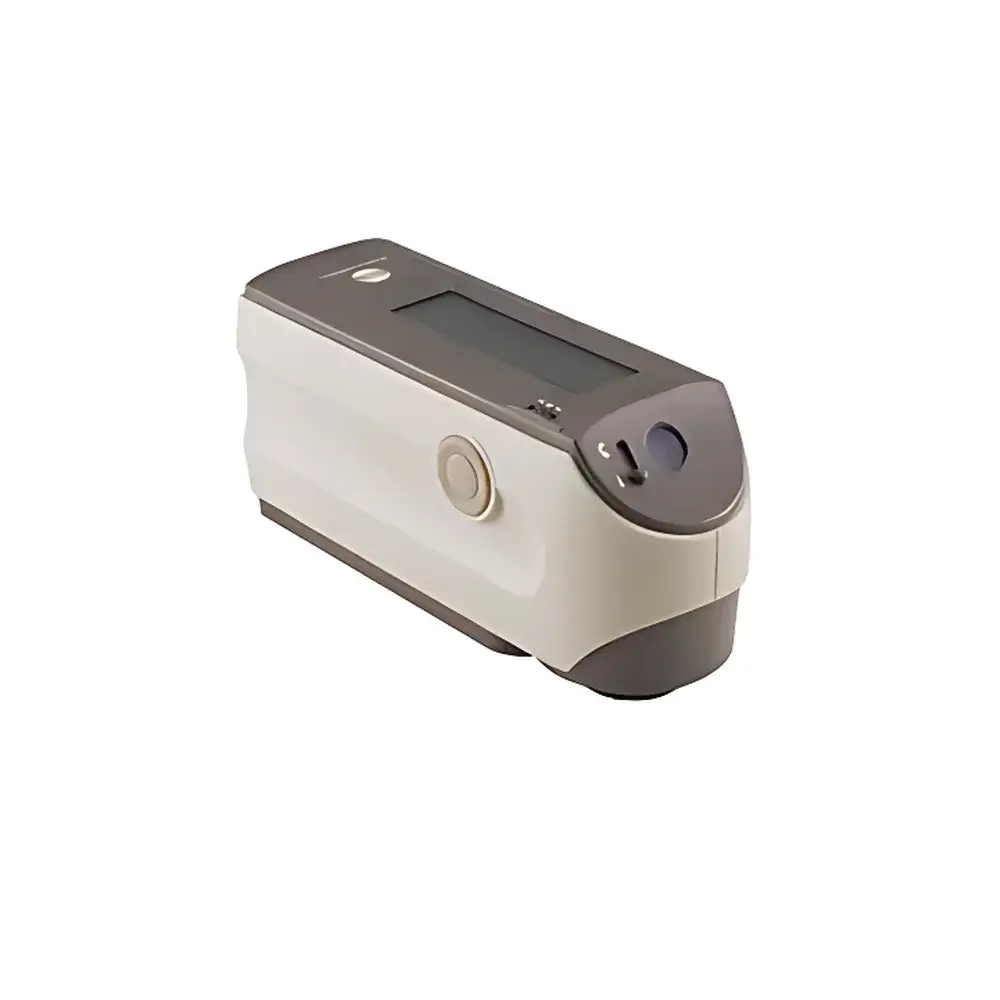
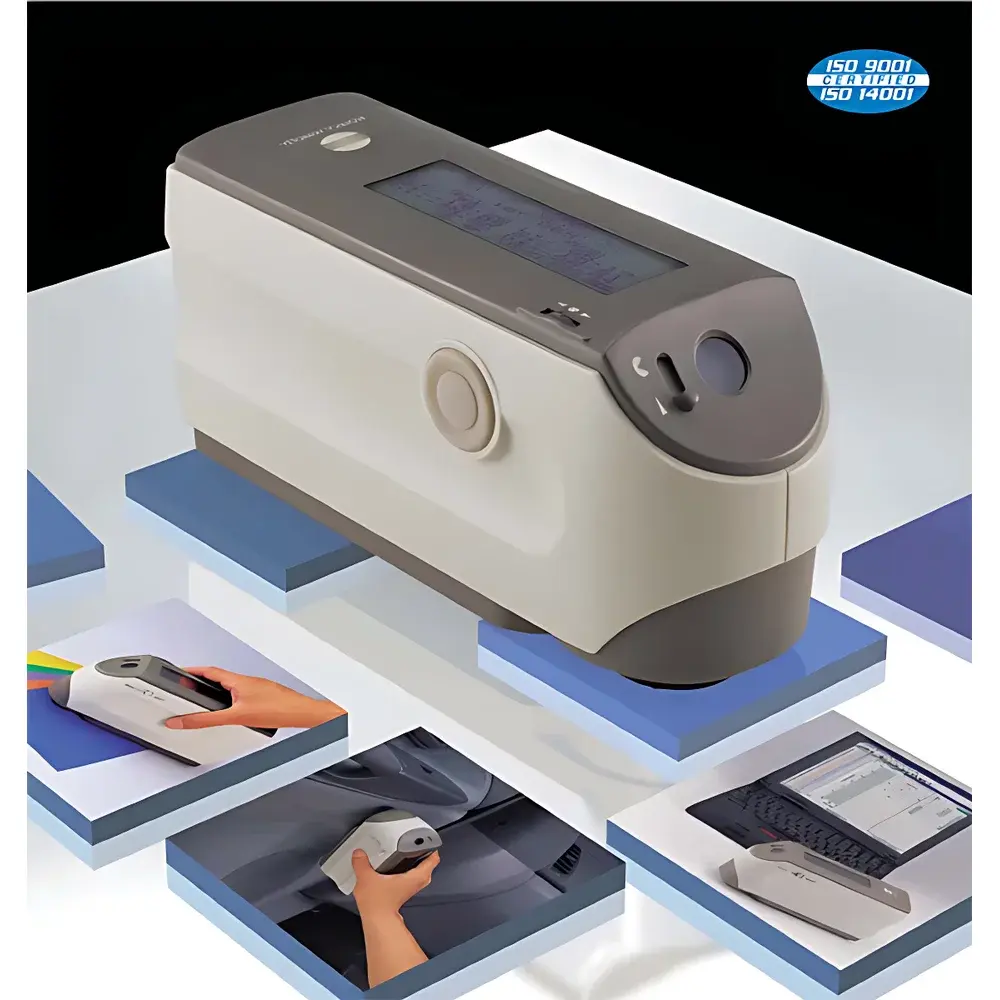
Konica Minolta CM-2600d / CM-2500d Portable Spectrophotometer
| Brand | Konica Minolta |
|---|---|
| Origin | Japan |
| Model | CM-2600d / CM-2500d |
| Optical Geometry | d/8° integrating sphere (SCI/SCE simultaneous measurement) |
| Wavelength Range | 360–740 nm |
| Wavelength Interval | 10 nm |
| Spectral Bandwidth | ~10 nm |
| Detector | Dual-row silicon photodiode array (40 elements) |
| Illumination | Pulsed xenon lamp (2 lamps for CM-2500d |
| Measurement Apertures | MAV Φ8 mm / SAV Φ3 mm |
| Repeatability | ΔE*ab ≤ 0.04 (after white calibration, 30 measurements) |
| Inter-instrument Agreement | ΔE*ab ≤ 0.2 (SCI/MAV, BCRA Series II) |
| Display | High-resolution graphical LCD with intuitive navigation wheel interface |
| Compliance | ISO 7724-1, CIE No. 15, ASTM E1164, DIN 5033-7, JIS Z 8722, ISO 2470, ASTM D2244, E308, E313, E1164, BS 6923, VDA 280 Part 1–3 |
Overview
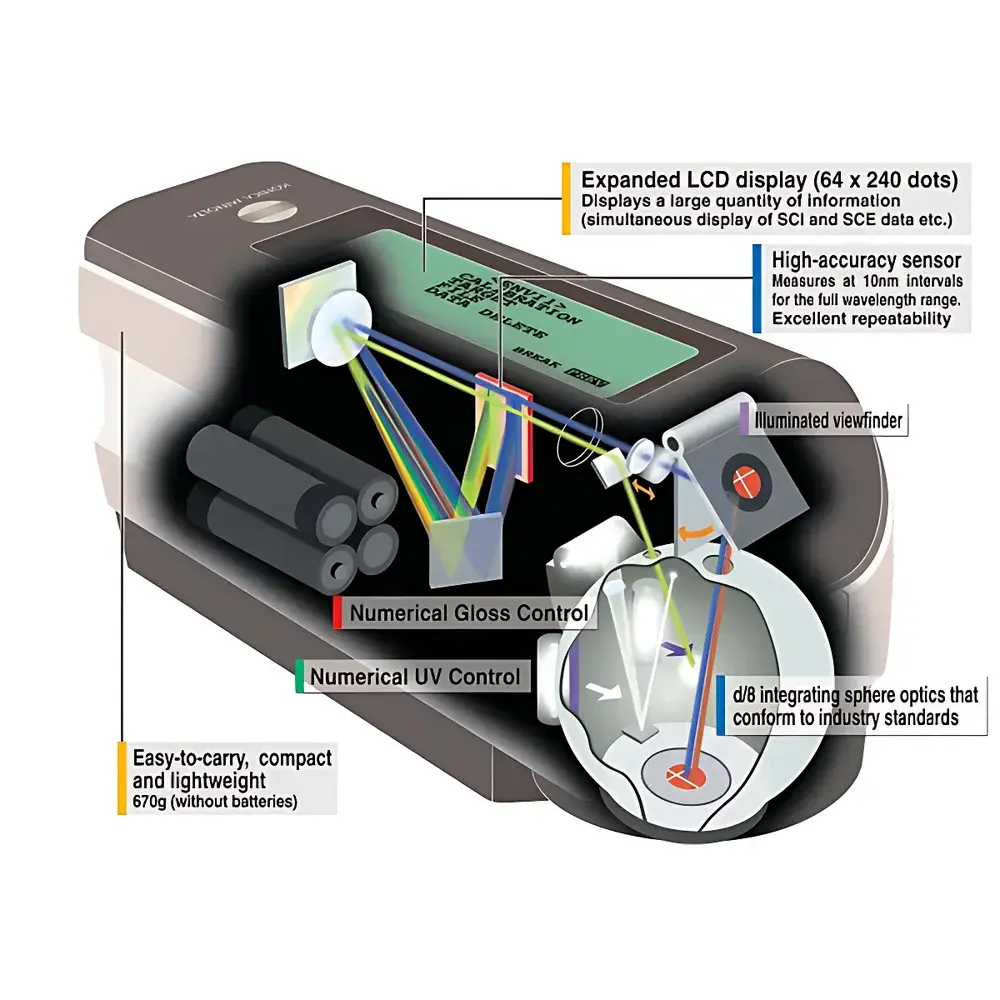
The Konica Minolta CM-2600d and CM-2500d are high-precision portable spectrophotometers engineered for rigorous color quality control in industrial production environments. Based on the d/8° integrating sphere optical geometry—compliant with ISO 7724-1, CIE No. 15, and ASTM E1164—these instruments perform simultaneous spectral measurement under both Specular Component Included (SCI) and Specular Component Excluded (SCE) conditions. This dual-mode capability enables accurate differentiation between total reflectance (including surface gloss) and diffuse reflectance (gloss-independent), essential for evaluating coated, textured, or glossy substrates across automotive, packaging, textiles, and paper industries. The CM-2600d integrates patented Digital Gloss Control and Digital UV Control technologies—world-first innovations in portable instrumentation—eliminating mechanical moving parts (e.g., motorized filters or gloss traps) to ensure long-term optical stability and field reliability. Its solid-state optical architecture features a high-energy pulsed xenon light source (three lamps for CM-2600d, two for CM-2500d), a plane holographic grating, and a dual-row 40-element silicon photodiode array, delivering consistent 10 nm spectral resolution from 360 nm to 740 nm. With measurement repeatability of ΔE*ab ≤ 0.04 and inter-instrument agreement of ΔE*ab ≤ 0.2 (SCI/MAV, BCRA Series II), the system meets stringent requirements for cross-site color data exchange and process validation.
Key Features
- Digital Gloss Control: Simultaneous SCI/SCE measurement via synchronized dual xenon lamp pulsing—no mechanical gloss trap required, ensuring zero drift and extended service life.
- Digital UV Control (CM-2600d only): Real-time UV-inclusive and UV-excluded measurements using dedicated xenon lamp pairs and embedded spectral correction algorithms—critical for fluorescent whitening agent (FWA)-containing materials such as paper, detergents, and textiles.
- Two interchangeable apertures: MAV (Φ8 mm) for general-purpose measurement and SAV (Φ3 mm) for small or patterned samples—both calibrated to NIST-traceable standards with independent optical path alignment.
- Ergonomic one-handed operation: Compact housing (193 × 69 × 96 mm), weight ≤ 670 g (with calibration tile), and intuitive navigation wheel interface reduce operator fatigue during high-volume field use.
- High-resolution graphical LCD: Displays spectral curves, CIELAB values, ΔE calculations, pass/fail status, and L*C*h vectors—supporting six languages (English, German, French, Spanish, Italian, Japanese) for global manufacturing teams.
- Robust optical design: Fully sealed optical path, no moving gratings or filters, and xenon-based illumination provide stable output across temperature (5–40°C) and humidity (≤80% RH at 35°C).
Sample Compatibility & Compliance
The CM-2600d/2500d accommodates diverse sample types—including opaque solids, translucent films, textured surfaces, and low-reflectance dark materials—via optimized LED-assisted sample viewing and adjustable aperture selection. Its d/8° geometry conforms to international standard requirements for colorimetric measurement of flat and moderately curved surfaces. Instrument compliance includes ISO 7724-1 (colorimetry), ISO 2470 (paper brightness), ASTM D2244 (color difference), ASTM E313 (yellowness index), ASTM E1164 (spectral data reporting), DIN 5033-7 (photometric quantities), JIS Z 8722 (color measurement conditions), and VDA 280 Parts 1–3 (automotive paint evaluation). All built-in color spaces (CIELAB, CIELCH, CMC, CIE94, CIEDE2000), illuminants (D65, A, F2, F7, etc.), and observer angles (2° and 10°) are implemented per CIE recommendations. Data integrity is maintained through traceable calibration against Konica Minolta’s proprietary white reference tile (CM-A145), certified to ISO 13655:2017 spectral reflectance standards.
Software & Data Management
Data acquisition and analysis are supported by SpectraMagic™ NX software (CM-S100w), which provides full audit trail functionality compliant with FDA 21 CFR Part 11 and GLP/GMP documentation requirements. The software enables batch calibration management, statistical process control (SPC) charting, tolerance zone definition (elliptical or rectangular ΔE limits), and automated report generation in PDF or Excel formats. Instrument communication occurs via RS-232C (RJ-45 port) or USB 2.0 (using IF-A24 adapter), supporting secure data export without cloud dependency. Internal memory stores up to 1,700 measurement sets (each containing paired SCI/SCE spectra), with timestamping and operator ID tagging. Firmware updates are performed locally via USB, ensuring regulatory continuity in validated environments where network connectivity is restricted.
Applications
These spectrophotometers serve critical roles in end-to-end color management workflows: incoming raw material verification (e.g., plastic pellets, textile yarns), in-process coating consistency checks (automotive clearcoats, industrial paints), final product release testing (consumer electronics housings, food packaging), and supplier color matching audits. The CM-2600d’s Digital UV Control accelerates QC for FWA-treated media—reducing measurement cycle time by >60% compared to filter-based UV adjustment methods. In printing and packaging, simultaneous SCI/SCE data supports gloss compensation for spot-color matching and substrate variability analysis. For R&D labs, spectral reflectance data (360–740 nm at 10 nm intervals) feeds into predictive color formulation models and metamerism assessment tools.
FAQ
What is the difference between CM-2600d and CM-2500d?
The CM-2600d includes Digital UV Control and dual-aperture capability (Φ8 mm and Φ3 mm), while the CM-2500d supports only Φ8 mm measurement and lacks UV-adjustment functionality.
Does the instrument comply with FDA 21 CFR Part 11 requirements?
While the hardware itself does not enforce electronic signatures, SpectraMagic™ NX software provides full audit trail, user access control, and electronic record retention aligned with Part 11 expectations for regulated color QC processes.
Can the device measure transparent or translucent samples?
It is designed for reflective measurement of opaque and semi-opaque materials; transmission mode requires optional accessories (e.g., transmission cell holder) not included in standard configuration.
How is inter-instrument agreement maintained across a fleet of devices?
Konica Minolta implements factory calibration traceable to NIST standards, and recommends periodic verification using the supplied CM-A145 white tile and BCRA Series II reference set per ISO 13655 procedures.
Is spectral data export possible in CSV or XML format?
Yes—SpectraMagic™ NX supports export of full spectral reflectance data (360–740 nm), tristimulus values, and derived indices in CSV, TXT, and XML formats for integration with LIMS or ERP systems.






