
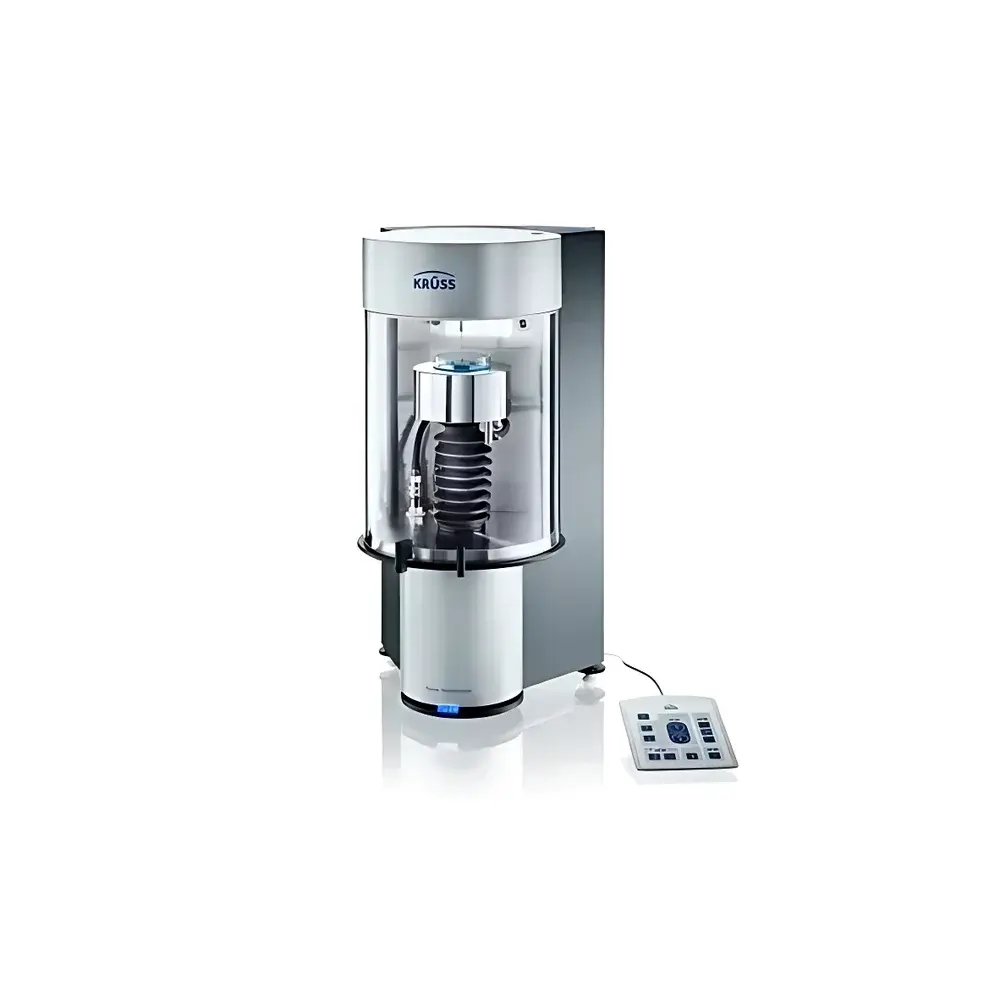
Krüss K100C Force-Based Tensiometer
| Origin | Germany |
|---|---|
| Manufacturer Type | Authorized Distributor |
| Origin Category | Imported |
| Model | K100C |
| Pricing | Available Upon Request |
Overview
The Krüss K100C Force-Based Tensiometer is a fully automated, high-precision instrument engineered for the quantitative determination of surface tension (γ), interfacial tension (IFT), critical micelle concentration (CMC), and contact angle on solids, fibers, and powders. It operates on the fundamental principle of force measurement—specifically, the Wilhelmy plate and du Noüy ring methods—where a calibrated probe (plate or ring) is immersed in or withdrawn from a liquid phase, and the resulting wetting force is measured via a high-resolution electromagnetic force transducer. This gravimetric approach delivers traceable, SI-referenced results with exceptional reproducibility (< 0.1 mN/m repeatability under controlled conditions). Designed for both routine QC laboratories and advanced R&D environments, the K100C integrates metrological rigor with process automation, enabling standardized, operator-independent measurements compliant with ASTM D971 (petroleum products), IEC 62961 (transformer oil aging), and ISO 1409 (plastics—determination of surface tension of polymer melts).
Key Features
- Fully automated measurement sequence controlled via ADVANCE software, including probe immersion depth, dwell time, withdrawal speed, and data acquisition trigger logic
- High-stability electromagnetic force sensor with internal temperature compensation and external calibration capability using NIST-traceable precision weights
- Dual-probe support: Precision-machined platinum-iridium Wilhelmy plates (standard and micro-plate variants) and du Noüy rings, each with certified geometric profiles and surface cleanliness verification protocols
- Magnetically latched, electronically sensed glass access door minimizing air current interference and enabling synchronized workflow initiation upon closure
- Integrated keyboard for direct hardware control—sample stage positioning, LED illumination intensity adjustment, and magnetic stirrer activation—reducing software navigation overhead
- Modular thermal management: Compatible with Krüss Peltier-based thermostats (–10 °C to +80 °C) and optional TJ60 high-temperature unit (up to 300 °C) for molten polymers, bitumen, and hot-melt adhesives
- Automated CMC titration module with syringe pump-driven surfactant dilution, real-time γ vs. log[c] curve generation, and algorithmic inflection point detection per ISO 18288
Sample Compatibility & Compliance
The K100C accommodates liquids, emulsions, molten thermoplastics, and heterogeneous dispersions. Its large-volume sample vessel (≥ 120 mL) supports extended stability studies and minimizes evaporation artifacts. For non-uniform samples, an integrated magnetic stirrer ensures homogenization prior to measurement without introducing air bubbles or shear-induced structural changes. The system meets GLP and GMP documentation requirements through ADVANCE’s audit-trail-enabled software, supporting 21 CFR Part 11 compliance with electronic signatures, user access levels, and immutable raw-data archiving. All measurement templates—including those for CMC, transformer oil aging (ASTM D971), detergent residue screening, and food-grade surfactant validation—are pre-validated and editable only by authorized personnel.
Software & Data Management
ADVANCE software provides template-driven method definition, eliminating manual parameter entry errors. Each template embeds instrument configuration, probe geometry, fluid density input (optional auto-detection via integrated densitometer interface), temperature setpoint, and post-processing algorithms (e.g., Harkins-Jordan correction for ring method, Zuidema-Waters correction for plate method). Raw force-vs-time datasets are stored in HDF5 format with embedded metadata (timestamp, operator ID, environmental conditions, calibration certificate ID). Export options include CSV, PDF reports with statistical summaries (mean, SD, CV%), and direct integration into LIMS via OPC UA or REST API. Batch processing allows retrospective re-evaluation of historical datasets using updated correction models.
Applications
- Quality assurance of surfactants, wetting agents, and emulsifiers across pharmaceutical, agrochemical, and personal care industries
- Monitoring oxidative degradation of transformer oils and lubricants via interfacial tension decline over accelerated aging cycles
- CMC profiling for formulation optimization—linking molecular architecture to colloidal stability and foaming behavior
- Wettability assessment of carbon fibers, textile filaments, and porous membranes using single-fiber contact angle analysis (with K100SF variant)
- Surface energy mapping of polymer films and coatings via contact angle hysteresis and Owens-Wendt analysis
- Process validation for cleaning-in-place (CIP) systems in food and biopharma manufacturing, quantifying residual surfactant load via surface tension threshold detection
FAQ
What measurement principles does the K100C support?
The K100C implements the Wilhelmy plate and du Noüy ring methods per ISO 1409 and ASTM D1331, with optional add-ons for pendant drop (via external camera module) and bubble pressure (when interfaced with BP100).
Can the K100C measure surface tension at elevated temperatures?
Yes—when equipped with the TJ60 high-temperature unit, it maintains ±0.2 °C stability from ambient to 300 °C, enabling surface tension characterization of polymer melts, asphalt binders, and solder fluxes.
Is CMC determination fully automated?
Yes—the integrated micro-titrator performs sequential dilutions, acquires surface tension after equilibration, and computes CMC using first-derivative peak detection aligned with ISO 18288 guidelines.
How is instrument calibration verified?
Force sensor linearity and zero-point stability are verified using certified stainless-steel calibration weights (10 mg to 1 g); probe geometry is validated optically using Krüss-certified profilometry reports.
Does the system support regulatory-compliant data handling?
ADVANCE software includes full 21 CFR Part 11 functionality: role-based access control, electronic signatures, change history logging, and encrypted raw-data storage with hash-verified integrity checks.
Related Products



