
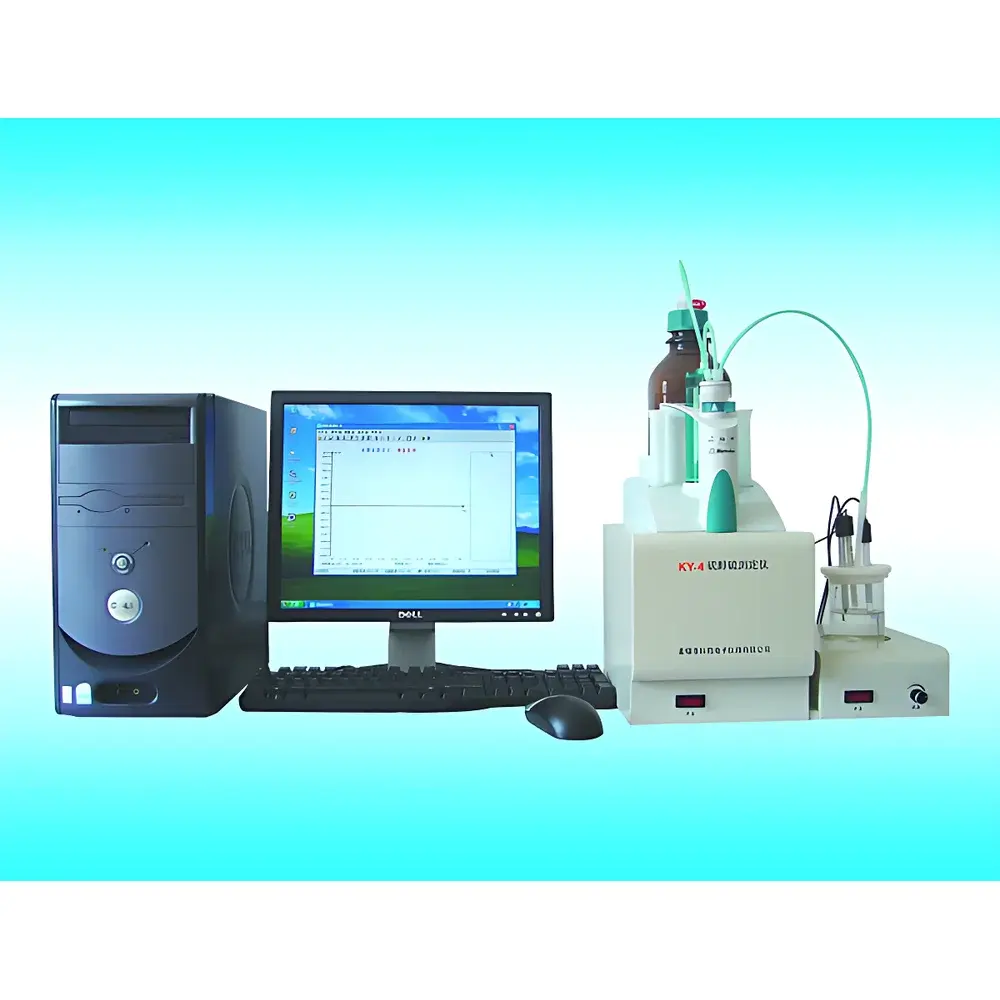
KY-6 Automatic Acid Number Titrator by Keyuan Instruments
| Brand | Keyuan Instruments |
|---|---|
| Origin | Jiangsu, China |
| Manufacturer Type | OEM Manufacturer |
| Region of Origin | Domestic (China) |
| Model | KY-6 |
| Instrument Category | Automatic Potentiometric Titrator |
| Application Scope | Universal |
| Measurement Range | ≥0.001 mg KOH/g |
| Potentiometric Measurement Range | −2000.0 to +2000.0 mV |
| Electronic Unit Basic Error | ±0.1% F·S ± 0.1 mV |
| Input Impedance | ≥1 × 10¹² Ω |
| Burette Capacity | 10 mL |
| Minimum Dispensing Volume | 0.001 mL |
| Burette Accuracy | ±0.1% F·S |
| Titration Accuracy | ±0.1% F·S |
| Endpoint Detection | Adaptive endpoint recognition via smoothed titration curve analysis |
| Compliance Standards | GB/T 7304–2000, GB/T 18609–2010 |
Overview
The KY-6 Automatic Acid Number Titrator is a fully automated potentiometric titration system engineered for precise and reproducible determination of acid number in petroleum products, crude oils, lubricants, and related hydrocarbon-based samples. It operates on the fundamental principle of potentiometric titration, where the potential change across a pH-sensitive electrode pair (typically a combination glass reference electrode and a platinum or antimony indicator electrode) is monitored continuously during titration with standardized alcoholic potassium hydroxide (KOH) solution. The instrument identifies the inflection point of the titration curve—corresponding to the stoichiometric neutralization of acidic components—using real-time derivative analysis and adaptive curve smoothing algorithms. Designed specifically for compatibility with the methanol–isopropanol–toluene solvent system specified in GB/T 7304–2000 and GB/T 18609–2010, the KY-6 delivers trace-level sensitivity down to 0.001 mg KOH/g, making it suitable for both routine QC testing in refinery laboratories and method development in R&D environments.
Key Features
- Integrated high-precision 10 mL burette with ±0.1% full-scale accuracy and 0.001 mL minimum dispensing resolution, ensuring volumetric fidelity across low- and mid-range acid number measurements.
- Imported anti-diffusion titration head with inert PTFE tubing and low-dead-volume fluid path, minimizing carryover and enhancing repeatability between sequential analyses.
- Real-time potentiometric monitoring over a wide dynamic range (−2000.0 to +2000.0 mV) with input impedance ≥1 × 10¹² Ω, enabling stable signal acquisition even in low-conductivity organic matrices.
- Automated sequence control including auto-rinse, auto-fill, pre-titration dosing, and conditional continuation—reducing operator intervention and standardizing procedural execution.
- Windows-based graphical user interface supporting step-by-step guided workflows, parameter logging, and audit-ready operation history with timestamped event tracking.
- Comprehensive data output capability: direct export of raw potential vs. volume datasets, first-derivative plots, and final acid number reports in PDF or CSV format.
Sample Compatibility & Compliance
The KY-6 is validated for use with samples soluble in the mixed solvent system of toluene, isopropanol, and water (per GB/T 7304–2000) or methanol–isopropanol (per GB/T 18609–2010), covering light distillates, heavy fuel oils, crude oils, and refined lubricants. Its electrochemical architecture meets the metrological requirements for GLP-compliant laboratories, including traceable calibration protocols for electrode potential and burette volume. While not certified to ISO/IEC 17025 out-of-the-box, the system supports documentation practices aligned with FDA 21 CFR Part 11 when deployed with controlled access, electronic signature, and audit trail configurations. All operational parameters—including titrant concentration, sample mass, solvent volume, and endpoint threshold—are fully configurable and stored with metadata for full method traceability.
Software & Data Management
The embedded Windows application provides full method editor functionality: users may define multi-step titration protocols, set dynamic endpoint detection windows, configure automatic re-titration thresholds, and assign sample IDs with batch metadata. Raw sensor data (mV vs. mL) is recorded at ≥10 Hz sampling rate and subjected to Savitzky–Golay smoothing prior to first-derivative calculation. All analytical sessions generate immutable log files containing instrument ID, operator ID, environmental temperature (0–35 °C), calibration timestamps, and electronic signatures. Export formats include ANSI-standard CSV for LIMS integration and print-ready PDFs compliant with internal QA documentation standards. No cloud connectivity or remote telemetry is enabled by default—data residency remains local unless explicitly configured per site IT policy.
Applications
- Determination of total acid number (TAN) in crude oil per ASTM D664 / GB/T 18609 for corrosion risk assessment in upstream and midstream operations.
- Quality control of turbine oils, transformer oils, and hydraulic fluids where acid buildup indicates oxidation degradation.
- Monitoring acid number evolution during accelerated oxidation tests (e.g., ASTM D943, D2272).
- Analysis of biodiesel (FAME) and bio-blended fuels per EN 14104, where low-level acidity reflects ester hydrolysis or feedstock contamination.
- Support of refinery process optimization through rapid feedback on naphtha, kerosene, and diesel fractions post-treating.
FAQ
What electrode types are supported for acid number titration on the KY-6?
The system is optimized for combination pH electrodes with shielded reference junctions and low-resistance glass membranes; optional antimony or quinhydrone electrodes may be used for non-aqueous applications upon validation.
Can the KY-6 comply with ASTM D664 methodology?
While designed primarily to GB/T 7304 and GB/T 18609, the KY-6’s hardware specifications (electrode impedance, burette precision, endpoint algorithm) meet or exceed the performance criteria required by ASTM D664 when operated with appropriate solvent and titrant preparation protocols.
Is the software compatible with laboratory information management systems (LIMS)?
Yes—CSV exports contain all raw and processed data fields required for automated ingestion into common LIMS platforms; custom API integration is available via RS-232 or TCP/IP upon request.
How is calibration traceability maintained?
The instrument supports dual-point electrode calibration using certified buffer standards and volumetric verification using gravimetric NIST-traceable water dispense checks at 1 mL and 10 mL points.
Does the system support multi-sample unattended operation?
No autosampler is integrated; however, the titration head and electrode assembly are designed for manual sample exchange with repeatable positioning, enabling semi-automated batch processing when paired with external sample changers.





