
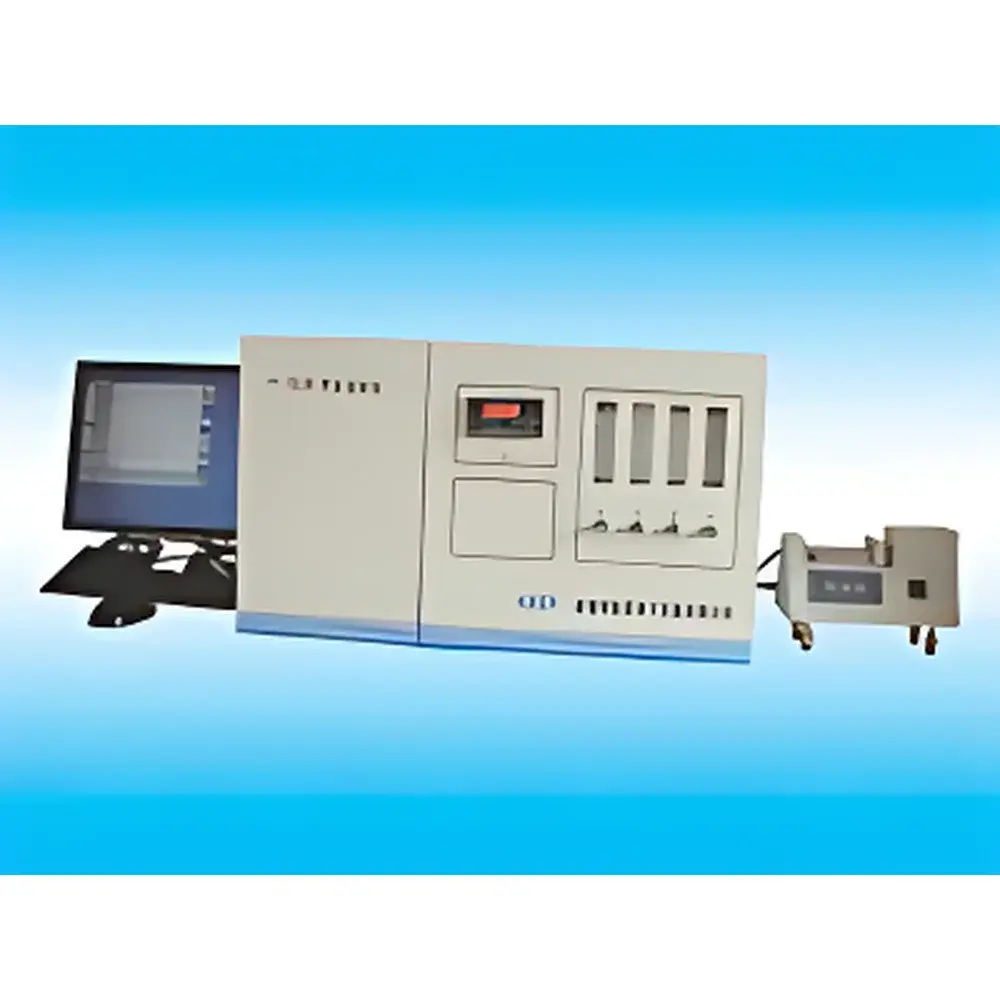
Kyoyuan KY-3000S UV Fluorescence Sulfur Analyzer
| Brand | Kyoyuan |
|---|---|
| Origin | Jiangsu, China |
| Manufacturer Type | Direct Manufacturer |
| Model | KY-3000S |
| Detection Principle | UV Fluorescence (for Sulfur) |
| Applicable Standards | SH/T 0689, ASTM D5453 |
| Sample Types | Liquid, Solid, Gas (with optional injectors) |
| Measurement Range | 0.2 mg/L to 5000 ppm (as sulfur) |
| Detection Limit | 0.2 mg/L (S) |
| Carrier Gases | High-purity O₂ (≥99.98%), High-purity Ar (≥99.98%) |
| Furnace Temperature Range | Ambient to 1100 °C |
| Temperature Control Accuracy | ±3 °C |
| Power Consumption | 2 kW |
| Dimensions (W×D×H) | 680 × 480 × 400 mm |
| Data Acquisition | 24-bit ADC, USB interface |
| PMT Voltage | Adjustable |
| Calibration Options | Single-point or multi-point calibration |
| Software Compatibility | Windows, macOS, Linux |
Overview
The Kyoyuan KY-3000S UV Fluorescence Sulfur Analyzer is a laboratory-grade elemental analyzer engineered for precise, trace-level quantification of total sulfur in hydrocarbon-based and organic matrices. It operates on the well-established ultraviolet fluorescence detection principle: samples are combusted in a high-temperature quartz furnace under controlled oxygen-rich conditions, converting all sulfur species into sulfur dioxide (SO₂). The SO₂ gas is then carried by inert argon into a reaction chamber where it is excited by pulsed UV light; the resulting fluorescence emission at ~340 nm is detected by a photomultiplier tube (PMT). Signal intensity is directly proportional to sulfur concentration, enabling linear, wide-dynamic-range quantification from sub-ppm to percent-level concentrations. Designed in full compliance with SH/T 0689 and ASTM D5453, this instrument serves as a primary method for regulatory sulfur testing in refineries, petrochemical QA/QC labs, and third-party testing facilities—meeting the analytical rigor required for fuel specification compliance (e.g., ASTM D7039, ISO 20846, EN 15486).
Key Features
- High-stability combustion system with programmable temperature control (ambient to 1100 °C) and ±3 °C precision, ensuring complete oxidation of refractory sulfur compounds including thiophenes and sulfides.
- Optimized UV fluorescence detection module featuring adjustable PMT high-voltage supply, enabling dynamic signal optimization across diverse sample matrices and concentration ranges.
- 24-bit analog-to-digital conversion with USB 2.0 interface ensures high-resolution signal capture and low-noise baseline stability; minimum detectable signal <1 µV supports reliable quantification at 0.2 mg/L detection limit.
- Modular injector architecture: standard liquid autosampler included; optional solid sampler (combustion boat + ceramic furnace) and gas sampling valve (for LPG, natural gas, refinery off-gas) enable full-sample-state flexibility.
- Robust quartz pyrolysis tube design with dual configurations—light-duty (for gasoline, naphtha) and heavy-duty (for residual fuels, bitumen)—minimizes carbon buildup and extends maintenance intervals.
- Fully agnostic software platform compatible with Windows (7–11), macOS (10.15+), and major Linux distributions (Ubuntu LTS, RHEL 8+); no proprietary OS lock-in or runtime dependencies.
Sample Compatibility & Compliance
The KY-3000S accommodates a broad spectrum of sample types without matrix-specific hardware modification: volatile liquids (gasoline, jet fuel), viscous oils (diesel, lubricants), solids (plastics, catalysts, coal ash), and compressed gases (LPG, syngas, flare gas). All analyses adhere strictly to the reaction stoichiometry and calibration traceability requirements defined in ASTM D5453 and SH/T 0689. Instrument validation includes linearity verification (r² ≥ 0.999 over 0.2–5000 ppm), repeatability assessment (<2.0% RSD at 10 ppm S), and interference testing per ASTM D7039 Annex A1. System suitability checks—such as blank response monitoring, reference material recovery (NIST SRM 2724b, 1634c), and daily calibration verification—are fully scriptable within the software and generate audit-ready logs compliant with GLP and ISO/IEC 17025 documentation standards.
Software & Data Management
The embedded acquisition and analysis software provides full lifecycle data handling: real-time chromatogram visualization, peak integration with customizable baselines, multi-point calibration curve generation (linear, quadratic, or forced-zero), and automated report generation with configurable templates (PDF, CSV, XML). All raw data files (.kyd) are stored in open binary format with embedded metadata (operator ID, timestamp, method name, furnace temp, gas flows, PMT voltage). Audit trail functionality records every parameter change, calibration event, and result modification—including user identity and timestamp—in an immutable log file compliant with FDA 21 CFR Part 11 requirements when deployed with optional electronic signature modules. Data export supports LIMS integration via ASTM E1394 or direct SQL database push (ODBC/JDBC drivers provided).
Applications
- Regulatory sulfur testing in transportation fuels (ULSD, gasoline, aviation turbine fuel) per EPA 40 CFR Part 1090, EU Fuel Quality Directive 2009/30/EC.
- Quality control of feedstocks and intermediates in petrochemical production (e.g., naphtha desulfurization efficiency, FCC catalyst poisoning assessment).
- Environmental analysis of sulfur in waste oils, contaminated soils, and industrial effluents.
- R&D support for low-sulfur additive development, catalyst screening, and hydrotreating process optimization.
- Compliance verification for ASTM D129, D2622, and ISO 8754 methodologies where UV fluorescence offers superior selectivity over XRF or WDXRF.
FAQ
What sample introduction methods are supported out-of-the-box?
The standard configuration includes a liquid autosampler with 10-position vial tray and syringe-driven injection. Solid and gas analysis require separately ordered accessories: ceramic boat loader with auxiliary furnace, and pressure-regulated gas sampling valve with flow controller.
Is the instrument suitable for routine analysis in ISO 17025-accredited laboratories?
Yes—the KY-3000S meets essential metrological requirements for accredited testing, including documented uncertainty budgets, traceable calibration using NIST-traceable sulfur standards, and built-in system suitability protocols aligned with ILAC-G8:2022.
Can the software comply with FDA 21 CFR Part 11 for electronic records?
With optional user authentication module and digital certificate integration, the software supports role-based access control, electronic signatures, and tamper-evident audit trails required for regulated pharmaceutical or biofuel applications.
What maintenance is required for long-term operational stability?
Routine maintenance includes monthly quartz tube inspection/cleaning, quarterly PMT gain verification using certified check standards, and biannual carrier gas filter replacement. No optical alignment or vacuum pump servicing is required.
How does the instrument handle high-sulfur samples that may cause quenching or memory effects?
The system employs active purge cycles between injections, dynamically adjusted furnace residence time, and optional high-flow argon washout to minimize carryover; validated carryover <0.5% for 5000 ppm S challenge samples.
Related Products





