
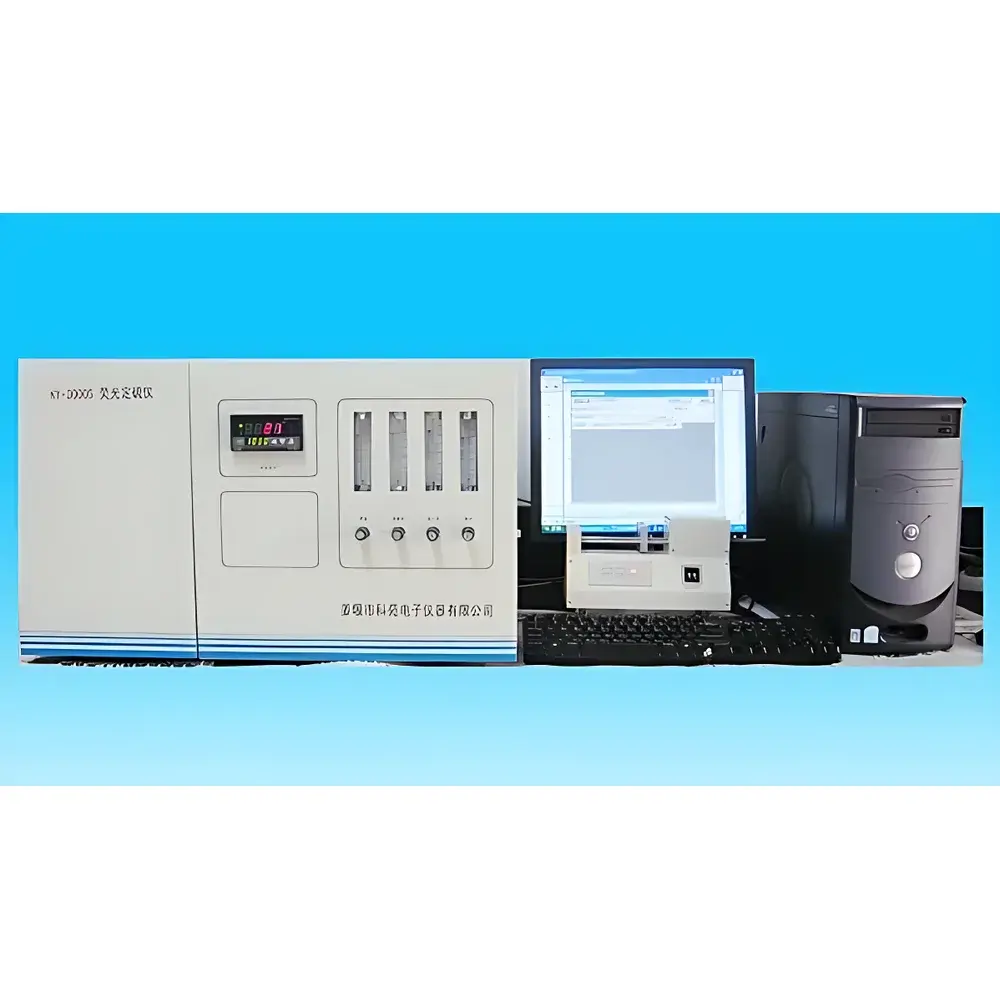
Kyoyuan KY-3000S UV Fluorescence Sulfur Analyzer
| Brand | Kyoyuan |
|---|---|
| Origin | Jiangsu, China |
| Manufacturer Type | Direct Manufacturer |
| Country of Origin | China |
| Model Compliance | SH/T 0689, ASTM D5453, GB/T 34100-2017 |
| Detection Principle | UV Fluorescence (S) |
| Sample Types | Liquid, Solid, Gas (with optional injectors) |
| Detection Range | 0.2 mg/L to 5000 ppm (up to % level) |
| LOD | 0.2 mg/L (as sulfur) |
| Repeatability | ±0.2 mg/L at 1.0 mg/L |
| Temperature Control | Ambient to 1300 °C, ±1 °C accuracy |
| Gas Requirements | High-purity O₂ (≥99.98%), high-purity Ar (≥99.98%) |
| Power Consumption | 2 kW |
| Data Acquisition | 24-bit USB interface, signal resolution <1 µV |
| PMT Voltage | Adjustable |
| Calibration | Single-point or multi-point linear/nonlinear curve fitting |
| Software Compatibility | Windows 7/10/11, macOS (via Wine-compatible runtime), Linux (CLI-supported) |
Overview
The Kyoyuan KY-3000S UV Fluorescence Sulfur Analyzer is a laboratory-grade elemental sulfur quantification system engineered for precision, regulatory compliance, and operational robustness in petrochemical, refining, and quality control environments. It implements the ultraviolet fluorescence detection principle—where sulfur-containing compounds are combusted in a high-temperature quartz furnace under controlled oxygen/argon atmosphere to generate excited SO₂* species, which emit characteristic UV photons (λ ≈ 300–400 nm) upon relaxation. These emissions are captured by a low-noise photomultiplier tube (PMT) with user-adjustable high-voltage bias, enabling dynamic signal optimization across wide concentration ranges. The instrument is fully aligned with internationally recognized test methods including SH/T 0689 (China), ASTM D5453 (Standard Test Method for Determination of Total Sulfur in Light Hydrocarbons, Motor Fuels and Other Oil Products by Ultraviolet Fluorescence), and GB/T 34100–2017. Its design prioritizes trace-level sensitivity (LOD = 0.2 mg/L), broad dynamic range (0.2 mg/L to % w/w), and thermal stability up to 1300 °C with ±1 °C control fidelity—making it suitable for demanding applications such as ultra-low-sulfur diesel (ULSD), jet fuel certification, and catalyst poisoning studies.
Key Features
- 24-bit high-resolution USB data acquisition architecture with sub-microvolt signal detection capability (<1 µV minimum detectable signal)
- Programmable PMT high-voltage control for real-time gain optimization and extended linear response
- Multi-point calibration support (linear and non-linear curve fitting) with automated drift correction and baseline stabilization
- Modular sample introduction system accommodating liquid autosamplers, solid combustion boats, and gas loop injectors (optional)
- Quartz combustion tube with integrated ceramic insulation and dual-zone temperature profiling (oxidation + reaction zones)
- Onboard gas flow regulation with digital mass flow controllers for O₂ and Ar, ensuring stoichiometric combustion and inert carrier consistency
- Thermally stable furnace assembly rated for continuous operation at 1300 °C with active cooling and over-temperature protection
Sample Compatibility & Compliance
The KY-3000S accepts liquid hydrocarbon samples (e.g., gasoline, diesel, naphtha), solid matrices (e.g., polymer pellets, catalyst powders, lubricant additives), and gaseous streams (e.g., LPG, refinery off-gas) when equipped with appropriate sample introduction modules. All measurement protocols adhere strictly to SH/T 0689, ASTM D5453, and GB/T 34100–2017 validation requirements—including system suitability testing, blank correction, recovery verification (spike tests), and intermediate precision assessment. Instrument qualification documentation supports GLP and GMP audit readiness. Optional 21 CFR Part 11-compliant software modules provide electronic signatures, audit trails, and role-based access control for regulated laboratories.
Software & Data Management
The embedded analytical software operates natively on Windows platforms (7 through 11) and supports cross-platform deployment via standardized APIs. It delivers full lifecycle data handling: method setup (combustion parameters, calibration curves, integration windows), real-time chromatogram visualization, peak deconvolution, quantitative reporting (ppm, mg/L, wt%), and customizable PDF/CSV export. Raw data files are stored in open binary format with embedded metadata (operator ID, timestamp, instrument serial, calibration history). Built-in diagnostic tools monitor detector response decay, furnace temperature stability, and gas purity alerts—enabling predictive maintenance and root-cause analysis without external service intervention.
Applications
- Regulatory compliance testing for sulfur limits in transportation fuels (EPA Tier 3, Euro 6/VII, China VI)
- Refinery process stream monitoring: feedstock screening, hydrotreater efficiency evaluation, product blending verification
- Quality assurance of base oils, lubricants, and specialty chemicals per ASTM D2622 and ISO 20846
- Research into sulfur speciation effects on catalyst deactivation and emission formation mechanisms
- Environmental testing of biofuels and synthetic hydrocarbons for total sulfur content prior to certification
- Contract laboratory services requiring ISO/IEC 17025 method validation and uncertainty budgeting
FAQ
What standards does the KY-3000S comply with?
It is fully compliant with SH/T 0689, ASTM D5453, and GB/T 34100–2017 for total sulfur determination by UV fluorescence.
Can the instrument analyze solid or gaseous samples?
Yes—solid samples require a quartz boat and optional ash-free combustion protocol; gas analysis requires a calibrated loop injector and pressure-regulated sampling manifold.
Is the software compatible with modern operating systems?
The native application runs on Windows 7/10/11; command-line interfaces and data exchange formats (CSV, XML) enable integration with macOS and Linux-based LIMS environments.
What gas purity is required for optimal performance?
High-purity oxygen (≥99.98%) and argon (≥99.98%) are mandatory to prevent quenching effects and ensure complete oxidation of refractory sulfur species.
How is calibration verified during routine use?
Calibration integrity is confirmed using certified reference materials (CRMs) traceable to NIST or equivalent national metrology institutes, with daily system suitability checks per ASTM D5453 Section 9.
Related Products






