
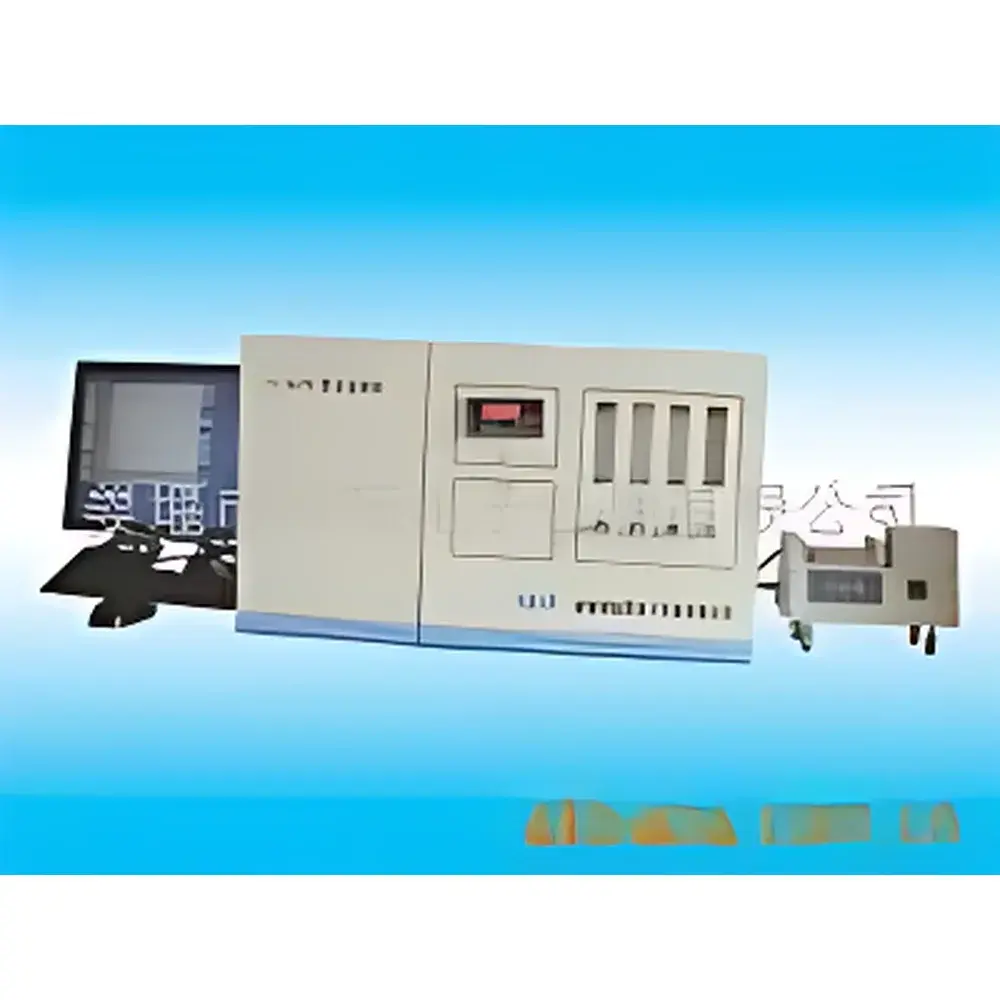
Kyoyuan KY-3000S UV Fluorescence Total Sulfur Analyzer
| Brand | Kyoyuan |
|---|---|
| Origin | Jiangsu, China |
| Manufacturer Type | Direct Manufacturer |
| Country of Origin | China |
| Model | KY-3000S |
| Price Range | USD 7,000–14,000 (FOB) |
| Analyte | Total Sulfur |
| Sample Types | Liquid, Solid, Gas (with optional injectors) |
| Detection Principle | Ultraviolet Fluorescence (UVF) |
| Measurement Range | 0.2–5000 mg/L (as S), extendable to wt% |
| LOD | 0.2 mg/L (as S) |
| Furnace Temperature Range | Ambient to 1100 °C |
| Temp Control Accuracy | ±0.5% or ±3 °C, whichever is greater |
| High Voltage Supply | DC 700–900 V (software-adjustable, default ~650 V) |
| Carrier Gases | Argon ≥99.98%, Oxygen ≥99.98% |
| Power Supply | AC 220 V ±10%, 50 Hz ±0.5 Hz, ≤2 kW |
| Dimensions | 680 × 480 × 400 mm |
| Compliance Standards | SH/T 0689, ASTM D5453 |
| Data Acquisition | 24-bit USB interface, minimum detectable signal <1 µV |
| PMT HV Adjustment | Fully software-controlled, single- or multi-point calibration supported |
| Software Compatibility | Windows 10/11, Linux (via Wine), macOS (virtualized) |
Overview
The Kyoyuan KY-3000S UV Fluorescence Total Sulfur Analyzer is a benchtop elemental analyzer engineered for precise, trace-level quantification of total sulfur in petroleum-based matrices and related industrial materials. It operates on the well-established ultraviolet fluorescence (UVF) detection principle: samples are combusted in a high-temperature quartz furnace under controlled oxygen/argon atmosphere, converting all sulfur species—whether mercaptans, sulfides, thiophenes, or sulfate salts—into excited-state SO2 molecules. Upon relaxation, these emit characteristic UV photons (~350 nm) detected by a low-noise photomultiplier tube (PMT). Signal intensity is linearly proportional to sulfur mass flow rate, enabling direct calibration against certified reference materials traceable to NIST or CNAS. Designed specifically for compliance with SH/T 0689 and ASTM D5453, the KY-3000S delivers metrologically sound results required for refinery process control, fuel specification verification (e.g., Euro 5/6, Tier 3 gasoline), and regulatory reporting under EPA 40 CFR Part 80 and ISO 8217.
Key Features
- Modular sample introduction architecture supporting liquid autosampling (standard), solid sampling (optional ceramic boat injector), and gas-phase analysis (optional pressurized loop injector) — all thermally isolated to prevent cross-contamination.
- High-stability quartz combustion furnace with dual-zone temperature control (up to 1100 °C), featuring PID-driven thermal regulation and real-time drift compensation to maintain ±0.5% accuracy across extended runs.
- Digitally tunable PMT high-voltage supply (700–900 V DC), adjustable via embedded firmware to optimize signal-to-noise ratio for low-concentration (1000 ppm) applications without hardware modification.
- 24-bit analog-to-digital conversion with USB 2.0 interface ensures sub-microvolt resolution and immunity to electromagnetic interference common in refinery lab environments.
- Full traceability framework: audit-ready electronic logs record operator ID, calibration history, gas pressure profiles, furnace ramp rates, and raw spectral integrals — compliant with GLP and FDA 21 CFR Part 11 when paired with validated LIMS integration.
Sample Compatibility & Compliance
The KY-3000S accommodates a broad spectrum of petroleum and petrochemical matrices without derivatization or pre-treatment. Validated applications include gasoline, diesel, jet fuel (Jet A-1, JP-8), naphtha, crude oil emulsions, lubricating oils, biodiesel blends (B5–B20), liquefied petroleum gas (LPG), natural gas condensates, and sulfur-containing polymers (e.g., vulcanized rubber, polythiophene films). Solid analysis requires optional high-temperature ceramic boats and inert carrier gas purging; gas analysis mandates calibrated loop injection with back-pressure regulation. All measurement protocols strictly adhere to SH/T 0689 (Chinese national standard) and ASTM D5453 (Standard Test Method for Determination of Total Sulfur in Light Hydrocarbons, Motor Fuels and Oils by Ultraviolet Fluorescence), ensuring inter-laboratory reproducibility within ±5% RSD at 10 ppm S level. Instrument validation includes system suitability testing per USP and routine performance qualification per ISO/IEC 17025:2017 Clause 7.7.
Software & Data Management
Control and data processing are managed through Kyoyuan’s proprietary SulfurView™ v4.x software, compatible with Windows 10/11 (64-bit), Ubuntu LTS (22.04+), and macOS Monterey or later (via Parallels Desktop). The software provides full ICH-compliant audit trail functionality, including immutable timestamps, user authentication (LDAP/Active Directory support), electronic signatures, and change history for all method parameters and calibration curves. Quantitative workflows support internal standard correction, matrix-matched calibration, and QC flagging based on user-defined acceptance criteria (e.g., recovery 85–115%, RSD <3%). Raw data files (.srf) are stored in HDF5 format for long-term archival integrity and third-party interoperability with ChemStation, OpenChrom, or custom Python/Pandas pipelines.
Applications
- Refinery quality assurance: Real-time monitoring of hydrotreater effluent, FCC feedstocks, and finished product blending tanks.
- Fuel certification: Verification of ultra-low-sulfur diesel (ULSD, ≤15 ppm), marine distillate fuels (IMO 2020 compliance), and aviation turbine fuels.
- Research & development: Kinetic studies of desulfurization catalysts, sulfur speciation modeling, and additive interaction analysis.
- Environmental compliance: Sulfur content verification in biofuels, waste-derived oils, and emissions control fluids.
- Contract laboratory services: Accredited testing per ISO/IEC 17025 for third-party certification reports.
FAQ
What combustion gases are required, and why must they meet ≥99.98% purity?
High-purity argon (carrier) and oxygen (combustion oxidant) minimize background carbon deposition and quenching effects on SO2 fluorescence. Impurities such as nitrogen oxides or moisture degrade PMT lifetime and introduce spectral interference.
Can the KY-3000S analyze solid samples like catalysts or rubber without acid digestion?
Yes — using the optional solid sampling module, samples are introduced into the hot zone via ceramic boats under inert purge, achieving quantitative sulfur release without wet chemistry.
Is multi-point calibration mandatory for regulatory submissions?
While single-point calibration suffices for routine QC, multi-point (≥5 levels) calibration with NIST-traceable standards is required for ISO/IEC 17025 accreditation and EPA-certified testing labs.
How does the instrument handle high-sulfur samples (e.g., heavy fuel oil) without detector saturation?
The software implements dynamic range extension via automatic gain switching and real-time dilution factor application, preserving linearity up to 5000 mg/L while maintaining sub-ppm LOD.
Does the system support remote diagnostics and preventive maintenance alerts?
Yes — integrated Ethernet port enables secure SSH access for firmware updates, sensor health monitoring (furnace thermocouple drift, PMT dark current), and automated calibration reminder scheduling.






