
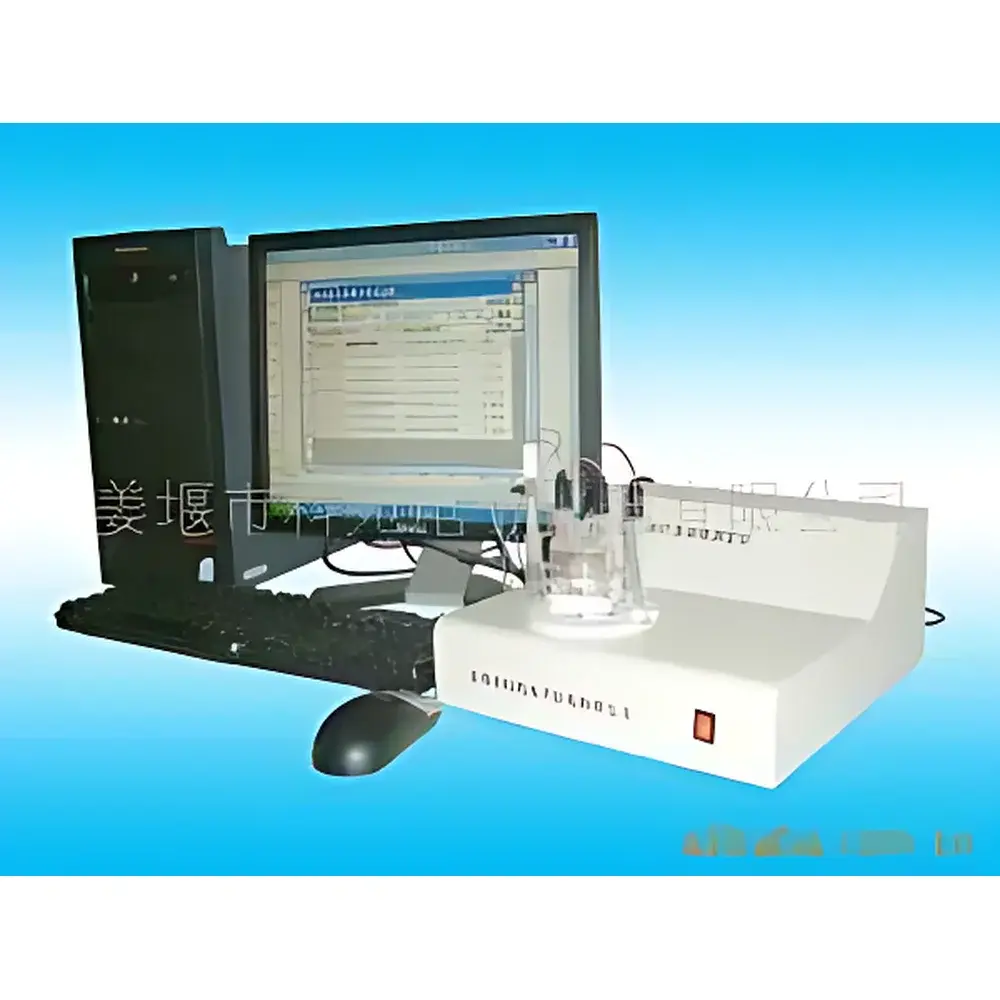
Kyoyuan KY-4 Microcoulometric Bromine Number and Bromine Index Analyzer
| Brand | Kyoyuan |
|---|---|
| Origin | Jiangsu, China |
| Manufacturer Type | Manufacturer |
| Product Category | Domestic |
| Model | KY-4 |
| Pricing | Upon Request |
| Measurement Principle | Microcoulometric Titration |
| Sample Form | Liquid |
| Method Standard | SH/T 0630-1996, SH/T 1551-2018, GB/T 11136-1989(2004), SH/T 1767-2008(2015), GB/T 1815-1997, ASTM D1492 |
| Bromine Number Range | 0–300 g Br/100 g sample |
| Bromine Index Range | 1–1000 mg Br/100 g sample |
| Accuracy | ±3% ±0.2 g Br (bromine number) |
| Detection Limit | 1 mg Br |
| Resolution | 0.01 mg Br |
| Bias Voltage Range | 0–500 mV |
| Dimensions | 280 × 280 × 160 mm |
| Power Consumption | 150 W |
| Interface | USB |
| Electrolyte | Benzene-free |
| Sample Volume | <10 mL (typical) |
| Analysis Time | ~60 seconds per sample |
| Endpoint Detection | Potentiometric |
Overview
The Kyoyuan KY-4 Microcoulometric Bromine Number and Bromine Index Analyzer is a dedicated benchtop elemental analyzer engineered for precise quantification of unsaturated hydrocarbons—primarily alkenes and dienes—in petroleum fractions, lubricants, solvents, and aromatic feedstocks. It operates on the fundamental principle of controlled-potential microcoulometric titration: an electrochemical cell generates bromine *in situ* via oxidation of bromide ions at the anode; the generated bromine reacts stoichiometrically with carbon–carbon double bonds in the injected liquid sample. The endpoint is detected potentiometrically by monitoring the potential shift across a dual-platinum indicator electrode pair. Total charge consumed during electrolysis—measured in coulombs—is directly proportional to the bromine consumed, enabling calculation of bromine number (g Br/100 g sample) and bromine index (mg Br/100 g sample) per ASTM D1492 and SH/T 0630-1996. This method eliminates reliance on hazardous, pre-prepared bromine reagents and avoids manual titration errors, delivering high reproducibility and trace-level sensitivity without solvent volatility or operator bias.
Key Features
- Benzene-free electrolyte system: Eliminates toxicity and regulatory handling constraints associated with traditional bromination solvents while maintaining analytical robustness.
- Potentiometric endpoint detection: Dual-platinum electrodes provide stable, drift-resistant signal acquisition, ensuring consistent endpoint recognition across matrix variations.
- Patented frit-based electrolytic cell design: Replaces conventional ion-selective membranes with a custom-sintered glass frit, eliminating membrane degradation, leakage, and calibration drift—critical for long-term operational stability.
- Full USB-based PC integration: Real-time control of electrolysis parameters, automatic endpoint discrimination, dynamic baseline correction, and integrated data logging are managed through Kyoyuan’s proprietary Windows-compatible software suite.
- Ultra-low sample consumption: Requires ≤10 mL for bromine number analysis and as little as 50 µL for high-sensitivity bromine index determination—minimizing material cost and waste generation.
- High-speed analysis cycle: Typical measurement duration is ≤60 seconds per sample, including injection, reaction, endpoint confirmation, and charge integration—enabling throughput of >50 samples per 8-hour shift.
- Sub-milligram resolution: 0.01 mg Br resolution and 1 mg Br detection limit support compliance with stringent specifications for highly saturated base oils and polymer-grade aromatics.
Sample Compatibility & Compliance
The KY-4 is validated for use with transparent, low-viscosity liquid samples including naphthas, kerosene, diesel, jet fuel, white spirit, benzene, toluene, xylene (BTX), styrene monomer, and olefinic process streams. It accommodates samples with dissolved water content up to 500 ppm without interference. All hardware and firmware comply with electromagnetic compatibility (EMC) requirements per IEC 61326-1. Analytical performance meets the precision and repeatability criteria defined in SH/T 0630-1996 (revised 2020), SH/T 1551-2018, and ASTM D1492. Data integrity protocols—including audit-trail-enabled result storage, user-access controls, and timestamped raw signal logs—are configurable to align with GLP and internal QA/QC documentation standards.
Software & Data Management
Kyoyuan’s KY-Control v3.2 software provides a secure, intuitive interface for instrument setup, method definition, real-time signal visualization (current vs. time, potential vs. time), and post-run data review. Each analysis session automatically saves raw coulombic traces, calculated results, calibration history, and operator ID. Export options include CSV, PDF, and XML formats compatible with LIMS integration. The software supports multi-point calibration curves with polynomial fitting, blank subtraction routines, and statistical reporting (mean, SD, RSD, confidence intervals). All electronic records adhere to ALCOA+ principles (Attributable, Legible, Contemporaneous, Original, Accurate, Complete, Consistent, Enduring, Available) and may be configured for 21 CFR Part 11 readiness upon request.
Applications
- Quality control of hydrogenation catalyst efficiency in refinery hydrotreaters by monitoring residual olefin content in treated naphtha.
- Specification verification of polymer-grade propylene and butadiene feedstocks per ASTM D2503 and ISO 16955.
- Stability assessment of transformer oils and turbine oils via bromine index trending—correlating with oxidation susceptibility.
- Batch release testing of industrial solvents (e.g., cyclohexane, hexane) where trace unsaturation impacts downstream polymerization kinetics.
- Research and development of bio-derived hydrocarbons, where precise unsaturation profiling informs catalytic upgrading strategies.
FAQ
What electrolyte composition is used in the KY-4, and why is it advantageous?
The KY-4 employs a proprietary benzene-free electrolyte containing lithium bromide, acetic acid, and methanol. This formulation ensures rapid bromine generation kinetics, low background current, and minimal solvent evaporation—enhancing safety, shelf life, and inter-laboratory reproducibility compared to legacy chlorobenzene- or pyridine-based systems.
Can the KY-4 analyze viscous or turbid samples?
No. The instrument requires homogenous, low-viscosity (<5 cSt at 25°C), optically clear liquids. Viscous or particulate-laden samples must be pre-diluted with compatible solvent (e.g., chloroform) and filtered (0.45 µm) prior to injection.
How is system performance verified between calibrations?
Daily system suitability is confirmed using certified bromine index reference standards (e.g., 10, 100, and 500 mg Br/100 g in heptane). Recovery tolerance is set at ±5% for bromine index and ±3% for bromine number per SH/T 0630-1996 Annex B.
Is the frit-based cell field-replaceable?
Yes. The sintered glass frit assembly is a modular component with standardized dimensions and can be replaced in under 10 minutes using standard lab tools—no factory recalibration required.
Does the software support networked deployment or remote diagnostics?
Standard licensing permits single-station operation. Enterprise licenses with centralized database hosting, remote firmware updates, and diagnostic telemetry are available under Kyoyuan’s K-Connect Service Agreement.




