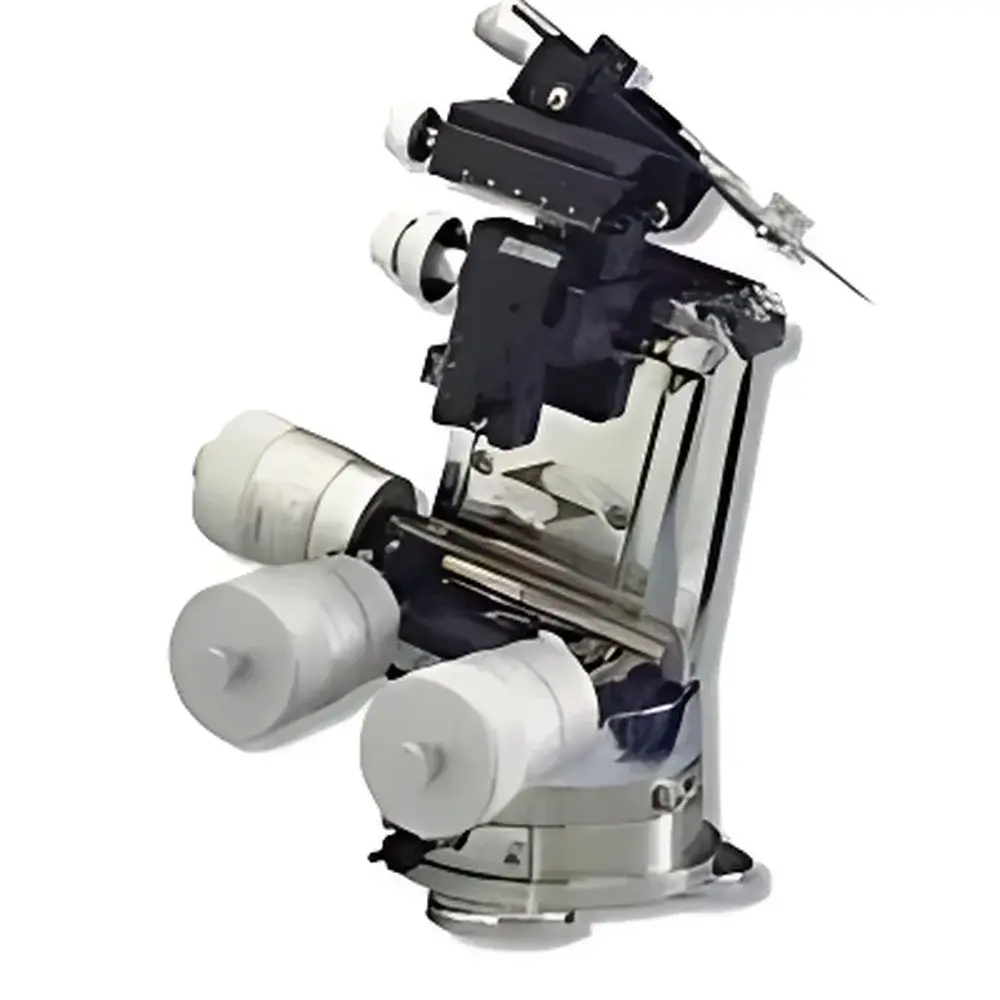
Sutter MP-85 Motorized Micromanipulator
| Brand | Sutter |
|---|---|
| Origin | USA |
| Model | MP-85 |
| Axes | XYZ motorized with manual coarse/fine/ultra-fine adjustment |
| X-axis rotation | 0–45° in 15° increments |
| Coarse resolution (XYZ) | 0.1 mm |
| Fine resolution (X-axis) | 0.01 mm |
| Ultra-fine resolution (X-axis) | 0.2 µm |
| Dimensions | 25 mm × 25 mm × 25 mm |
| Compliance | Designed for electrophysiology, patch-clamp, and intracellular injection workflows under GLP-aligned laboratory practices |
Overview
The Sutter MP-85 Motorized Micromanipulator is a compact, high-stability electromechanical positioning system engineered for sub-micron precision in live-cell electrophysiology and microinjection applications. It operates on the principle of piezo-assisted stepper motor actuation combined with dual-stage mechanical gearing—enabling seamless transition between coarse, fine, and ultra-fine positional control across three orthogonal axes (X, Y, Z). Unlike open-loop systems, the MP-85 integrates closed-loop feedback via optical encoders on its primary drive trains, ensuring positional repeatability within ±0.1 µm over extended operational cycles. Its design prioritizes thermal and mechanical drift suppression: the monolithic aluminum housing, low-thermal-expansion kinematic mounts, and passive damping elements collectively limit axial drift to <0.5 µm/h at ambient lab conditions (22 ± 1°C, 40–60% RH). This stability is critical for sustained intracellular recordings, whole-cell patch-clamp configurations, and long-duration microinjection protocols where electrode tip displacement must remain below cellular membrane deformation thresholds.
Key Features
- Three-axis motorized control (X/Y/Z) with independent coarse/fine/ultra-fine resolution modes
- X-axis rotational capability (0–45° in discrete 15° steps) for angled electrode approach—essential for oblique cortical or retinal slice access
- Ultra-fine positional resolution of 0.2 µm on the X-axis, achieved via harmonic drive reduction and backlash-free lead-screw transmission
- Compact cubic footprint (25 mm × 25 mm × 25 mm), optimized for integration into confined microscope stages and multi-probe rigs
- Modular mounting interface compatible with standard 3/8″-24 UNC threaded posts and Thorlabs-compatible dovetail rails
- Low-voltage DC operation (12 V nominal) with EMI-shielded cabling—minimizing electromagnetic interference during low-noise voltage-clamp measurements
Sample Compatibility & Compliance
The MP-85 is routinely deployed in compliance-critical environments including academic core electrophysiology facilities, contract research organizations (CROs) performing preclinical neuropharmacology studies, and ISO 17025-accredited laboratories conducting assay development for ion channel modulators. While not a medical device per FDA 21 CFR Part 820, its operational parameters align with ASTM E2919-22 (Standard Practice for Calibration of Micromanipulators Used in Electrophysiology) and support GLP documentation requirements for instrument qualification (IQ/OQ/PQ). The manipulator accommodates standard borosilicate glass micropipettes (1.0–1.5 mm OD), quartz-coated electrodes, and tungsten microelectrodes up to 150 µm shank diameter. Its non-magnetic construction prevents interference with MRI-compatible experimental setups, and its surface finish meets ISO 14644-1 Class 5 cleanroom handling standards when used with laminar flow hoods.
Software & Data Management
The MP-85 interfaces natively with Sutter’s MicroControl™ v4.x software suite via USB 2.0 (CDC class), supporting scriptable motion sequences (Python/Lua API), real-time position logging at 100 Hz, and synchronized timestamping with acquisition hardware (e.g., Axon Digidata, HEKA EPC10). All movement commands are logged with audit-trail metadata—including operator ID, timestamp, axis-specific step count, and encoder-derived absolute position—ensuring full traceability for FDA 21 CFR Part 11–compliant workflows. Firmware updates preserve backward compatibility with legacy LabVIEW VIs and MATLAB Instrument Control Toolbox drivers. No cloud connectivity or proprietary telemetry is embedded; data remains local unless explicitly exported via CSV or HDF5.
Applications
- Intracellular and whole-cell patch-clamp recording in acute brain slices, dissociated neurons, and organoids
- Cytoplasmic and nuclear microinjection of CRISPR-Cas9 ribonucleoproteins, fluorescent dyes, or morpholinos
- Single-cell electroporation for transfection efficiency optimization
- Microelectrode array (MEA) probe alignment and calibration in high-density neural interface studies
- Combined use with two-photon imaging systems for targeted photostimulation and simultaneous voltage recording
- Development of automated electrophysiology platforms requiring deterministic, repeatable probe trajectories
FAQ
What is the maximum load capacity supported by the MP-85 without compromising resolution?
The manipulator maintains specified resolution up to 150 g axial load; beyond this, encoder linearity degrades above ±0.3 µm deviation per 100 µm travel.
Can the MP-85 be integrated with third-party microscope stages such as Prior ProScan or Ludl MAC5000?
Yes—via TTL-triggered step pulse input and RS-232 serial command set, enabling hardware-synchronized stage-manipulator coordination.
Does the MP-85 require periodic recalibration?
No routine recalibration is needed; factory-set encoder offsets remain stable for ≥24 months under normal lab usage, verified by ASTM E2919-22 linearity checks.
Is vibration isolation mounting necessary for optimal performance?
While not mandatory, coupling to a pneumatic isolator table (e.g., Newport RS-2000) reduces RMS vibration transmission below 0.05 µm—recommended for sub-5 pA noise-floor recordings.
How does the MP-85 handle thermal expansion during prolonged experiments?
Its aluminum-alloy frame exhibits coefficient of thermal expansion (CTE) of 23.1 × 10⁻⁶ /°C; combined with symmetric thermal mass distribution, this limits net axial drift to ≤0.3 µm over 4-hour sessions at constant ambient temperature.