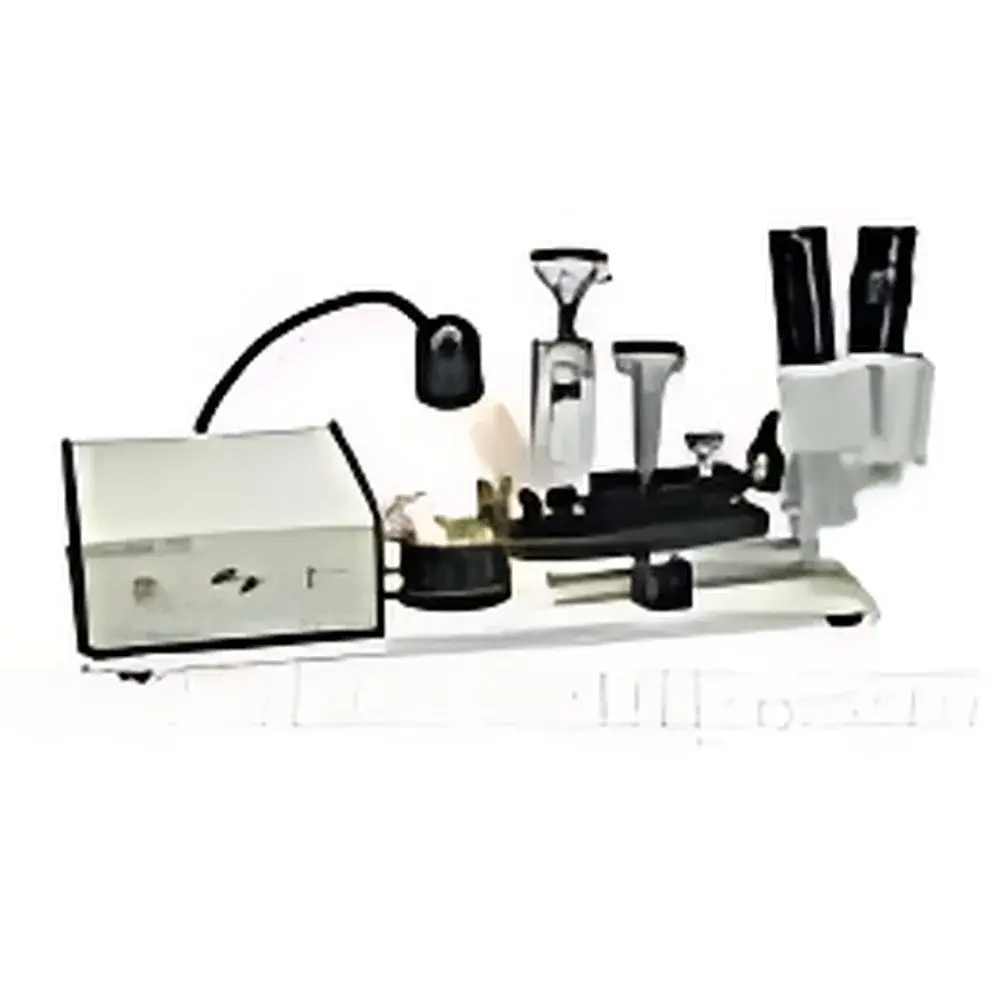
Sutter BV-10 Microelectrode Polishing System
| Brand | Sutter |
|---|---|
| Origin | USA |
| Model | BV-10 |
| Heating Elements | Platinum/Iridium wire and Tin-Lead alloy wire |
| Precision Control | Triple independent digital controllers for heat, pull force, and timing |
| Microscope Integration | Dual-objective stereo microscope (low- and high-magnification objectives for coating and polishing) |
| Construction | Corrosion-resistant chassis |
| Footprint | Compact design for benchtop integration in electrophysiology rigs |
| Application Focus | Patch-clamp electrode conditioning, intracellular microinjection, sharp electrode preparation |
Overview
The Sutter BV-10 Microelectrode Polishing System is an engineered solution for post-pull refinement of glass micropipettes used in demanding electrophysiological applications—including whole-cell patch-clamp, single-channel recording, and intracellular microinjection. Unlike passive fire-polishing methods, the BV-10 implements controlled thermal conditioning via resistive heating elements to reshape and smooth the tip geometry of pulled electrodes—reducing surface irregularities, eliminating micro-fractures, and achieving sub-0.3 µm tip uniformity. Its operation relies on precise coordination between localized resistive heating (via Pt/Ir or Sn/Pb alloy filaments), programmable tension application, and real-time visual monitoring through an integrated dual-magnification stereo microscope. This process directly enhances gigaseal formation probability, improves signal-to-noise ratio, and extends electrode functional lifetime—critical parameters in low-noise, high-resolution cellular recordings.
Key Features
- Dual-objective stereo microscope with switchable low-magnification (for electrode positioning and coating) and high-magnification (for tip inspection and polishing endpoint assessment) optics
- Triple independent digital controllers enabling simultaneous, repeatable adjustment of heating intensity, axial pull force, and dwell time—each with 0.1-unit resolution and non-volatile parameter storage
- Interchangeable heating filaments: high-stability platinum/iridium wire for high-temperature, oxidation-resistant polishing; tin-lead alloy filament for lower-temperature, rapid thermal cycling during delicate tip rounding
- Corrosion-resistant stainless steel and anodized aluminum housing designed for long-term stability in humid electrophysiology environments and compatibility with standard Faraday cages
- Benchtop footprint (24 × 18 × 22 cm) optimized for integration into crowded rig setups—fits beneath upright microscopes and adjacent to vibration-isolation tables without obstructing manipulator access
- Thermal safety interlock system with real-time filament temperature feedback and automatic cutoff at preset thresholds to prevent glass devitrification or tip collapse
Sample Compatibility & Compliance
The BV-10 accommodates borosilicate (e.g., BF150-86-10, GC150TF-10), quartz, and aluminosilicate capillaries with outer diameters from 1.0 mm to 1.5 mm and wall thicknesses up to 0.2 mm. It supports both single- and double-stage pull protocols and is routinely validated for use with Sutter P-97, P-1000, and Narishige PC-10 pullers. The system complies with IEC 61010-1:2010 for laboratory electrical equipment safety and meets electromagnetic compatibility requirements per EN 61326-1:2013. While not a medical device under FDA 21 CFR Part 820, its operational repeatability supports GLP-compliant documentation workflows when paired with Sutter’s optional LabVIEW-based logging interface.
Software & Data Management
The BV-10 operates as a stand-alone hardware platform with no embedded OS or network stack—ensuring deterministic response and eliminating firmware update dependencies. All control parameters are set via front-panel membrane switches and LED displays. For traceable protocol execution, users may integrate the unit with third-party acquisition systems (e.g., Axon pCLAMP, HEKA PatchMaster) using TTL-triggered I/O ports (BNC inputs for start/stop signals; opto-isolated outputs for status confirmation). Parameter logs—including heat level (0–100%), pull force (0–500 mN), and duration (0.1–9.9 s)—can be manually recorded or captured via external DAQ systems supporting analog voltage output (0–5 V scaling). Audit trails meet basic ALCOA+ principles when documented alongside experimental metadata in electronic lab notebooks (ELNs).
Applications
- Routine conditioning of patch pipettes prior to gigaseal formation in acute brain slice and cultured neuron preparations
- Tip optimization for sharp intracellular electrodes in in vivo neurophysiology (e.g., hippocampal CA1 recordings)
- Preparation of low-resistance, low-capacitance electrodes for high-fidelity current-clamp and voltage-clamp experiments
- Surface smoothing of ion-selective and enzyme-coated microsensors to minimize diffusion artifacts
- Reconditioning of reused electrodes in resource-constrained settings—extending usable lifespan while preserving tip geometry fidelity
FAQ
Can the BV-10 polish quartz pipettes?
Yes—the Pt/Ir filament provides sufficient thermal stability and controllability for quartz capillaries, though optimal settings require empirical calibration due to higher melting point and lower thermal conductivity compared to borosilicate.
Is calibration required before first use?
No factory calibration is needed; however, users should perform a tip-rounding validation using scanning electron microscopy (SEM) or optical tip-diameter measurement after initial setup to confirm alignment and thermal profile consistency.
Does the BV-10 support automated protocol sequencing?
No—it is intentionally designed as a manual, operator-guided instrument to maintain full tactile and visual control over the polishing endpoint—a critical requirement for electrophysiologists optimizing tip geometry on a per-experiment basis.
What maintenance does the heating filament require?
Filaments are consumables with typical lifespans of 200–500 polishing cycles depending on duty cycle and peak temperature; replacement kits (Pt/Ir and Sn/Pb variants) are available directly from Sutter Instrument Co.
Can the microscope be upgraded to include camera coupling?
Yes—the standard C-mount port accepts commercially available USB3 or GigE machine vision cameras (e.g., FLIR Grasshopper3, Basler ace) for digital tip imaging and archival—compatible with ImageJ/Fiji and NIS-Elements software platforms.