
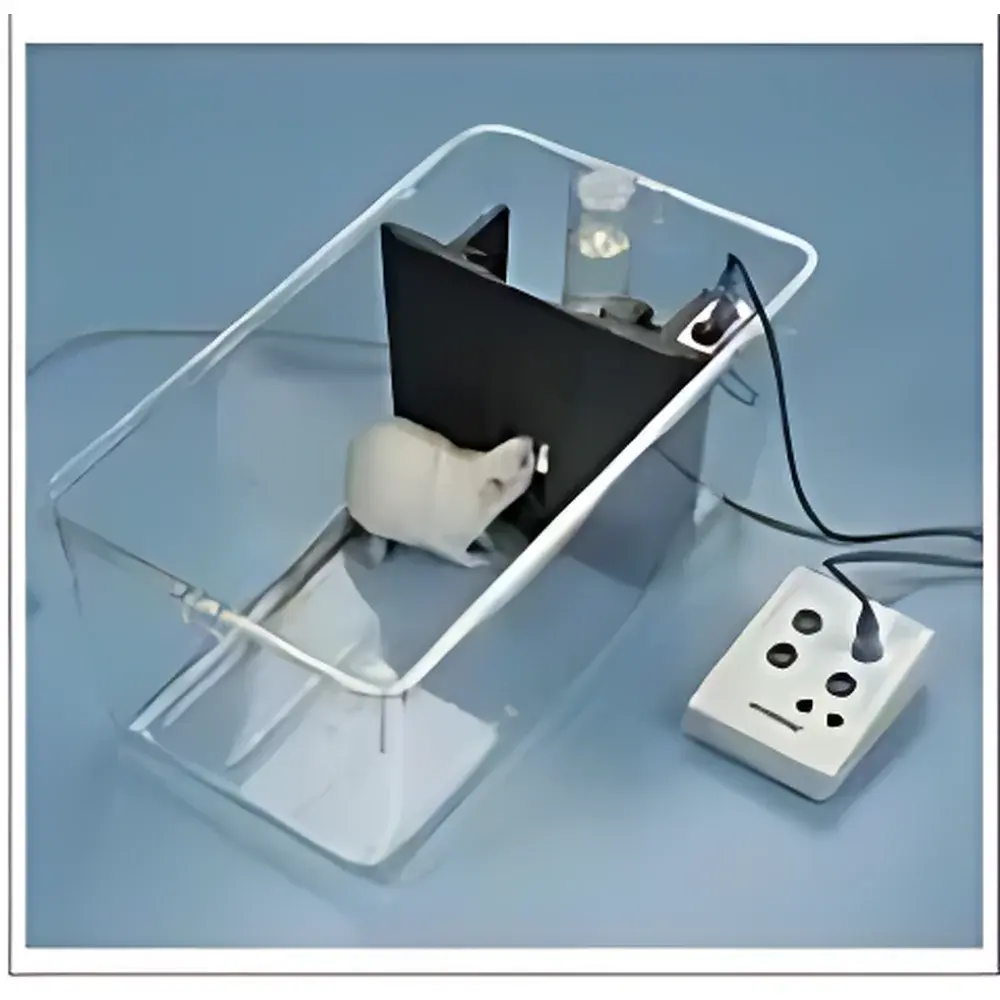
Ugo Basile Model 31300 Facial Nociception Analyzer
| Brand | Ugo Basile |
|---|---|
| Origin | Italy |
| Model | 31300 |
| Thermal Stimulation Range | Ambient Temperature to 70 °C |
| Mechanical Stimulus Levels | 5 Adjustable Force Steps |
| Data Acquisition Channels | Up to 16 Independent Cages |
| Behavioral Metrics | Feeding Duration (Min/Max/Mean), Feeding Attempts Count |
| Software Included | Yes |
Overview
The Ugo Basile Model 31300 Facial Nociception Analyzer is a specialized, non-invasive behavioral testing system engineered for quantitative assessment of orofacial nociception in rodents—primarily mice and rats. It operates on the principle of operant conflict-based paradigms, wherein animals are motivated to perform a natural behavior (feeding) under controlled aversive stimulation applied to the vibrissal pad region—the anatomical domain innervated by the maxillary division of the trigeminal nerve (V2). Unlike reflexive withdrawal assays, this system captures motivation-dependent behavioral output, offering higher translational relevance to clinical pain conditions involving affective and cognitive dimensions. The device integrates calibrated thermal and mechanical stimuli within a standardized feeding chamber, enabling concurrent evaluation of thermal hyperalgesia and mechanical allodynia/hyperalgesia without whisker trimming—a critical methodological advantage that preserves sensory integrity and avoids confounding neuroadaptive artifacts.
Key Features
- Integrated dual-modality stimulation: Precisely regulated thermal probe (ambient temperature to 70 °C, ±0.5 °C stability) and calibrated von Frey–style mechanical filament array with five discrete force levels (0.1–1.5 g range typical, traceable to ISO 13485-certified calibration protocols)
- No-whisker-trimming protocol: Designed to deliver stimuli directly to intact vibrissal follicles, maintaining physiological afferent input and minimizing procedural stress-induced modulation of baseline nociceptive thresholds
- Operant feeding assay architecture: Measures latency to initiate feeding, total feeding duration (with min/max/mean computation), and number of feeding attempts per session—behavioral endpoints validated against pharmacological controls (e.g., morphine, gabapentin, diclofenac)
- Multi-cage scalability: Supports simultaneous data acquisition from up to 16 independent home-cage–compatible test units, each with dedicated stimulus delivery and infrared beam-based feeding detection
- Real-time synchronization: All stimulus onset, behavioral event timestamps, and duration metrics are time-locked to a common internal clock with microsecond resolution, ensuring temporal fidelity for cross-animal cohort analysis
Sample Compatibility & Compliance
The Model 31300 is validated for use with C57BL/6, CD-1, Sprague-Dawley, and Wistar strains across standard age ranges (6–24 weeks). Its experimental design conforms to the principles outlined in the NIH Guide for the Care and Use of Laboratory Animals and aligns with recommendations from the International Association for the Study of Pain (IASP) regarding operant pain assessment. Data collection workflows support GLP-compliant study execution: audit trails, user access logs, and electronic signature capability are embedded within the proprietary software environment. While not FDA-cleared as a diagnostic device, the system meets essential requirements of ISO 14155:2020 (Clinical investigation of medical devices for human subjects) for preclinical model development and compound screening applications.
Software & Data Management
The included Ugo Basile Nociception Suite (v5.2+) provides full experimental control, real-time visualization, and post-hoc statistical analysis. Raw event logs (stimulus ID, timestamp, duration, cage ID, animal ID) are stored in encrypted SQLite databases compliant with ALCOA+ (Attributable, Legible, Contemporaneous, Original, Accurate, Complete, Consistent, Enduring, Available) data integrity standards. Export options include CSV, Excel, and MATLAB-compatible .mat formats. The software supports automated calculation of area-under-the-curve (AUC) for time-series feeding suppression, dose–response curve fitting (logistic 4PL), and group-wise ANOVA with Tukey’s HSD correction. Audit trail functionality complies with FDA 21 CFR Part 11 requirements when configured with role-based authentication and electronic signatures.
Applications
- Preclinical evaluation of novel analgesics targeting trigeminal neuropathic pain (e.g., TNF-α inhibitors, Nav1.7 modulators, CGRP antagonists)
- Characterization of orofacial pain phenotypes in genetically modified rodent models (e.g., Nav1.8-KO, TRPV1-KO, BDNF-overexpressing lines)
- Longitudinal monitoring of pain progression in inflammatory models (e.g., CFA-induced temporomandibular joint inflammation, infraorbital nerve chronic constriction injury)
- Behavioral pharmacokinetic–pharmacodynamic (PK–PD) correlation studies requiring high-temporal-resolution nociceptive readouts
- Validation of CNS-penetrant compounds where traditional reflex tests lack sensitivity due to sedative or motor-impairing side effects
FAQ
Is the Model 31300 compatible with automated home-cage monitoring systems?
Yes—its digital I/O interface supports TTL-level synchronization with third-party platforms including PhenoTyper, EthoVision XT, and SmartCage via programmable trigger outputs.
Can thermal and mechanical stimuli be delivered independently or only in combination?
Both configurations are supported: users may define standalone thermal-only, mechanical-only, or interleaved dual-stimulus protocols within the same session.
What is the minimum inter-trial interval required to avoid sensitization or fatigue effects?
Empirical validation indicates ≥90 minutes between successive trials per animal; the software enforces configurable inter-session lockout timers to ensure compliance.
Does the system provide hardware-level calibration certificates?
Each unit ships with a factory-issued calibration report traceable to national metrology institutes (UNI CEI EN ISO/IEC 17025 accredited), covering thermal probe accuracy and mechanical actuator force linearity.
How is animal identification managed across multi-cage experiments?
RFID reader integration (optional accessory) enables automatic animal ID logging; alternatively, manual ID entry with barcode scanning is supported through the software interface.




