
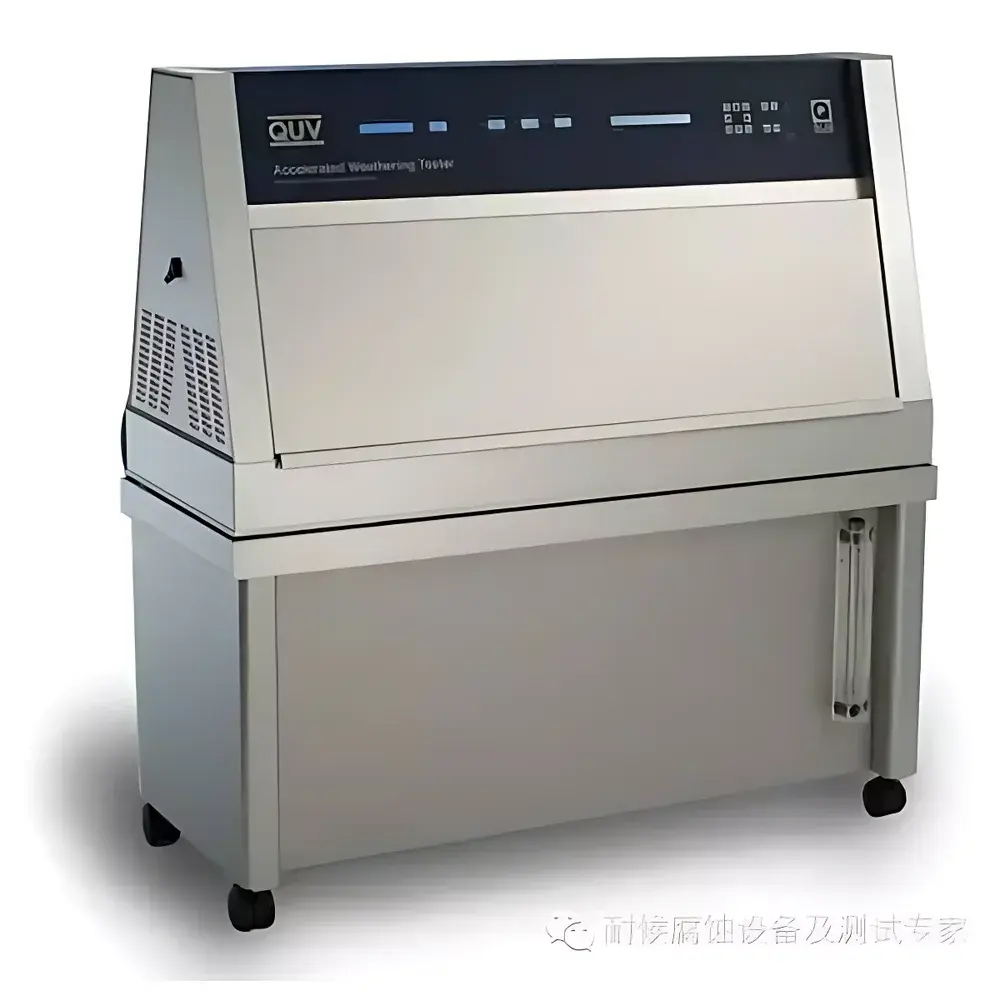
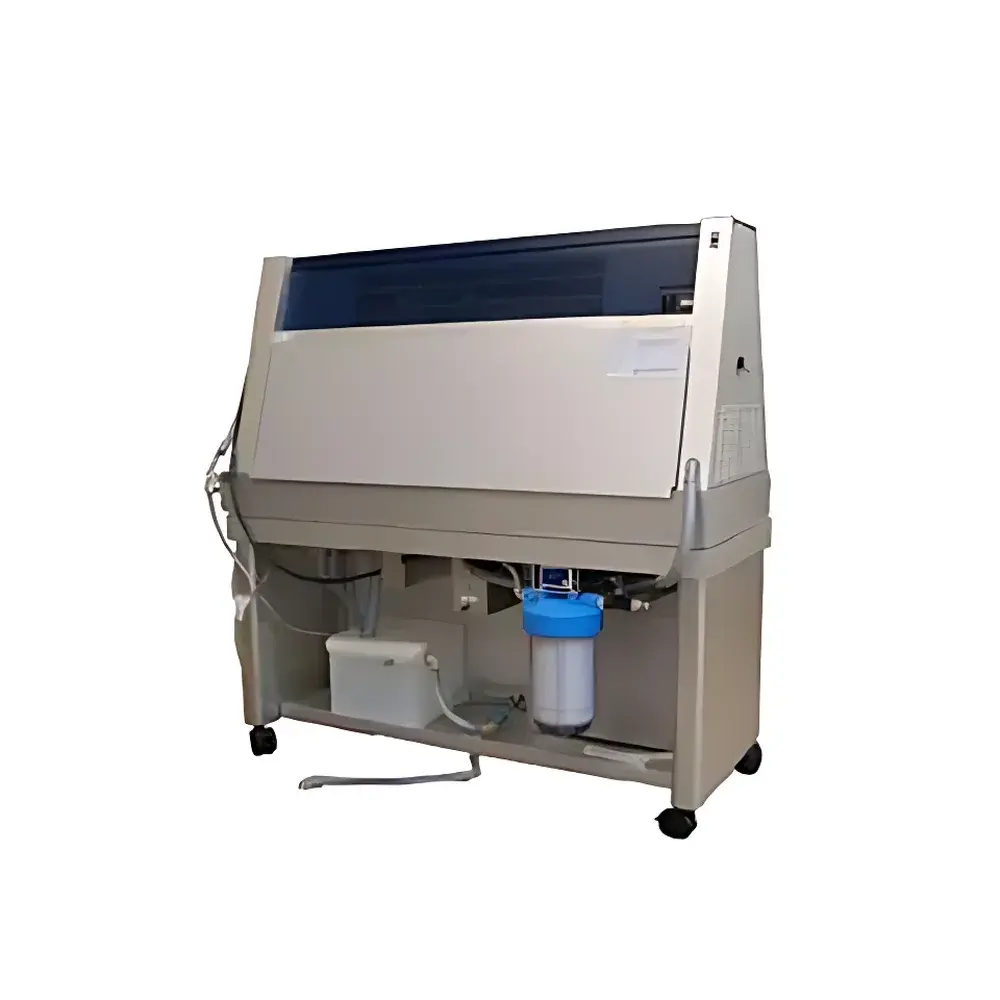
Q-LAB QUV Fluorescent UV Aging Test Chamber
| Brand | Q-LAB |
|---|---|
| Origin | USA |
| Model | QUV |
| Illumination Temperature Range | 35–80 °C |
| Black Panel Temperature Range | 35–80 °C |
| UV Wavelength Range | 320–420 nm |
| Chamber Dimensions (L×W×H) | 137 × 53 × 135 cm |
| Compliance | ISO 9000, ASTM G154, ISO 4892-3, IEC 61215, SAE J2020, AATCC TM186 |
| Lamp Type | UVA-340 or UVB-313 fluorescent lamps |
| Standard Sample Capacity | 48 × 75 mm × 150 mm specimens |
| Irradiance Control | CR-10 radiometer (traceable to NIST) |
| Power Supply | 120/230 V, 50/60 Hz, up to 1800 W |
| Water Consumption | 8 L/day (condensation), 7 L/min (spray) |
Overview
The Q-LAB QUV Fluorescent UV Aging Test Chamber is an industry-standard accelerated weathering instrument engineered for precision simulation of solar ultraviolet radiation and moisture-induced degradation mechanisms. Unlike broad-spectrum xenon arc testers, the QUV leverages calibrated fluorescent UV lamps—primarily UVA-340 (mimicking terrestrial sunlight down to 295 nm) and UVB-313 (for aggressive, high-intensity testing)—to deliver reproducible, spectrally controlled irradiance in the critical 320–420 nm range. Coupled with programmable condensation cycles (simulating overnight dew) and optional spray functionality (replicating rain exposure), the QUV enables controlled, repeatable exposure sequences that accelerate photochemical degradation pathways including polymer chain scission, pigment fading, surface oxidation, and loss of mechanical integrity. Its compact chamber architecture (137 × 53 × 135 cm internal volume) supports standardized specimen mounting per ASTM G154 and ISO 4892-3, making it a foundational tool for R&D labs, quality assurance departments, and regulatory submission testing across coatings, plastics, automotive trim, photovoltaic encapsulants, and textile industries.
Key Features
- Fluorescent UV lamp system with selectable UVA-340 or UVB-313 spectral output, compliant with ASTM G154 Cycle 1–4 and ISO 4892-3 Method A/B
- Black panel temperature control (35–80 °C) and chamber air temperature monitoring, enabling precise thermal management during irradiation and dark cycles
- Automated condensation cycle via heated water reservoir and chilled sample surface—no external chiller required
- Optional integrated spray function delivering deionized water at 7 L/min, synchronized with irradiation or dark phases per SAE J2020 or AATCC TM186 protocols
- Self-diagnostic controller with real-time fault logging, English-language alarm messages, and predictive maintenance prompts—including lamp usage tracking and automatic calibration reminders
- NIST-traceable CR-10 radiometer for irradiance measurement and ISO 9000-compliant calibration; annual recalibration required at Q-Lab facilities
- Programmable exposure profiles supporting multi-step cycles (e.g., 4 hrs UV @ 60 °C → 4 hrs condensation @ 50 °C), with end-of-test audible alert, display notification, and auto-shutdown capability
Sample Compatibility & Compliance
The QUV accommodates up to 48 standard specimens measuring 75 mm × 150 mm (3″ × 6″), mounted on aluminum sample racks that form part of the chamber’s structural boundary. Non-standard geometries—including thick molded parts, curved substrates, or irregularly shaped components—can be secured using custom fixtures without compromising airflow or irradiance uniformity. All configurations maintain compliance with ISO 4892-3 Annex B (irradiance uniformity ≥ ±15% across sample plane) and ASTM G154 Section 7.3 (minimum 0.89 W/m²/nm @ 340 nm for UVA-340 operation). The system meets GLP-relevant data integrity requirements through time-stamped event logging and user-accessible audit trails. It is routinely specified in OEM material qualification protocols (e.g., Ford CETP, GMW14872, Toyota TSL) and recognized by global certification bodies for IEC 61215 (PV module qualification) and UL 746C (polymeric materials).
Software & Data Management
The QUV operates via an embedded microprocessor-based controller with intuitive menu navigation and password-protected parameter locking. All exposure parameters—including setpoints, ramp rates, dwell times, lamp status, and CR-10 irradiance readings—are logged internally with UTC timestamps and retained for ≥12 months. Export is supported via USB flash drive in CSV format for integration into LIMS or statistical process control platforms. While native software does not support remote monitoring, the controller complies with RS-232/485 serial protocols for third-party SCADA integration. Calibration records—including CR-10 NIST traceability certificates and lamp replacement logs—are stored separately and align with FDA 21 CFR Part 11 expectations when paired with appropriate electronic signature workflows and change control documentation.
Applications
- Accelerated UV stability screening of architectural coatings, automotive clearcoats, and industrial finishes
- Photostability assessment of medical device polymers under ISO 10993-12 and USP
- Weathering validation of photovoltaic backsheet and encapsulant materials per IEC 61215 and UL 1703
- Colorfastness evaluation of textiles per AATCC TM186 and ISO 105-B02
- Failure mode analysis of outdoor signage, agricultural films, and geotextiles exposed to subtropical or desert climates
- Supporting ISO 9001 internal audit requirements for environmental stress testing capability verification
FAQ
What UV lamp types are compatible with the QUV, and how do they differ?
The QUV accepts UVA-340 lamps (spectrally matched to sunlight down to 295 nm) for realistic daylight simulation, and UVB-313 lamps for accelerated, high-energy testing. Lamp selection must align with applicable test standards—e.g., UVA-340 for ASTM D4329, UVB-313 for ASTM D4587.
Is CR-10 radiometer calibration mandatory—and why?
Yes. The CR-10 is the only radiometer validated for QUV irradiance control per ISO 4892-3. Annual recalibration at Q-Lab ensures NIST traceability and maintains compliance with ISO 9000 and internal QA procedures.
Can the QUV operate unattended over weekends?
Yes. The built-in timer supports scheduled shutdown, audible alerts, and on-screen completion messages—enabling secure long-duration exposures without operator presence.
What water quality is required for condensation and spray functions?
Deionized water (≤5 µS/cm conductivity) is required for spray; distilled or softened tap water may be used for condensation, though DI water minimizes mineral buildup on lamps and sensors.
How is temperature uniformity verified across the sample plane?
Per ASTM G154 Section 6.3, black panel thermometers are placed at nine designated positions during qualification. Uniformity must remain within ±3 °C across all points during steady-state operation.



