
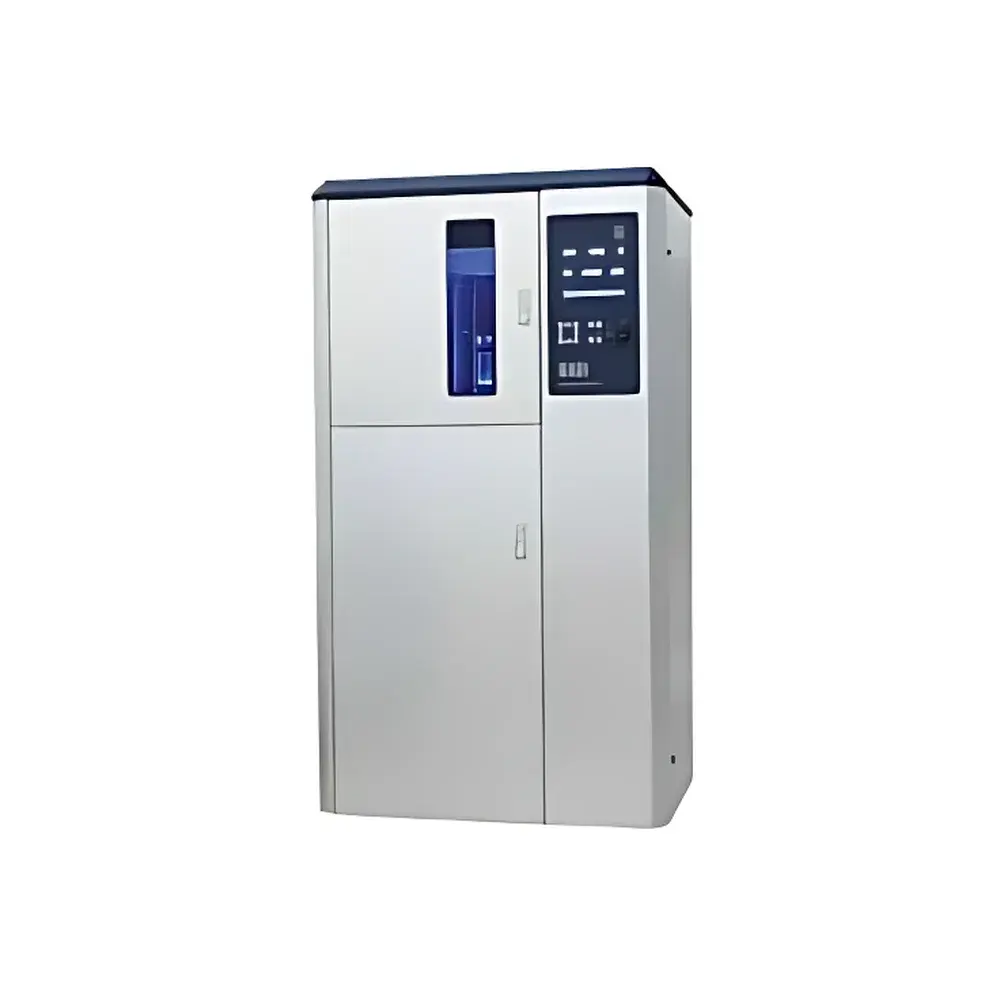
Q-LAB Q-SUN Xe-2-HS Xenon Arc Weathering Test Chamber
| Brand | Q-LAB |
|---|---|
| Origin | USA |
| Model | Q-SUN Xe-2-HS |
| Xenon Lamp Power | 1800 W |
| Cooling Type | Air-Cooled |
| Lamp Life | ~1500 hours |
| Sample Capacity | 31 specimens (46 mm × 122 mm) |
| Standard Humidity Control | Yes |
| Black Panel Temperature Control | Yes |
| Chamber Air Temperature Control | Yes |
| Optional Water Spray | Yes |
| Filter Options | Multiple ISO/AATCC-compliant daylight and extended UV filters |
Overview
The Q-LAB Q-SUN Xe-2-HS Xenon Arc Weathering Test Chamber is an air-cooled, single-lamp xenon arc exposure system engineered for precision simulation of full-spectrum solar radiation—including ultraviolet (UV), visible, and near-infrared (NIR) wavelengths—under controlled environmental conditions. Designed in accordance with the fundamental principles of accelerated weathering, it replicates natural sunlight degradation mechanisms through calibrated spectral output, enabling reproducible evaluation of material photostability, colorfastness, gloss retention, and surface integrity. Its core architecture adheres to the photometric and radiometric requirements defined in key international standards including ISO 105-B02, ISO 11341, AATCC TM 16, ASTM G155, and IEC 60068-2-9. Unlike water-cooled systems, the Xe-2-HS employs a single 1800 W air-cooled xenon lamp, reducing infrastructure dependencies while maintaining stable irradiance output over its nominal 1500-hour service life. The chamber integrates real-time irradiance monitoring via the proprietary SunEye feedback control system, which continuously adjusts lamp power to maintain user-specified irradiance setpoints—ensuring test repeatability across laboratories and time.
Key Features
- Air-cooled 1800 W xenon arc lamp with typical operational lifetime of approximately 1500 hours—minimizing cooling water infrastructure and associated maintenance overhead.
- SunEye irradiance control system providing closed-loop regulation of spectral irradiance at 340 nm or 420 nm, ensuring consistent radiant exposure and high inter-laboratory reproducibility.
- Independent, simultaneous control and digital display of chamber air temperature, relative humidity (RH), and black panel temperature—critical for simulating realistic diurnal thermal and hygric stress profiles.
- Optional water spray function activated during both light and dark cycles, delivering uniform wetting to simulate rain, dew, or condensation effects per ISO 20567-1 and ASTM D4587.
- Modular sample rack accommodating up to 31 specimens (46 mm × 122 mm); quick-release design enables tool-free installation and removal for high-throughput testing.
- Interchangeable optical filter assemblies—including Daylight-Q/B, Extended UV-Q/B, and Window Glass-Q/B—enabling compliance with diverse standard-specific spectral requirements.
Sample Compatibility & Compliance
The Q-SUN Xe-2-HS supports standardized specimen geometries required by textile, automotive, coatings, and polymer industries. Its sample carriage accommodates ISO 105-B02 face masks (full- and half-height variants), AATCC TM 16-3 paper masks, blue wool references (ISO 105-B04), photographic frames, and custom-mounted substrates. All accessory racks—including XR-11316-K (half-height ISO masks), XR-11376-K (half-height Method 2 masks), and XR-11229-K (AATCC TM 16-3 paper masks)—are manufactured to dimensional tolerances specified in relevant test methods. The system meets essential regulatory expectations for method validation under GLP environments and supports audit-ready documentation when paired with Q-LAB’s optional data logging and electronic signature modules compliant with FDA 21 CFR Part 11.
Software & Data Management
While the Xe-2-HS operates via an intuitive front-panel interface with dedicated parameter keys and real-time numeric displays, it interfaces seamlessly with Q-LAB’s optional Q-SUN Software Suite for enhanced traceability and workflow integration. This software enables automated test scheduling, remote status monitoring, export of irradiance history logs, and generation of calibration-certified reports aligned with ISO/IEC 17025 documentation practices. All temperature, humidity, and irradiance data points are timestamped and stored with configurable retention policies. When deployed in regulated QC/QA settings, the system supports role-based access control, electronic signatures, and immutable audit trails—facilitating compliance with GMP and ISO 9001 quality management frameworks.
Applications
This instrument is routinely deployed in textile laboratories for colorfastness-to-light testing per ISO 105-B02 and AATCC TM 16; in automotive R&D for evaluating dashboard trim, exterior seals, and interior fabrics against SAE J2412 and GMW 14124; and in paint & coating development for assessing chalking, cracking, and gloss loss per ASTM D4587 and ISO 11341. It also serves pharmaceutical packaging stability studies requiring UV-induced degradation profiling, as well as conservation science applications where pigment fading kinetics must be quantified under spectrally accurate illumination.
FAQ
What standards does the Q-SUN Xe-2-HS support out-of-the-box?
It natively supports ISO 105-B02, ISO 11341, AATCC TM 16 (Methods 1–3), ASTM G155, and IEC 60068-2-9—subject to correct filter selection and calibration.
Is black panel temperature measurement included as standard?
Yes—both black panel and chamber air temperature sensors are integrated and independently controllable.
Can the water spray function operate during dark cycles?
Yes—the spray system is programmable to activate in both irradiation and non-irradiation phases, replicating cyclic wet/dry exposure.
How is irradiance uniformity validated across the sample plane?
Q-LAB provides a certified irradiance mapping report upon installation, confirming ±15% spatial uniformity across the exposure area per ASTM G155 Annex A3.
What maintenance intervals are recommended for the xenon lamp and filters?
Lamp replacement is advised at ~1500 hours; optical filters require periodic inspection and replacement every 1,000–2,000 hours depending on cumulative irradiance dose and ambient contamination levels.



