
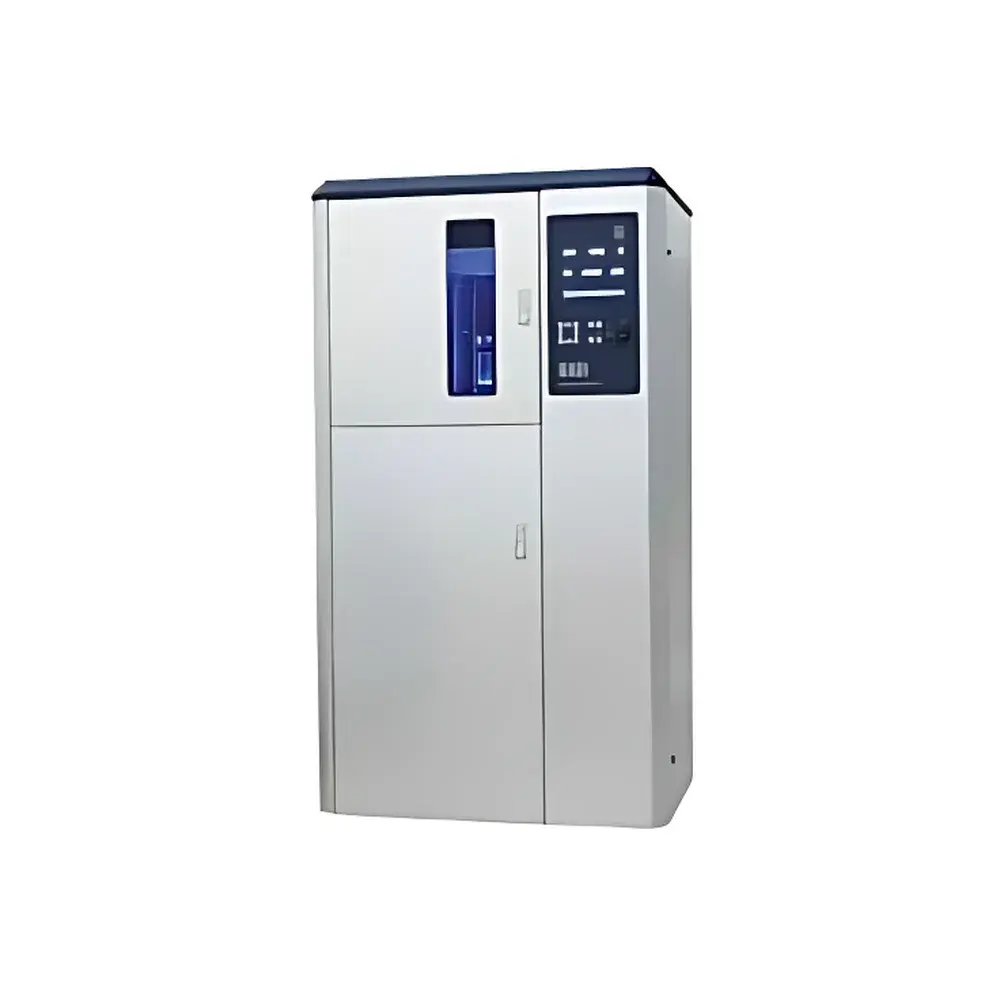
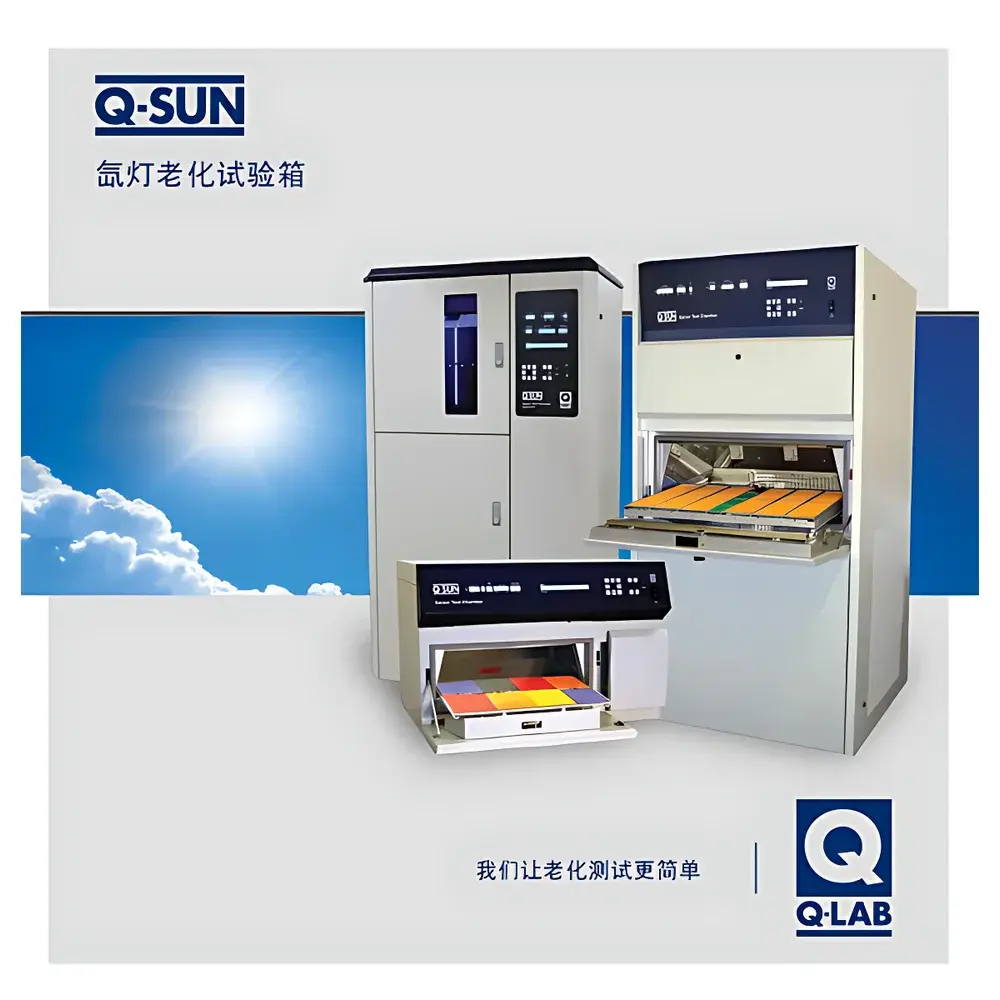
Q-Lab Q-Sun Xe-3-hbs Xenon Arc Weathering Test Chamber
| Brand | Q-LAB |
|---|---|
| Origin | USA |
| Model | Xe-3-hbs |
| Lamp Type | Triple 1800 W Xenon Arc Lamps |
| Sample Area | 3250 cm² (451 mm × 718 mm Tray) |
| Lamp Life | ≥1500 h |
| Irradiance Control | SOLAR EYE® Broadband or Narrowband (340 nm, 420 nm, TUV) |
| Humidity Control | Standard |
| Water Spray | Optional |
| Filter Systems | Daylight, Window Glass, Extended UV |
| Compliance | ASTM G151, ASTM G155, ISO 4892-2, ISO 105-B02/B04/B06, AATCC TM16, GB/T 8427–2013 |
Overview
The Q-Lab Q-Sun Xe-3-hbs Xenon Arc Weathering Test Chamber is a high-capacity, full-spectrum accelerated weathering instrument engineered for precise simulation of solar radiation, temperature, and moisture exposure. It employs three independently operated 1800 W xenon arc lamps to deliver reproducible irradiance across the ultraviolet (UV), visible, and near-infrared (NIR) spectrum—closely matching terrestrial sunlight under AM1.5 conditions. This spectral fidelity is critical for evaluating photodegradation mechanisms in organic materials, especially where color shift, chalking, gloss loss, or polymer chain scission are primary failure modes. Unlike narrowband UV fluorescent systems, the Xe-3-hbs enables testing under full-spectrum irradiation required by international standards for textile colorfastness (e.g., ISO 105-B series), automotive exterior materials (SAE J2527), and architectural coatings (ASTM D4355). Its large 451 mm × 718 mm horizontal sample tray accommodates up to 55 standard specimen holders and supports three-dimensional specimens—including molded parts, panels, and assembled components—without reorientation.
Key Features
- Triple 1800 W xenon arc lamp system with integrated SOLAR EYE® irradiance monitoring and feedback control, ensuring stable output at user-selected wavelengths (340 nm, 420 nm, or total UV)
- Full-spectrum daylight-filtered irradiance compliant with CIE 85:1989 and ISO 4892-2 spectral power distribution requirements
- Standard relative humidity control (10–95% RH, ±3% RH accuracy) with optional water spray function for cyclic wet/dry exposure
- Durable, field-replaceable optical filters including Daylight-Q/B, Window Glass-Q/B, and Extended UV configurations—each certified to maintain spectral integrity over ≥1500 h of operation
- Robust stainless-steel chamber construction with insulated double-wall housing and precision-balanced air circulation for uniform thermal distribution (±1.5°C stability)
- Integrated black panel thermometer (BPT) and optional white panel thermometer (WPT) for real-time surface temperature monitoring per ASTM G151
Sample Compatibility & Compliance
The Xe-3-hbs supports flat, curved, and volumetric samples up to 50 mm in height on its motorized, horizontally oriented sample tray. Its 3250 cm² exposure area meets the dimensional requirements of ISO 105-B02 (textile colorfastness to artificial light), ASTM D4355 (plastics outdoor exposure), and PV 3929 (automotive interior materials). The chamber is validated for conformance to IEC 60068-2-5 (radiation testing), JIS L0843 (Japanese textile standards), and GB/T 8427–2013 (Chinese textile colorfastness specification). All filter configurations comply with the spectral bandpass definitions in ISO 4892-2 Annex A and ASTM G155 Table 1. For regulated industries, the system architecture supports audit-ready data logging and user access control when integrated with Q-Lab’s Q-Sun Software v5.x, facilitating GLP/GMP-aligned test execution per FDA 21 CFR Part 11 requirements.
Software & Data Management
Q-Sun Software v5.x provides centralized control of irradiance setpoints, temperature/humidity profiles, spray cycles, and test duration. Real-time graphs display irradiance drift, chamber ambient conditions, and BPT/WPT trends. All operational parameters—including lamp hours, filter usage history, calibration dates, and user login events—are timestamped and stored in encrypted binary logs. Export options include CSV and PDF reports with embedded metadata for traceability. The software includes preloaded test methods aligned with ASTM G155 Cycle 1–10, ISO 105-B04, and AATCC TM16 Option III, reducing method setup time and minimizing procedural error. Remote monitoring via Ethernet or optional Wi-Fi enables secure off-site supervision without compromising data integrity.
Applications
The Xe-3-hbs serves as a primary tool for R&D and quality assurance laboratories evaluating material durability across diverse sectors: textile manufacturers use it for ISO 105-B02/B04 colorfastness validation; automotive Tier 1 suppliers perform SAE J2412/J2527 exterior component qualification; paint and coating developers assess chalk resistance per ASTM D4355; and photovoltaic module producers conduct IEC 61215 UV preconditioning. Its large capacity also supports batch-level screening of roofing membranes (ASTM D4354), packaging films (ISO 11341), and medical device polymers (ISO 10993-12). In academic research, the system supports mechanistic studies on photooxidation kinetics, pigment stabilization, and UV absorber efficacy under controlled environmental stressors.
FAQ
What standards does the Q-Sun Xe-3-hbs support for textile colorfastness testing?
It fully complies with ISO 105-B02, ISO 105-B04, ISO 105-B06, AATCC TM16 (Option III), and GB/T 8427–2013, using Daylight-Q/B or Window Glass-Q/B filters depending on application.
Is irradiance calibration traceable to NIST standards?
Yes—Q-Lab provides factory calibration certificates traceable to NIST via accredited third-party radiometric laboratories, with recommended recalibration every 12 months or after 1500 lamp hours.
Can the Xe-3-hbs operate without humidity control?
Yes; RH control is standard but can be disabled programmatically. However, most weathering standards (e.g., ISO 4892-2, ASTM G155) mandate defined humidity cycles for valid compliance.
What maintenance intervals are recommended for the xenon lamps and filters?
Lamps require replacement after ≥1500 h or when irradiance output falls below 90% of initial value; filters should be inspected quarterly and replaced after 2000 h or if visibly degraded.
Does the system support automated pass/fail evaluation against color difference thresholds (e.g., ΔE* ≤ 2.0)?
No—the Xe-3-hbs performs exposure only; post-test colorimetric analysis requires integration with a spectrophotometer (e.g., Konica Minolta CM-700d) and compatible software such as Q-Lab’s Q-Panel Color Analysis Module.



