
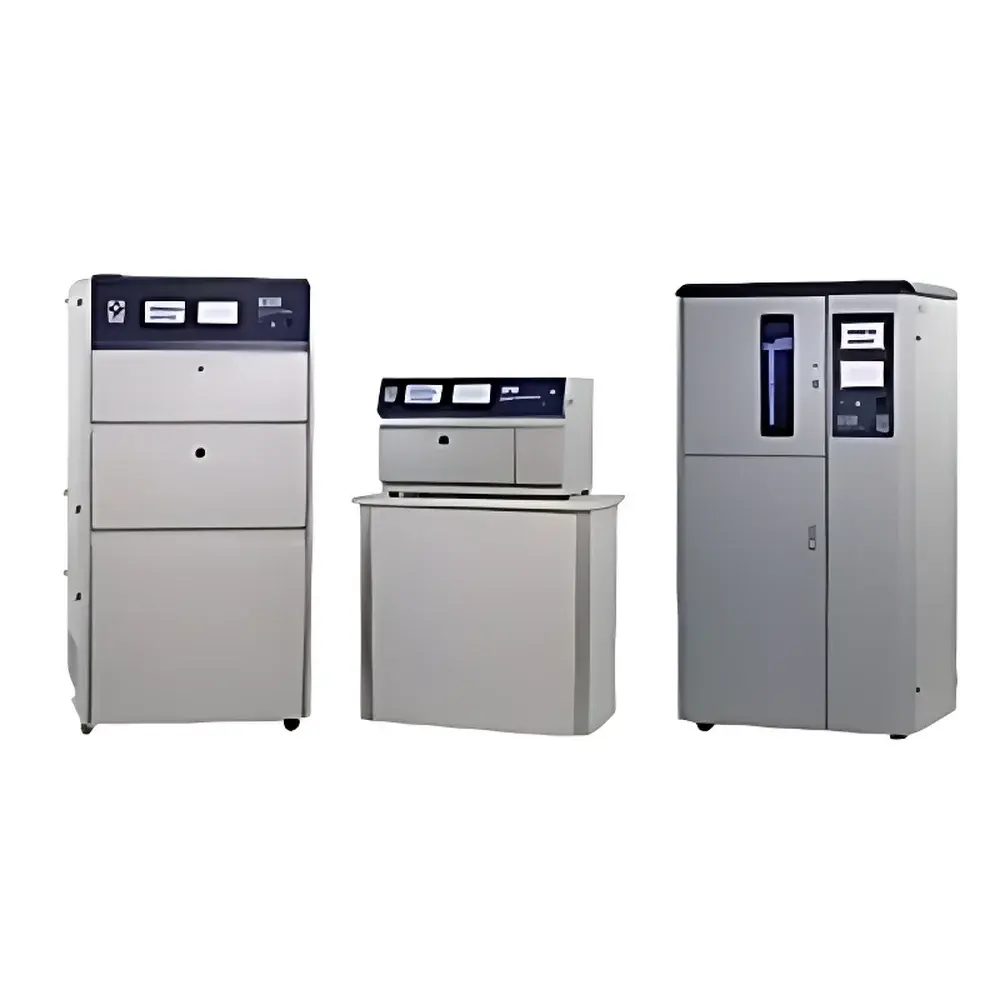
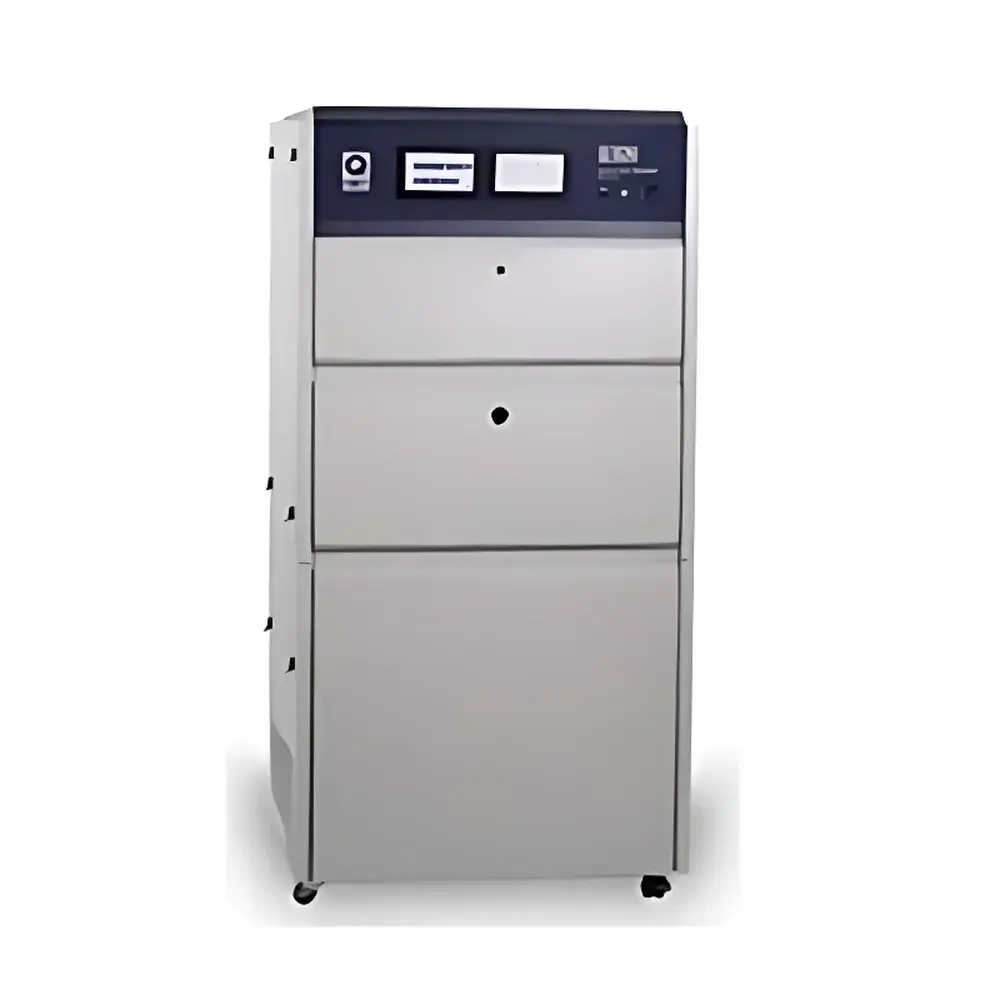
Q-LAB Q-SUN Xe-3-HC Xenon Arc Weathering Test Chamber
| Brand | Q-LAB |
|---|---|
| Origin | USA |
| Model | Q-SUN Xe-3-HC |
| Xenon Lamp Power | 1800 W |
| Irradiance Range | ≤1800 W/m² |
| Light Exposure Duration | 1–9999 h (continuously adjustable) |
| Relative Humidity Range | 20–95% RH |
| Black Panel Temperature Range | 42–120 °C (dependent on sensor type, irradiance level, filter configuration, lamp age, and ambient conditions) |
| Sample Capacity | 55 positions (51 × 102 mm per sample) |
| Cooling System | Integrated refrigerated cooling unit |
| Control Interface | Multi-language (English, French, Spanish, Italian, German), Ethernet-enabled, SOLAR EYE irradiance feedback control (340 nm, 420 nm, or TUV band) |
Overview
The Q-LAB Q-SUN Xe-3-HC Xenon Arc Weathering Test Chamber is an advanced, full-spectrum accelerated weathering instrument engineered for high-fidelity simulation of natural sunlight exposure. It employs three independently operated 1800 W xenon arc lamps to replicate the solar spectrum across ultraviolet (UV), visible, and near-infrared (NIR) wavelengths—spanning approximately 295–800 nm—with spectral fidelity validated against global reference solar irradiance data (ASTM G155, ISO 4892-2). Unlike narrowband UV-only testers, the Xe-3-HC enables photodegradation studies where long-wave UV-A, visible light, and thermal IR components critically influence material response—particularly in color stability, gloss retention, polymer embrittlement, and cosmetic/pharmaceutical formulation integrity. Its integrated refrigerated cooling system, dual black panel and chamber air temperature control, and precision humidity regulation (20–95% RH) allow rigorous decoupling of radiant heat load from test specimen thermal history—a requirement for ISO 105-B02, AATCC TM 16, and USP compliant stability protocols.
Key Features
- Triple 1800 W xenon arc lamp array with real-time SOLAR EYE irradiance monitoring and closed-loop control at user-selectable wavelengths (340 nm, 420 nm, or TUV band)
- Independent black panel temperature control (42–120 °C) and chamber air temperature regulation, enabling precise thermal management for heat-sensitive substrates
- Integrated refrigeration-based cooling system eliminating reliance on ambient airflow or external chillers
- Humidity control over 20–95% RH with programmable wet/dry cycles, supporting ASTM G155 Cycle 1–10 and ISO 11341 spray-integrated protocols
- 55-position sample capacity accommodating standard 51 × 102 mm specimens; compatible with industry-standard sample holders and multi-angle mounting fixtures
- Multi-language touchscreen controller (English, French, Spanish, Italian, German) with built-in diagnostics, service scheduling, and safety shutdown logic
- Ethernet connectivity supporting remote monitoring, automated data logging, and secure firmware updates
Sample Compatibility & Compliance
The Q-SUN Xe-3-HC accommodates rigid and flexible flat-panel specimens—including textiles, automotive trim, architectural coatings, medical device packaging, pharmaceutical blister foils, and cosmetic emulsion containers—without requiring custom fixtures. Its chamber geometry and lamp-to-sample distance ensure uniform irradiance distribution per ASTM G155 Annex A1 (±15% spatial uniformity across test plane). The system complies with international standards governing lightfastness, weathering resistance, and photostability testing, including ISO 4892-1 & -2, ISO 105-B02/B04/B06, AATCC TM 16/169, SAE J2412/J2527, IEC 60068-2-5, GB/T 8427–2013, and PV 1303. For regulated environments, the controller supports audit-trail generation, user-access level management, and electronic signature capability—facilitating alignment with FDA 21 CFR Part 11 and GLP/GMP documentation requirements when paired with validated software configurations.
Software & Data Management
The embedded controller logs irradiance (W/m²), black panel temperature (°C), chamber air temperature (°C), relative humidity (% RH), elapsed exposure time (h), and cycle phase status at user-defined intervals (1 s to 60 min resolution). Data export is supported via USB flash drive or Ethernet to Windows-based systems using Q-Lab’s optional “Virtual Strip Chart” software—enabling real-time plotting, statistical trend analysis, and automatic report generation in PDF or CSV format. Logged datasets include timestamped metadata (operator ID, test method ID, calibration certificate traceability), ensuring full chain-of-custody for regulatory submissions. Remote diagnostics are enabled through encrypted email transmission of system logs directly to Q-Lab Technical Support, reducing mean time to resolution for field issues.
Applications
This instrument serves laboratories conducting comparative durability assessments for OEMs and suppliers in automotive (interior/exterior trim, headlamp lenses), aerospace (composite surface coatings), textiles (colorfastness to light per ISO 105-B02), consumer electronics (display laminates, housing polymers), pharmaceuticals (photostability per ICH Q1B), and cosmetics (emulsion packaging integrity under tropical conditions). Its ability to maintain stable black panel temperatures below 60 °C during high-irradiance exposures makes it suitable for evaluating thermally labile actives and biopolymer matrices where conventional xenon testers induce non-representative thermal degradation pathways.
FAQ
What spectral filters are available for the Q-SUN Xe-3-HC?
Standard filter options include Daylight-Q, Window-Q, and Extended UV-Q, each designed to match specific terrestrial solar transmission profiles (e.g., unfiltered daylight, through-window exposure, or enhanced UV stress). Filter selection directly affects irradiance distribution and must be documented per test method requirements.
Does the Xe-3-HC support cyclic testing with moisture?
Yes—it integrates programmable water spray (front-only or front-and-back nozzles), condensation, and humidity hold phases synchronized with irradiance and temperature profiles per ASTM G155 Cycle 3 (light + spray) and Cycle 7 (light + condensation).
How is irradiance calibrated and maintained?
Calibration uses NIST-traceable reference sensors; SOLAR EYE continuously adjusts lamp power to maintain setpoint irradiance within ±5% tolerance. Annual recalibration by authorized Q-Lab service engineers is recommended for ISO/IEC 17025-compliant operations.
Is the system compliant with FDA 21 CFR Part 11?
When configured with validated software, electronic signatures, and audit-trail logging enabled, the system meets foundational Part 11 requirements. Full compliance requires site-specific validation documentation and procedural controls administered by the end-user laboratory.
What maintenance is required between test cycles?
Lamp replacement every 1,500–2,000 hours, quartz filter cleaning after each 500-hour cycle, and annual verification of humidity sensor accuracy and refrigeration system performance are standard preventive actions outlined in the operator manual.



