
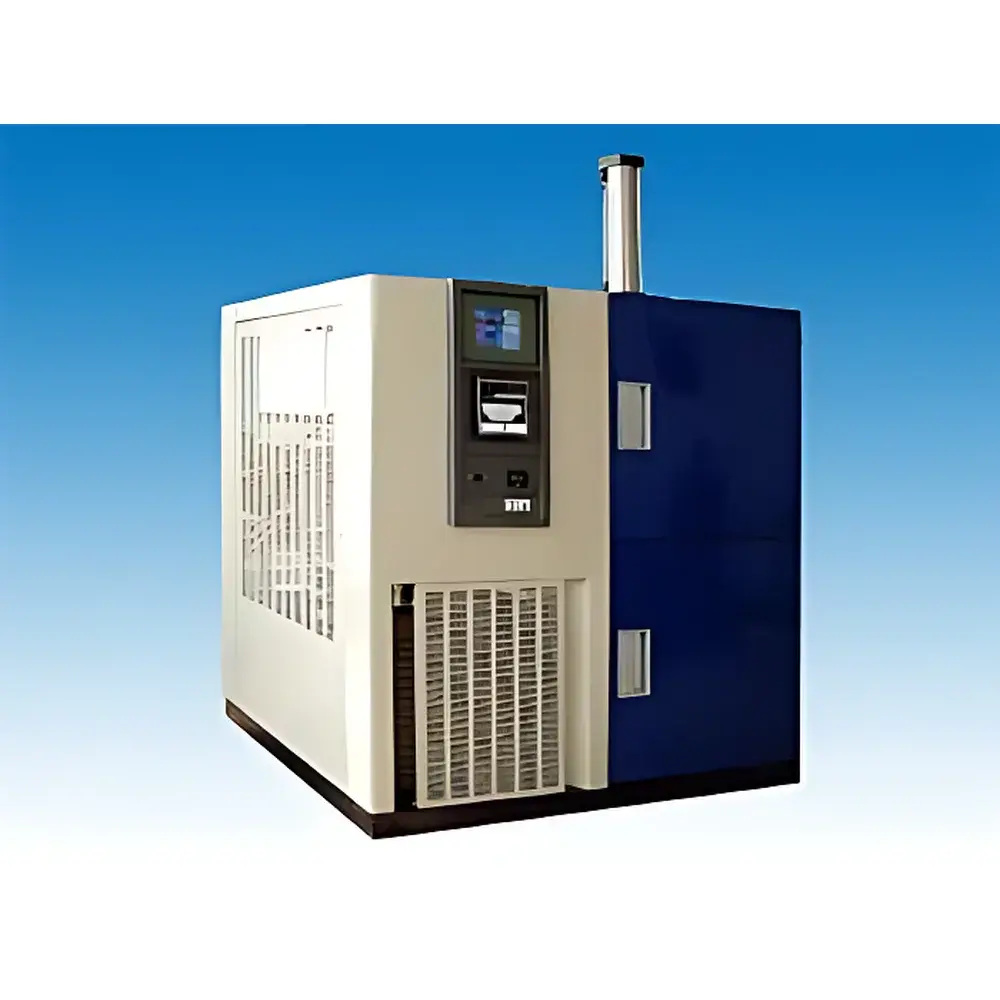
LabCompanion CTS-1 Dual-Chamber Thermal Shock Test Chamber
| Brand | LabCompanion |
|---|---|
| Origin | Guangdong, China |
| Manufacturer Type | Original Equipment Manufacturer (OEM) |
| Model | CTS-1 |
| Pricing | Upon Request |
| Chamber Configuration | Two-Zone Vertical Basket Transfer Design |
| Temperature Range | −55 °C to +120 °C (Exposure Zone) |
| High-Temp Zone | +60 °C to +180 °C |
| Low-Temp Zone | +10 °C to −70 °C |
| Temperature Uniformity | ±1 °C |
| Transition Time (Basket Transfer) | ≤10 s |
| Temperature Recovery Time | ≤5 min |
| Heating System | Sheathed NiCr Wire |
| Cooling System | Air-Cooled Dual-Stage Cascade Refrigeration (2 × 3 HP Tecumseh/Tecumseh-derived compressors) |
| Air Circulation | Centrifugal Forced Convection |
| Controller | Honeywell IP2000 Touchscreen HMI (5.7" LCD, Chinese/English UI, Programmable Logic-Based Sequencing) |
| Sensor | Pt100 RTD |
| Cabinet Material | Powder-Coated Cold-Rolled Steel (Exterior), SUS304 Stainless Steel (Interior) |
| Power Supply | 380 V, 50 Hz, 16 kW |
| Dimensions (W×D×H) | 1010 × 1390 × 1350 mm |
| Exposure Chamber Volume | 2 × 94.2 L (450 × 450 × 460 mm each) |
| Basket Size | 250 × 250 mm |
| Safety Protections | Overcurrent, Ground Fault, Compressor High-Pressure/Low-Pressure, Overtemperature, Leakage Current, Short-Circuit, and Audible Alarm |
Overview
The LabCompanion CTS-1 Dual-Chamber Thermal Shock Test Chamber is an industrial-grade environmental stress screening (ESS) system engineered for rapid, repeatable thermal transition testing of electronic components, aerospace hardware, automotive modules, and advanced composite materials. It operates on the principle of abrupt thermal displacement—transferring test specimens between two thermally isolated chambers via a pneumatically actuated basket—to induce controlled thermal gradients that accelerate failure mechanisms associated with coefficient-of-thermal-expansion (CTE) mismatch, interfacial delamination, solder joint fatigue, and microcrack propagation. Unlike single-chamber ramp-based systems, the CTS-1’s dual-zone architecture enables true step-change exposure with minimal thermal inertia, delivering high-fidelity simulation of real-world operational extremes such as aircraft ascent/descent cycles or outdoor electronics subjected to diurnal ambient swings.
Key Features
- Dual-zone vertical configuration: independent high-temperature (+60 °C to +180 °C) and low-temperature (+10 °C to −70 °C) chambers aligned along a single vertical axis for gravity-assisted, low-vibration specimen transfer.
- Pneumatic basket actuation with ≤10-second dwell-to-dwell transfer time and ≤5-minute temperature recovery—meeting critical requirements for MIL-STD-810H Method 503.5 and IEC 60068-2-14 validation protocols.
- Honeywell IP2000 programmable touchscreen controller featuring ladder-logic sequencing, multi-step profile definition, real-time data logging (time-stamped temperature vs. chamber zone), and password-protected parameter locking for audit compliance.
- Air-cooled dual-stage cascade refrigeration system using two 3 HP compressors, enabling stable operation at −70 °C without liquid nitrogen dependency—reducing long-term operating costs and infrastructure complexity.
- Forced-air circulation via backward-curved centrifugal fans ensures ±1 °C temperature uniformity across the full exposure volume (94.2 L per chamber), verified per ASTM E741 and ISO 16750-4 calibration guidelines.
- Comprehensive safety architecture including dual redundant Pt100 sensors, compressor high/low pressure cutouts, ground fault interruption, overcurrent protection, and audible/visual alarm escalation—certified to IEC 61000-6-2/6-4 EMC standards.
Sample Compatibility & Compliance
The CTS-1 accommodates specimens up to 250 × 250 mm in footprint and supports both bare PCBs and fully assembled modules mounted on standard test fixtures. Its stainless-steel interior (SUS304) resists corrosion from outgassing organics and residual flux residues, making it suitable for pre-conditioning prior to HALT/HASS or qualification per JEDEC JESD22-A104F. The chamber meets structural and operational requirements referenced in MIL-STD-202G (Method 107), IPC-9701A (Thermal Cycling Performance), and AEC-Q200 Rev D for passive component stress testing. While not inherently certified to UL 61010-1 or CE Machinery Directive, its electrical and mechanical design aligns with essential health and safety requirements when installed per manufacturer-specified clearances and grounding protocols.
Software & Data Management
Data acquisition is natively handled by the Honeywell IP2000 controller, which records timestamped chamber temperatures (high/low zones), basket position status, and system alarms at user-configurable intervals (1–60 seconds). Export is supported via USB 2.0 to CSV format for post-processing in MATLAB, Python Pandas, or statistical process control (SPC) platforms. Optional RS485 Modbus RTU or Ethernet/IP interfaces enable integration into centralized MES or SCADA environments for traceability under ISO 9001:2015 or IATF 16949 quality management systems. Audit trails—including operator login events, profile edits, and emergency stop activations—are retained for ≥30 days and comply with basic GLP documentation expectations; full 21 CFR Part 11 compliance requires third-party validation packages and digital signature implementation.
Applications
- Qualification testing of BGA, QFN, and wafer-level CSP packages per JEDEC J-STD-020D.1 moisture sensitivity level (MSL) preconditioning workflows.
- Reliability screening of EV battery modules, power inverters, and ADAS sensor housings exposed to rapid cabin-to-ambient transitions.
- Material compatibility assessment for conformal coatings, potting compounds, and thermal interface materials (TIMs) under repeated thermal cycling.
- Failure analysis root cause isolation in MEMS devices, optical assemblies, and hermetic ceramic packages where thermal shock induces seal leakage or lens misalignment.
- Process validation support for reflow soldering line setup, especially for mixed-technology boards combining lead-free and legacy SnPb terminations.
FAQ
What is the minimum specimen mass the CTS-1 can reliably test without affecting thermal recovery performance?
The chamber is optimized for specimens weighing between 0.1 kg and 15 kg. Loads below 0.5 kg may exhibit faster apparent recovery due to low thermal mass, but validation per IEC 60068-2-14 requires representative mass loading—typically ≥3 kg for production-level qualification.
Can the CTS-1 operate continuously for extended thermal shock profiles (e.g., 1,000 cycles)?
Yes. With scheduled maintenance (compressor oil inspection every 2,000 hours, refrigerant leak checks quarterly), the system supports uninterrupted operation for >5,000 cycles. The pneumatic transfer mechanism has demonstrated >100,000 actuation cycles in accelerated life testing.
Is remote monitoring supported out-of-the-box?
Basic remote status viewing (chamber temps, runtime, alarm flags) is enabled via built-in web server on the Honeywell controller. Full remote control and historical data access require optional secure VPN tunneling and IT department coordination.
Does the system include calibration certificates traceable to NIST or equivalent national metrology institutes?
Factory calibration is performed using NIST-traceable Pt100 reference probes. A certificate of conformance (CoC) is provided with shipment; formal ISO/IEC 17025 calibration reports are available as a value-added service upon request.
How does the CTS-1 handle condensation during low-temperature exposure phases?
The system employs dew-point-controlled purge air injection during basket retraction and integrated drain traps in the cold chamber base—preventing ice accumulation on basket rails and sensor surfaces without requiring manual defrost cycles.



