
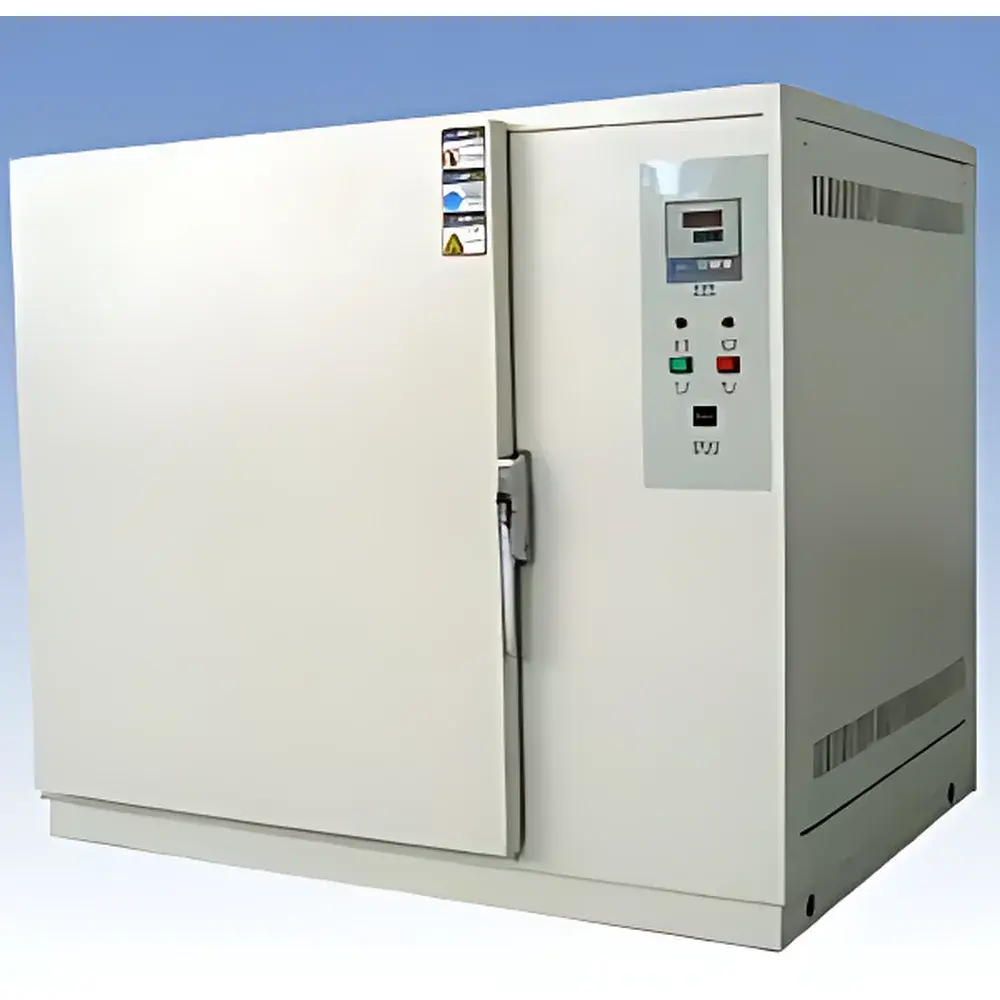
LabCompanion DGF Series Forced-Convection Hot Air Oven
| Brand | LabCompanion |
|---|---|
| Model | DGF |
| Type | Forced-Convection Constant-Temperature Drying Oven |
| Temperature Range | R.T.+10°C to 300°C (DGF 3002B–3006B) |
| Temperature Uniformity | ±2.5% |
| Temperature Fluctuation | ±0.5°C (≤±1°C for higher-range models) |
| Heating Method | Nickel-Chromium Alloy Heaters |
| Control System | Microprocessor-Based PID Controller with PT100 Sensor |
| Timer Range | 0–999 min |
| Internal Volume | 110–640 L |
| Power Supply | AC 220 V / 50 Hz or AC 380 V / 50 Hz |
| Construction | Inner Chamber – SUS304 Stainless Steel (BN variants) or Pre-treated Cold-Rolled Steel (N variants) |
| Safety Features | Independent Over-Temperature Protection Circuit |
| Compliance | JB/T 5520–1991 Technical Specification for Drying Ovens |
| Optional Accessories | Programmable Temperature Controller, RS232/RS485 Interface, Chart Recorder, Additional Shelves, Observation Window, Φ50 Cable Port, Casters (4), Two Standard Shelves, User Manual |
Overview
The LabCompanion DGF Series Forced-Convection Hot Air Oven is an industrial-grade laboratory drying and thermal processing system engineered for precision, repeatability, and long-term operational stability. Designed in accordance with JB/T 5520–1991 — the Chinese national standard governing performance, safety, and construction requirements for laboratory drying ovens — this series employs forced-air circulation via a rear-mounted centrifugal blower to ensure uniform heat distribution across the working chamber. The principle of convective heat transfer enables consistent thermal exposure of non-flammable, non-explosive samples during drying, baking, sterilization, curing, aging, and low-temperature heat treatment applications. Its temperature control architecture integrates a Class A PT100 platinum resistance thermometer with a microprocessor-based PID algorithm, supporting both manual tuning and auto-tuning modes to maintain setpoint accuracy under varying load conditions and ambient fluctuations.
Key Features
- Forced convection airflow system with adjustable blower speed (standard configuration), ensuring rapid thermal equilibration and minimal spatial temperature gradients (±2.5% uniformity)
- Microprocessor-controlled PID temperature regulation with real-time LED display of both setpoint and actual chamber temperature
- Dual-stage safety architecture: primary control loop + independent mechanical over-temperature cut-off switch (fail-safe design per IEC 61000-6-2 EMI immunity guidelines)
- High-efficiency insulation using layered ultra-fine glass wool or mineral rock wool, minimizing external surface temperature rise and energy consumption
- Modular chamber construction with corrosion-resistant SUS304 stainless steel (BN models) or high-strength pre-treated cold-rolled steel (N models), suitable for repeated thermal cycling
- Standard equipment includes four locking casters, two adjustable stainless-steel shelves, and a comprehensive user manual compliant with ISO/IEC 17025 documentation requirements
- Timer function supports unattended operation up to 999 minutes with automatic shutdown upon completion
Sample Compatibility & Compliance
The DGF oven accommodates a broad range of non-hazardous solid and semi-solid specimens, including electronic components (LEDs, LCD panels, quartz crystals, capacitors, resistors), polymer films, pharmaceutical excipients, food-grade powders, ceramic precursors, and coated substrates. It is routinely deployed in GLP-compliant quality control laboratories for residual solvent removal, moisture content stabilization, and accelerated aging per ASTM D3045 (Standard Practice for Heat Aging of Plastics) and IEC 60068-2-2 (Environmental Testing – Part 2: Tests – Test B: Dry Heat). While not certified for Class I Division 1 hazardous locations, its design conforms to general-purpose electrical safety standards (GB 4793.1, equivalent to IEC 61010-1) and electromagnetic compatibility directives (GB/T 18268.1). All units undergo factory calibration verification traceable to national metrology institutes.
Software & Data Management
The base configuration operates via front-panel keypad input and local LED readout without embedded software. However, optional RS232 or RS485 serial interfaces enable integration with laboratory information management systems (LIMS) or SCADA platforms for remote monitoring and data logging. When equipped with the programmable controller option, users may define multi-segment temperature ramps, dwell times, and cooling profiles — supporting protocols aligned with FDA 21 CFR Part 11 requirements when paired with validated third-party software (e.g., WinWedge, LabVIEW DAQmx). Audit trail functionality, electronic signatures, and data export in CSV or XML formats are achievable through compatible host applications. Calibration records and maintenance logs can be maintained in accordance with ISO/IEC 17025 clause 7.7.
Applications
- Electronics manufacturing: Burn-in testing and moisture desorption of PCB assemblies and passive components
- Pharmaceutical R&D: Excipient drying prior to tablet compression; stability-indicating assays under controlled thermal stress
- Materials science: Thermal curing of epoxy resins, pre-sintering of metal-organic frameworks (MOFs), and binder burnout in ceramic green bodies
- Food analysis: Moisture loss determination per AOAC 950.46; shelf-life acceleration studies at elevated temperatures
- Academic research: Kinetic modeling of dehydration processes; catalyst activation under inert atmospheres (when used with optional nitrogen purge kit)
- Quality assurance labs: Routine validation of drying protocols per internal SOPs or customer-specific release criteria
FAQ
What is the maximum allowable operating temperature for the DGF 3002B model?
The DGF 3002B is rated for continuous operation from ambient +10°C up to 300°C. Exceeding this limit may compromise sensor accuracy and accelerate insulation degradation.
Can the oven be used for sterilization of medical devices?
No. This unit is not designed or validated for microbiological sterilization (e.g., steam autoclaving or dry-heat sterilization per ISO 17665). It supports thermal decontamination and depyrogenation only under user-defined, non-regulated protocols.
Is the temperature uniformity specification verified under loaded or unloaded conditions?
All published uniformity values (±2.5%) are measured per JB/T 5520–1991 under no-load conditions at steady state, using nine calibrated PT100 probes positioned on a 3×3 grid at mid-height.
Does the oven support data recording out-of-the-box?
Basic models do not include built-in data logging. Continuous temperature logging requires either the optional chart recorder or external DAQ hardware connected via RS232/RS485 interface.
How often should the PT100 sensor be recalibrated?
Annual calibration is recommended for GLP/GMP environments. Calibration intervals may be extended based on risk assessment and historical performance data per ISO/IEC 17025 clause 6.6.
Related Products



