
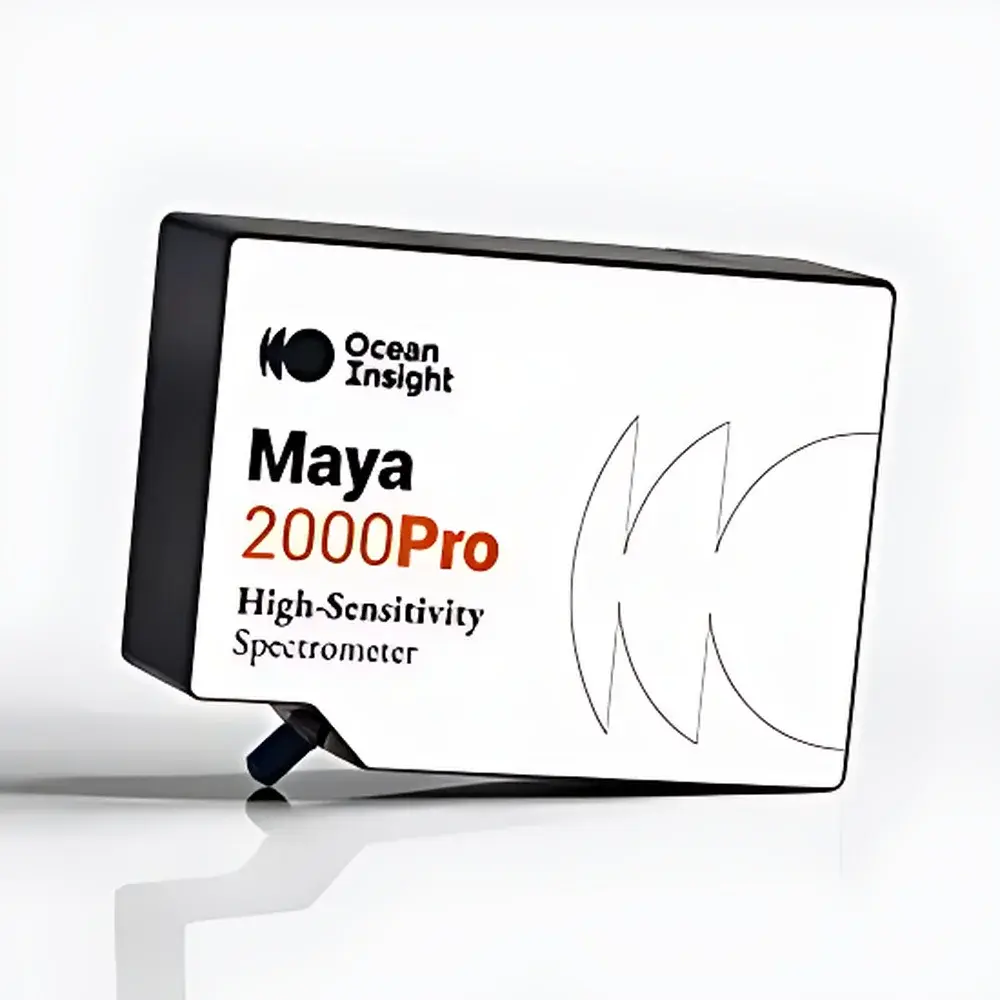
Ocean Optics Maya 2000 Fiber Optic Spectrometer
| Brand | Ocean Optics |
|---|---|
| Origin | Shanghai, China |
| Manufacturer Type | Original Equipment Manufacturer (OEM) |
| Product Category | Domestic |
| Model | Maya 2000 |
| Spectral Range | 200–1100 nm |
| Detector Type | Back-illuminated 2D FFT-CCD (Hamamatsu S9840) |
| Quantum Efficiency | up to 90% @ 250 nm |
| Signal-to-Noise Ratio | 450:1 (full well, with 5 s integration) |
| Dynamic Range | 15,000:1 (typical, A/D-limited) |
| Stray Light | <0.05% @ 600 nm |
| Optical Resolution (FWHM) | ~0.035 nm (configurable via grating and slit selection) |
| Integration Time | 5 ms – 20 s |
| A/D Conversion | 16-bit, 500 kHz sampling |
| Pixel Array | 2048 × 14 active pixels (14 µm × 14 µm) |
| Readout Speed | Optimized for high-throughput acquisition |
| Slit Options | 5, 10, 25, 50, 100, 200 µm |
| Grating Options | 14 standard gratings, including HC-1 broadband grating (175–1100 nm) |
| Onboard Features | 10 user-programmable GPIOs, programmable trigger modes (single/continuous), integrated order-sorting filters, focusing lens assembly for enhanced throughput |
Overview
The Ocean Optics Maya 2000 is a high-performance, back-illuminated fiber optic spectrometer engineered for demanding UV-VIS-NIR spectroscopic applications requiring exceptional quantum efficiency, low electronic noise, and broad spectral coverage. Based on Hamamatsu’s S9840 2D fast Fourier transform (FFT)-CCD detector architecture, the Maya 2000 leverages back-thinned silicon technology to achieve up to 90% quantum efficiency at 250 nm—eliminating the need for UV-enhancing coatings and ensuring batch-to-batch consistency in ultraviolet response. Unlike front-illuminated CCDs, its deep-depletion, thermally stable design delivers superior signal fidelity across the full 200–1100 nm range without active cooling, making it ideal for portable, OEM-integrated, and benchtop laboratory systems where size, power, and thermal management are constrained.
Key Features
- Back-illuminated 2D FFT-CCD detector (Hamamatsu S9840) with 2048 × 14 active pixels (14 µm pitch), enabling high spatial and spectral discrimination
- Configurable optical resolution down to ~0.035 nm FWHM via interchangeable slits (5–200 µm) and 14 grating options—including the HC-1 holographic grating for extended 175–1100 nm coverage
- High dynamic range of 15,000:1 (A/D-limited) and signal-to-noise ratio of 450:1 (at full-well capacity, 5 s integration), optimized for low-light and time-resolved measurements
- Integrated order-sorting filters suppress second- and third-order diffraction artifacts, critical for accurate quantitative analysis in broadband applications
- Dedicated focusing lens assembly increases optical throughput by enhancing coupling efficiency from fiber input to detector plane
- Onboard programmability: 10 general-purpose input/output (GPIO) lines, hardware-triggered acquisition (single or continuous), and real-time integration control via USB 2.0 interface
- Low electronic noise architecture with 16-bit, 500 kHz analog-to-digital conversion and integration times ranging from 5 ms to 20 s
Sample Compatibility & Compliance
The Maya 2000 interfaces seamlessly with standard SMA 905 optical fibers and supports diverse sampling configurations—including cuvette holders, integrating spheres, reflection probes, and flow cells—enabling compatibility with liquid, solid, gas, and plasma samples. Its spectral response and linearity (<1.0% deviation post-calibration) meet requirements for ASTM E308 (computing CIE tristimulus values), ISO 13406-2 (display luminance uniformity), and USP (spectrophotometric absorbance verification). While not inherently FDA 21 CFR Part 11 compliant, the instrument supports audit-trail-capable data capture when paired with validated SpectraSuite software deployments under GLP/GMP environments. All firmware and calibration files adhere to NIST-traceable wavelength and radiometric standards.
Software & Data Management
The Maya 2000 is fully supported by Ocean Insight’s SpectraSuite cross-platform software suite, compatible with Windows, macOS, and Linux operating systems. SpectraSuite provides real-time spectral visualization, multi-channel averaging, dark/baseline correction, peak identification, and export in CSV, XML, and HDF5 formats. Application programming interfaces (APIs) are available for Python, MATLAB, LabVIEW, and C/C++, facilitating integration into automated QA/QC workflows, OEM instrumentation, and custom data acquisition platforms. Raw spectral data retains full 16-bit depth and timestamp metadata, supporting traceable analysis chains required in regulated industries. Firmware updates and spectral calibration files are digitally signed and version-controlled via Ocean Insight’s secure repository.
Applications
- UV-Vis absorption and reflectance spectroscopy of nanomaterials, catalysts, and thin films
- Fluorescence lifetime and quantum yield measurements in life science and photophysics research
- Plasma emission monitoring in semiconductor process chambers and laser-induced breakdown spectroscopy (LIBS)
- Colorimetric analysis in paint, textile, and display manufacturing per CIE 1931 and CIELAB standards
- Environmental water quality assessment (e.g., nitrate, chlorophyll-a, dissolved organic carbon quantification)
- OEM integration into handheld analyzers, process analyzers, and educational spectrometry platforms
FAQ
Is the Maya 2000 suitable for UV-sensitive measurements below 220 nm?
Yes—the back-thinned CCD achieves >70% quantum efficiency at 200 nm without UV-enhancing coatings, ensuring stable, reproducible response across the deep UV region.
What is the difference between the Maya 2000 and Maya 2000-Pro?
The Maya 2000 prioritizes faster readout speed, while the Maya 2000-Pro emphasizes higher dynamic range and SNR through optimized electronics and longer full-well integration; both share identical optical and mechanical specifications.
Can I perform radiometric calibration with this spectrometer?
Yes—NIST-traceable irradiance and radiance calibrations are available as optional factory services; users may also apply custom calibrations using calibrated light sources and reference detectors.
Does the device support synchronization with external equipment?
Yes—via TTL-compatible trigger inputs/outputs and programmable GPIOs, enabling precise timing coordination with lasers, shutters, or motion stages.
Is SpectraSuite validated for use in regulated pharmaceutical environments?
SpectraSuite itself is not pre-validated, but its configuration, audit trail, and data export features can be qualified per internal SOPs to satisfy FDA 21 CFR Part 11 and EU Annex 11 requirements.
Related Products





