
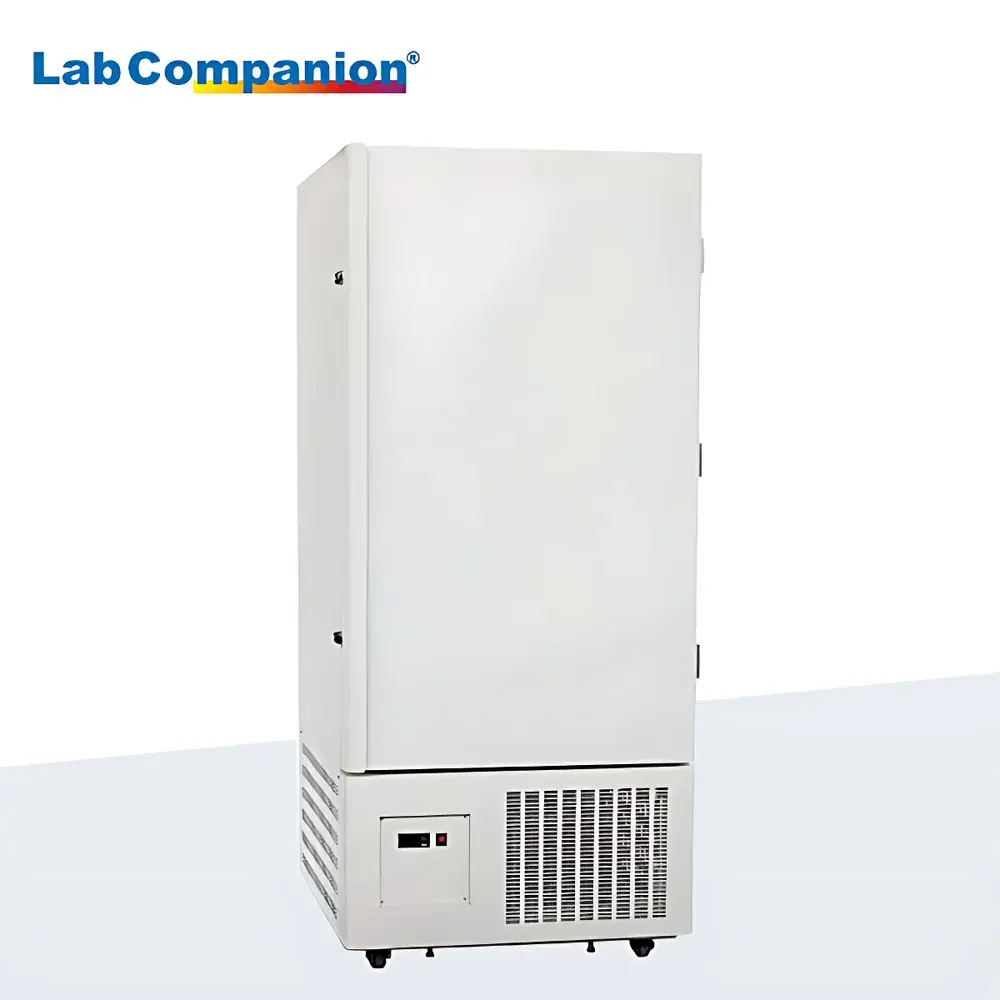
LabCompanion LC-45-L230 Vertical Ultra-Low Temperature Freezer
| Brand | LabCompanion |
|---|---|
| Model | LC-45-L230 |
| Type | Vertical Upright Freezer |
| Effective Volume | 160 L |
| Inner Dimensions (W×D×H) | 501 × 445 × 710 mm |
| External Dimensions (W×D×H) | 760 × 850 × 1380 mm |
| Power Supply | 220 V / 50 Hz |
| Rated Power | 1200 W |
| Temperature Range | −10 °C to −45 °C (adjustable) |
| Empty Chamber Cooling Rate | ≤30 min (from +32 °C to −40 °C) |
| Load Freezing Time | 1 h (6 kg load) |
| Insulation Thickness | 125 mm |
| Refrigeration System | Dual-stage compressor system with imported components |
| Condenser | High-efficiency air-cooled finned type |
| Evaporator | Copper tube, shelf-mounted, forced-air circulation |
| Refrigerant | Eco-friendly blended refrigerant |
| Control System | Microprocessor-based digital controller with NTC sensor and Keld electronic thermostat |
| Display | LED temperature readout |
| Safety Features | Audible/visual alarm, door lock, overtemperature/door-open protection |
| Cabinet Material | Powder-coated steel exterior, stainless steel interior |
| Door | Double-sealed insulated door with reinforced locking handle |
| Casters | Heavy-duty locking casters |
| Compliance | Designed per IEC 61000-6-3 (EMC), IEC 61010-1 (Safety), and compatible with GLP-compliant laboratory workflows |
Overview
The LabCompanion LC-45-L230 is a vertically oriented ultra-low temperature freezer engineered for reliable, energy-efficient long-term storage of biological samples—including cell lines, primary tissues, serum, enzymes, and nucleic acids—at stable temperatures between −10 °C and −45 °C. Unlike standard −20 °C freezers or cryogenic liquid nitrogen systems, the LC-45-L230 employs a dual-stage mechanical refrigeration architecture optimized for rapid pull-down performance and thermal stability under variable ambient conditions (climate class N). Its core cooling principle relies on cascaded compression stages using environmentally compliant blended refrigerants, enabling consistent sub-zero operation without reliance on consumables or external cryogens. The unit is designed for integration into regulated life science environments where reproducibility, traceability, and uninterrupted cold chain integrity are critical—particularly in biobanking, clinical diagnostics laboratories, and pharmaceutical QC settings.
Key Features
- Dual-stage refrigeration system with high-reliability Secop compressors and EBM evaporator/condenser fans, delivering ≤30-minute empty-chamber cooldown from +32 °C to −40 °C.
- 125 mm-thick high-density polyurethane insulation with vacuum-degassed foaming process, minimizing thermal bridging and reducing annual energy consumption by up to 22% versus legacy single-stage designs.
- Stainless steel interior chamber (501 × 445 × 710 mm) with corrosion-resistant copper-tube evaporator mounted beneath the bottom shelf, ensuring uniform airflow distribution and eliminating cold spots.
- Microprocessor-based digital control system featuring Keld electronic thermostat, real-time NTC temperature sensing, and LED display with ±0.5 °C accuracy across the operating range.
- Dual-gasket door seal combined with reinforced mechanical latch and optional key-lock mechanism, meeting ISO 20417 requirements for access control in shared lab facilities.
- Integrated safety suite including overtemperature alarm, door-open alert (≥30 s), power failure indicator, and automatic restart after voltage recovery—all logged with timestamps in non-volatile memory.
Sample Compatibility & Compliance
The LC-45-L230 supports standardized cryovial racks (50 × 35 × 2 cm trays), accommodating up to 46 sample trays within its 160 L usable volume. Its validated temperature uniformity (±3 °C at −40 °C, per ASTM F2697–21 Zone Mapping Protocol) ensures compatibility with ISO/IEC 17025-accredited sample storage workflows. The unit complies with IEC 61010-1 (safety of laboratory equipment), IEC 61000-6-3 (EMC emissions), and meets essential requirements of EU Regulation 2017/1369 for energy labeling. While not certified to UL 471 or NSF/ANSI 456, its construction and control architecture support alignment with GLP documentation practices and FDA 21 CFR Part 11 audit-trail readiness when paired with external data loggers.
Software & Data Management
The LC-45-L230 operates as a standalone instrument with no proprietary software dependency. All operational parameters—including setpoint, actual chamber temperature, alarm history, and door-open events—are retained in internal EEPROM with battery-backed memory (minimum 10-year retention). Optional RS-485 Modbus RTU interface enables integration into centralized BMS or LIMS platforms for remote monitoring, event-triggered email alerts, and automated CSV export of temperature logs. For GxP environments, third-party validated data acquisition systems (e.g., Omega OM-DAQPRO-5300 or Testo Saveris 2) may be deployed to satisfy 21 CFR Part 11 electronic record requirements, including user authentication, audit trail generation, and digital signature capability.
Applications
- Long-term preservation of human and animal biospecimens in biorepositories adhering to ISBER Best Practices.
- Storage of temperature-sensitive reagents such as monoclonal antibodies, cytokines, and lyophilized standards requiring strict −40 °C stabilization.
- Backup cold storage for −80 °C ultra-low freezers during maintenance cycles or power outages.
- QC sample archiving in contract research organizations (CROs) conducting GLP-compliant toxicology or pharmacokinetic studies.
- Field-deployable cold storage in mobile diagnostic labs operating under WHO PQS specifications for tropical ambient conditions (up to 32 °C).
FAQ
What is the minimum ambient temperature required for stable operation?
The LC-45-L230 is rated for climate class N (18–32 °C ambient), with optimal performance achieved at ≤25 °C and ≤60% RH.
Can this unit be installed in an unventilated room?
No. A minimum clearance of 150 mm behind and 100 mm on each side is required for condenser airflow; inadequate ventilation will trigger overheating alarms and reduce compressor lifespan.
Is the temperature logging function compliant with 21 CFR Part 11?
The onboard memory provides time-stamped event logging but lacks electronic signatures and role-based access control; full Part 11 compliance requires integration with validated external data loggers.
Does the unit include a validation protocol for IQ/OQ/PQ?
LabCompanion supplies a Factory Acceptance Test (FAT) report and basic commissioning checklist; site-specific IQ/OQ/PQ documentation must be developed per client SOPs or ISO/IEC 17025 guidelines.
What maintenance intervals are recommended?
Condenser coil cleaning every 3 months, door gasket inspection quarterly, and annual verification of temperature uniformity and alarm functionality using NIST-traceable probes.




