
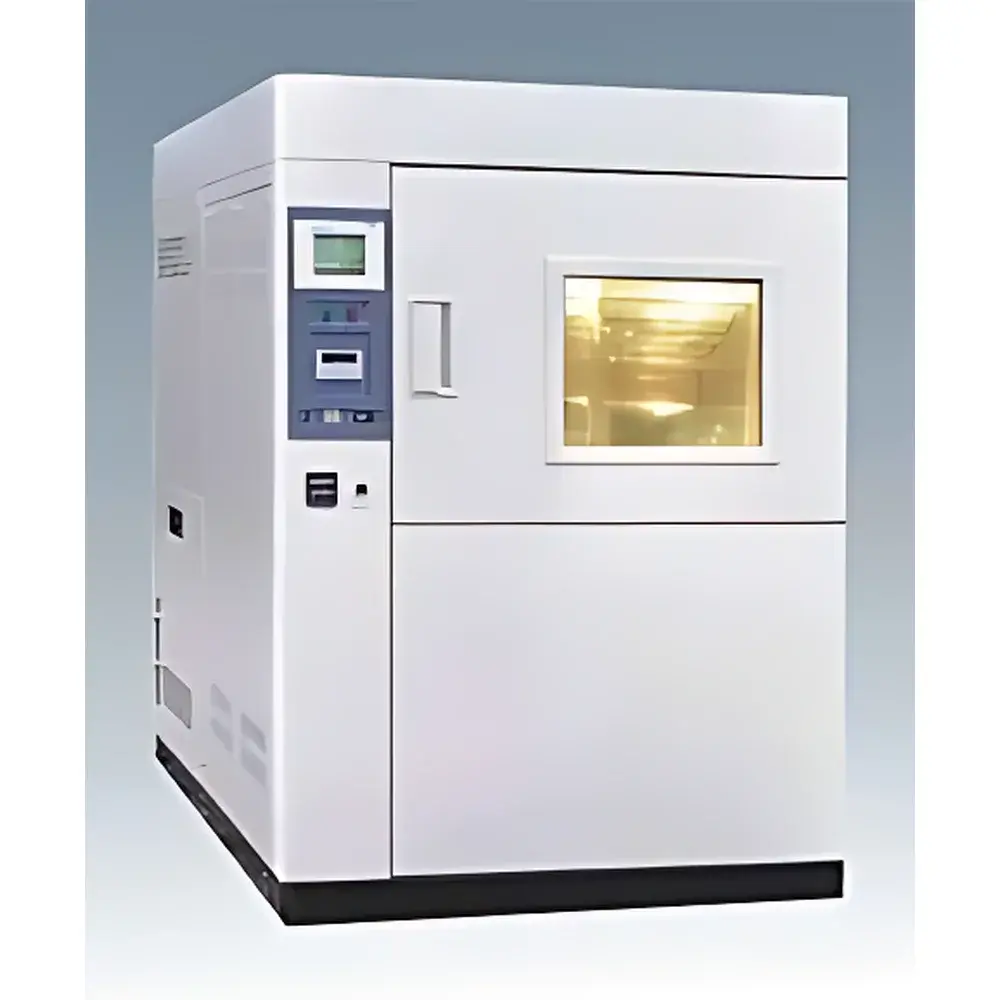
LabCompanion TS Series Three-Zone Gas-Actuated Thermal Shock Chamber
| Brand | LabCompanion |
|---|---|
| Origin | Guangdong, China |
| Manufacturer Type | Direct Manufacturer |
| Country of Origin | China |
| Model | TS Series |
| Pricing | Upon Request |
| Temperature Range (Test Chamber) | −55 °C to +150 °C |
| Temperature Deviation | ±2 °C |
| Temperature Recovery Time | ≤5 min |
| Test Method | Pneumatic Air Damper Switching (2-Zone or 3-Zone Operation) |
| High-Temp Zone Range | +60 °C to +200 °C |
| Low-Temp Zone Range | −55 °C to −10 °C (TS40/TS55-05/08) or −65 °C to −10 °C (TS55-15/25) |
| Heating Rate (RT → +200 °C) | ~35 min |
| Cooling Rate (+20 °C → −55 °C) | ~60 min |
| (+20 °C → −65 °C) | ~70 min |
| Control Interface | 7.5″ TFT Color Touchscreen (Chinese UI) |
| Data Logging | 96 Programmable Test Profiles |
| Communication | RS-232 / RS-485 |
| Refrigeration System | Dual-Stage Mechanical Compression with R-507 / R-23 Eco-Friendly Refrigerants |
| Construction | SUS304 Stainless Steel Interior, Polyurethane + Glass Wool Insulation |
| Power Supply | AC 380 V ±10%, 50 Hz, 3-Phase 4-Wire + PE |
| Safety Protections | Over-Temp, Over-Pressure, Phase Failure, Compressor Thermal & Pressure Monitoring, Air Pressure Interlock, Leakage Circuit Breaker, Exhaust Valve, Motor Reverse Prevention Relay |
Overview
The LabCompanion TS Series Three-Zone Gas-Actuated Thermal Shock Chamber is an engineered solution for evaluating the reliability and structural integrity of electronic components, aerospace hardware, military-grade electronics, and advanced materials under rapid, extreme temperature transitions. Unlike single- or dual-chamber thermal shock systems, this instrument employs a true three-zone architecture—comprising independent high-temperature, low-temperature, and test zones—enabling precise, repeatable, and contamination-free thermal cycling without mechanical movement of test specimens. The core methodology relies on pneumatic damper switching to direct pre-conditioned air streams into the static test chamber, eliminating thermal lag associated with moving baskets and ensuring superior temperature uniformity (±2 °C) and recovery time (≤5 min). This design conforms to the fundamental requirements of thermal shock testing as defined by IEC 60068-2-14, while supporting full compliance with MIL-STD-810H Method 503.5 and ASTM D5229/D5229M for composite material evaluation under thermal stress.
Key Features
- Three-zone static-test architecture: Specimens remain stationary in the central test chamber while hot and cold air are pneumatically routed from dedicated reservoir zones—minimizing mechanical wear, vibration artifacts, and positional thermal gradients.
- Dual-stage refrigeration system using environmentally compliant R-507 and R-23 refrigerants, paired with stainless steel brazed plate heat exchangers and imported semi-hermetic compressors for stable sub-zero operation down to −65 °C.
- 7.5″ color TFT touchscreen controller with intuitive Chinese-language HMI, supporting up to 96 user-defined thermal profiles, real-time curve logging, and programmable cycle counts (1–999), dwell times (1 min–99 h 59 min), and automatic defrost scheduling.
- Robust thermal insulation combining high-density polyurethane foam and glass wool (≥100 mm thickness), coupled with SUS304 interior cladding and electrostatically coated carbon steel exterior for long-term corrosion resistance and thermal retention.
- Integrated safety architecture including compressor high-pressure/overheat cutoffs, phase failure detection, air pressure interlock for damper actuation, PT100 platinum RTD sensors with PID control, and redundant over-temperature protection in all three zones.
- Standard RS-232/RS-485 communication interface for integration into centralized lab management systems, enabling remote monitoring, parameter synchronization, and audit-ready data export compatible with GLP/GMP documentation workflows.
Sample Compatibility & Compliance
The TS Series accommodates test loads up to 15 kg across internal volumes ranging from 50 L to 250 L (models TS40–TS55), with standardized 50 mm cable ports and optional 25 × 100 mm elongated feedthroughs for powered device-in-test (DIT) configurations. Its static test zone eliminates inertial stress during transitions—critical for fragile PCB assemblies, MEMS devices, and optoelectronic modules. The system meets or exceeds key international standards including GB/T 2423.1 (cold), GB/T 2423.2 (dry heat), GB/T 2423.22 (temperature change), GJB 150.5 (military thermal shock), and ISO 16750-4 (road vehicles). While not certified to UL or CE out-of-the-box, its electrical architecture (380 V, 3-phase, PE-grounded) and safety logic align with EN 61000-6-2/6-4 EMC immunity/emission baselines and can be validated per customer-specific qualification protocols.
Software & Data Management
The embedded microcontroller supports both fixed-setpoint and multi-segment programmable operation, with timestamped event logging (alarm triggers, door openings, power interruptions) stored internally for ≥30 days. All temperature profiles are editable via touchscreen or exported/imported via USB. When connected to a host PC, the RS-485 interface enables bidirectional communication using Modbus RTU protocol—allowing third-party SCADA platforms or custom Python-based validation scripts to initiate runs, retrieve live sensor data (PT100 readings at 1 Hz resolution), and archive CSV-formatted thermal history files. Audit trails include operator ID (via optional login module), parameter change timestamps, and firmware version metadata—facilitating 21 CFR Part 11 readiness when deployed in regulated QC environments.
Applications
This thermal shock chamber serves critical roles in accelerated life testing (ALT), failure mode analysis (FMA), and qualification screening across multiple sectors: solder joint reliability assessment per IPC-J-STD-020; validation of conformal coating adhesion under thermal cycling; evaluation of battery cell thermal runaway propagation; verification of hermetic seal integrity in medical implant housings; and environmental stress screening (ESS) of avionics modules prior to flight certification. Its ability to execute 2-zone (hot↔cold) or 3-zone (hot↔ambient↔cold) sequences—with independent dwell time control per phase—makes it suitable for simulating real-world operational transients such as aircraft ascent/descent profiles or satellite eclipse-entry cycles.
FAQ
What distinguishes the TS Series from conventional two-chamber thermal shock testers?
Unlike basket-transfer systems, the TS Series uses pneumatic air routing to deliver pre-conditioned air to a stationary test chamber—eliminating mechanical motion-related failures, reducing maintenance intervals, and improving repeatability across >10,000 thermal cycles.
Can the controller interface support English-language menus?
The standard HMI operates in Chinese; however, firmware-level language localization is available upon request for OEM integration or export markets requiring English-only operation.
Is external compressed air required for damper actuation?
Yes—a clean, oil-free compressed air supply (0.5–0.7 MPa) must be provided externally; an optional integrated air compressor module is available as a factory-configured accessory.
How is traceability ensured during regulatory audits?
All profile executions generate immutable log entries with CRC-protected timestamps, sensor IDs, and setpoint deviations; raw data exports include calibration certificate references and controller firmware build identifiers.
What maintenance intervals are recommended for long-term reliability?
Compressor oil analysis every 2,000 operating hours, refrigerant leak checks quarterly, and damper actuator lubrication annually—documented in the included maintenance logbook aligned with ISO 55001 asset management principles.



