
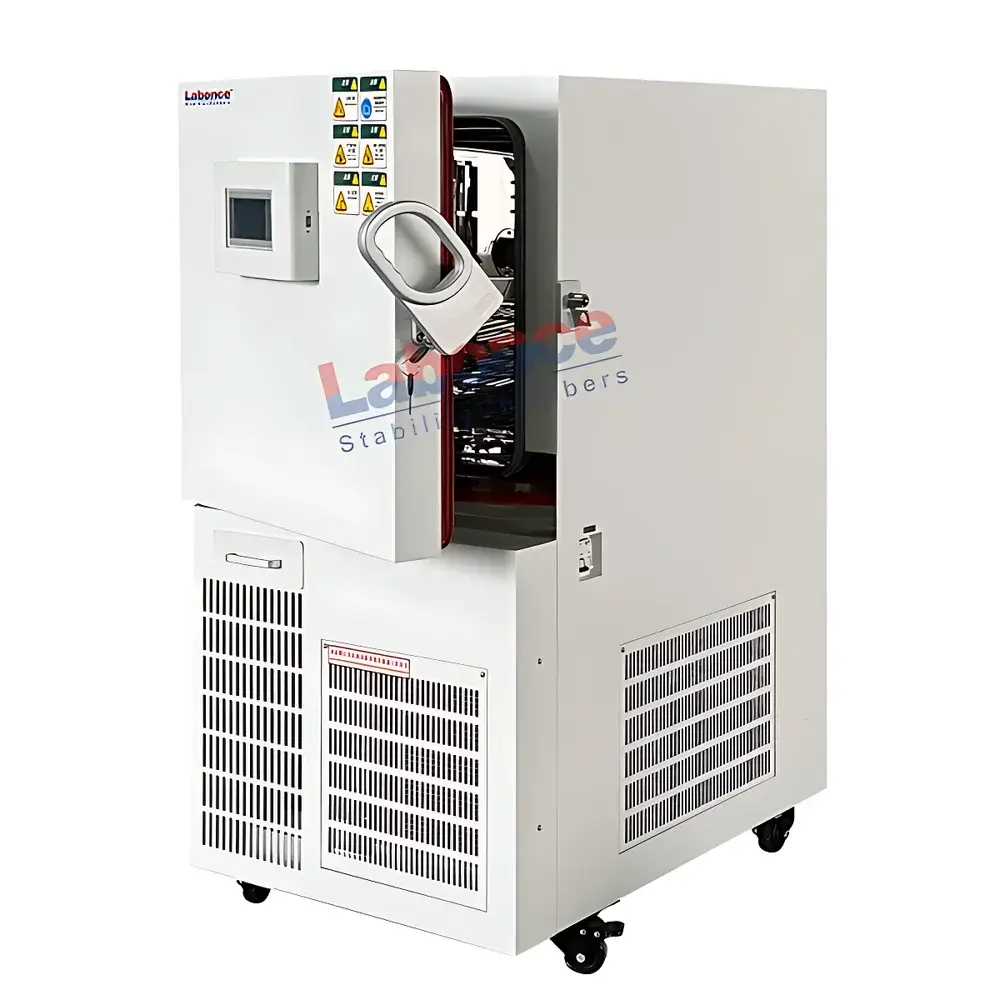
Labonce Labonce-100GDJ High-Low Temperature Environmental Test Chamber
| Brand | Labonce |
|---|---|
| Model | Labonce-100GDJ |
| Temperature Range | -20 °C to 150 °C (Option A) / -40 °C to 150 °C (Option B) / -60 °C to 150 °C (Option C) |
| Internal Volume | 100 L |
| Interior Dimensions (W×D×H) | 450 mm × 450 mm × 500 mm |
| Exterior Dimensions (W×D×H) | 730 mm × 1040 mm × 1570 mm |
| Temperature Uniformity | ±2.0 °C |
| Temperature Fluctuation | ±0.5 °C |
| Heating Rate | 1–3 °C/min |
| Cooling Rate | 0.7–1 °C/min |
| Construction | Exterior – Powder-coated steel |
| Control System | Programmable color touchscreen controller with multi-segment and constant-value programming |
| Data Logging | Built-in electronic data storage with USB export capability |
| Safety Protections | Compressor overheat & high-pressure overload protection |
| Compliance | GB/T 10592–2008 |
Overview
The Labonce Labonce-100GDJ High-Low Temperature Environmental Test Chamber is an engineered solution for accelerated environmental stress testing of electrical, electronic, and electro-mechanical components under controlled thermal conditions. Designed for laboratory-based reliability validation and quality assurance workflows, this chamber operates on a forced-air convection principle with a precisely balanced air circulation system to maintain spatial temperature uniformity across the test volume. Unlike ambient-condition chambers, the Labonce-100GDJ delivers programmable thermal profiles—including ramp-hold cycles, step changes, and extended dwell periods—enabling standardized evaluation of material behavior, solder joint integrity, polymer dimensional stability, and semiconductor package performance during exposure to extreme cold or heat. Its architecture supports both qualification testing per industry-defined protocols and routine in-process verification prior to product release.
Key Features
- Triple-range refrigeration configuration: Standard models support operating ranges of –20 °C to +150 °C (Option A), –40 °C to +150 °C (Option B), or –60 °C to +150 °C (Option C), enabling flexibility across application-specific thermal severity requirements.
- Optimized air distribution system: A re-engineered horizontal airflow duct layout ensures ≤±2.0 °C temperature deviation across the full working volume (per GB/T 10592–2008), minimizing thermal gradients that could compromise test repeatability.
- Dual-layer thermal insulation: High-density polyurethane foam (≥100 mm thickness) combined with vacuum-sealed door gaskets reduces external heat exchange, improving energy efficiency and stabilizing chamber dynamics during rapid transitions.
- Industrial-grade refrigeration: Hermetically sealed scroll compressors from globally certified OEM suppliers deliver consistent cooling capacity with noise levels maintained below 65 dB(A) at 1 m distance—critical for shared lab environments.
- Intuitive control interface: A 7-inch full-color resistive touchscreen controller provides real-time graphical display of setpoint, actual temperature, ramp rate, and elapsed time, supporting up to 99 programmable segments with loop functionality.
- Integrated safety architecture: Redundant thermal protection includes independent mechanical overtemperature cut-off (non-resettable), digital upper/lower deviation alarms, compressor discharge temperature monitoring, and fan motor thermal shutdown—all logged with timestamps.
Sample Compatibility & Compliance
The Labonce-100GDJ accommodates standard test specimens up to 450 mm × 450 mm × 500 mm (W×D×H) on two adjustable stainless-steel shelves (SUS304, load-rated to 15 kg/shelf). Its interior chamber is fully compatible with non-corrosive, non-outgassing samples—including PCB assemblies, passive components, plastic housings, and metal fasteners. The chamber meets the structural and performance criteria outlined in GB/T 10592–2008 (“Technical Requirements for High-Low Temperature Test Chambers”) and is routinely deployed in laboratories conducting tests aligned with IEC 60068-2-1 (Cold), IEC 60068-2-2 (Dry Heat), and MIL-STD-810G Method 501.4/502.5. While not inherently humidity-capable (unlike the JS-series variants), its thermal-only design eliminates condensation-related artifacts—making it suitable for dry thermal cycling where moisture control introduces unwanted variables.
Software & Data Management
Data acquisition and traceability are supported via embedded flash memory (≥16 MB) capable of storing ≥30 days of continuous 1-second interval logging (temperature only). All recorded datasets include ISO 8601-formatted timestamps, operator ID fields (configurable), and event markers for program start/stop, alarm triggers, and manual interventions. Export is performed via standard USB 2.0 interface using FAT32-formatted drives; output files conform to CSV format with header rows compliant with ASTM E2911-13 (Standard Guide for Data Exchange in Environmental Testing). Audit trail functionality satisfies GLP-compliant documentation needs, and optional RS485 Modbus RTU communication enables integration into centralized facility monitoring systems (SCADA/BMS) without proprietary middleware.
Applications
- Thermal shock pre-screening of automotive ECUs prior to AEC-Q200 qualification
- Accelerated life testing of lithium-ion battery cells under low-temperature discharge conditions
- Evaluation of adhesive bond strength retention in aerospace composite assemblies after 500-cycle thermal cycling (–40 °C ↔ +125 °C)
- Validation of optical sensor housing dimensional stability across operational temperature envelopes
- Verification of solder paste reflow profile compatibility with lead-free assembly processes
- Stress screening of medical device PCBs per ISO 13485 production release protocols
FAQ
What temperature uniformity specifications does the Labonce-100GDJ meet?
Per GB/T 10592–2008, the chamber maintains ≤±2.0 °C spatial uniformity across the entire working volume at steady-state conditions.
Is remote monitoring or Ethernet connectivity available as standard?
No—networked operation requires optional RS485 Modbus RTU hardware add-on; no built-in Wi-Fi or Ethernet port is included.
Can the unit be calibrated to NIST-traceable standards?
Yes—third-party calibration services are supported using accredited providers; Labonce supplies mounting points for Class A PT100 sensors at nine defined locations per IEC 60068-3-5.
Does the controller support password-protected parameter locking for SOP compliance?
Yes—the touchscreen interface includes three-tier user access (Operator, Engineer, Administrator) with configurable password policies and change logging.
What is the expected mean time between failures (MTBF) for the refrigeration system?
Based on field data from installed base units operating continuously at 25 °C ambient, MTBF exceeds 12,000 hours for the compressor assembly under nominal load conditions.



