
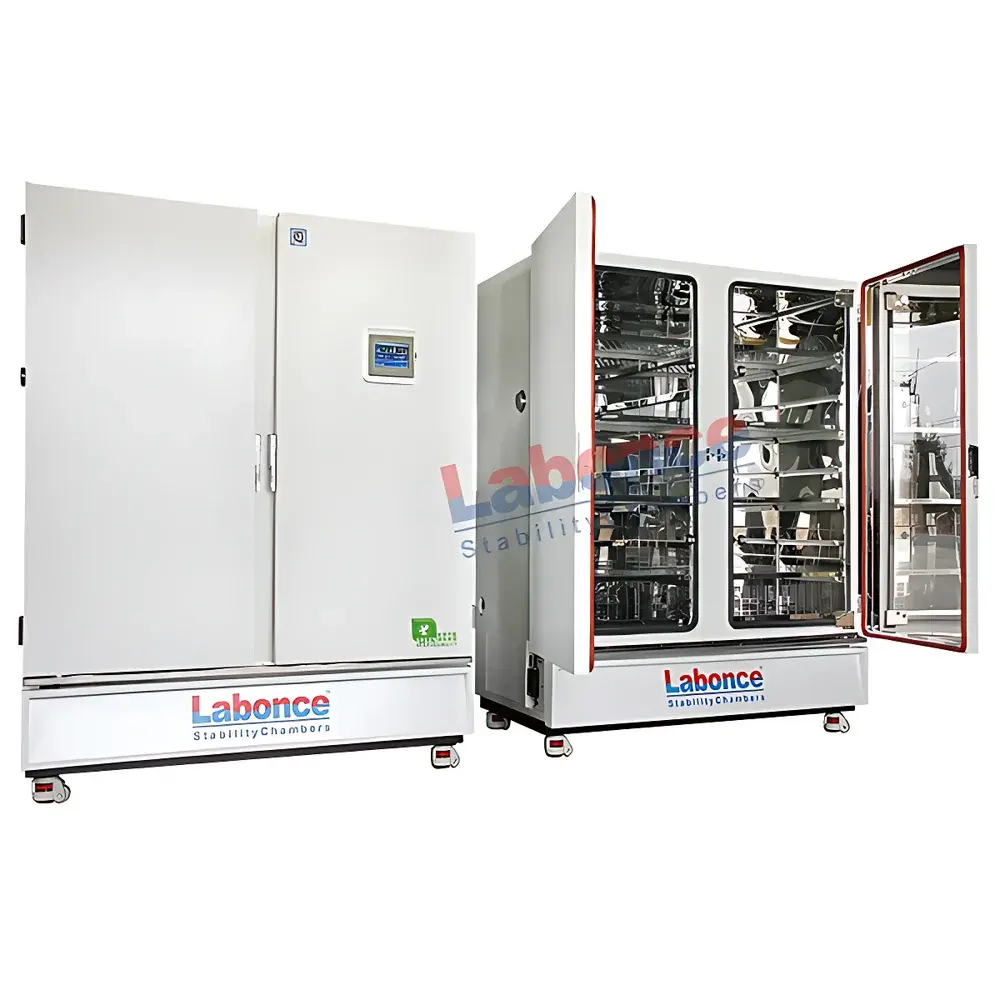
Labonce Labonce-2000GS-FC Dual-Door Pharmaceutical Stability Testing Chamber
| Brand | Labonce |
|---|---|
| Origin | Beijing, China |
| Manufacturer Type | Direct Manufacturer |
| Country of Origin | China |
| Model | Labonce-2000GS-FC |
| Temperature Range | 10–65 °C |
| Humidity Range | 15–95 %RH |
| Internal Volume | 2000 L |
| Internal Dimensions (W×D×H) | 1500×970×1400 mm |
| External Dimensions (W×D×H) | 1710×1380×1990 mm |
| Power Consumption | 3.5 kW |
| Temperature Uniformity | ±1.0 °C |
| Temperature Fluctuation | ±0.5 °C |
| Humidity Uniformity | ±3 %RH |
| Humidity Fluctuation | ±2 %RH |
| Ambient Operating Temperature | +5 to +35 °C |
| Power Supply | 220 V, 50/60 Hz |
| Standard Compliance | ICH Q1–Q5, Chinese Pharmacopoeia 2020 Edition |
| Control System | 7-inch programmable color touchscreen with variable-frequency drive (VFD) output display |
| User Access | Three-tier role-based authentication (Admin / Supervisor / Operator) |
| Audit Trail | Time-stamped, tamper-evident operation and alarm logs exportable via USB in read-only format |
| Refrigeration | Imported hermetic inverter compressor |
| Humidity Sensor | OEM capacitive RH sensor (low drift, maintenance-free) |
| Data Output | Integrated dot-matrix printer + internal electronic storage |
| Safety Systems | Independent overtemperature cutoff, compressor overheat/overpressure protection, low-water and dry-run prevention |
| Alarm Modes | Local audible alarm + remote SMS notification for temperature/humidity deviation and power failure |
| Door Design | Dual-door configuration — outer solid insulated door |
Overview
The Labonce Labonce-2000GS-FC Dual-Door Pharmaceutical Stability Testing Chamber is an engineered environmental simulation system designed explicitly for long-term, regulatory-compliant stability studies under ICH Q1A(R3), Q1B, Q1C, Q5C, and the Chinese Pharmacopoeia 2020 Edition. It maintains precise, reproducible control of temperature (10–65 °C) and relative humidity (15–95 %RH) across its 2000 L working volume—critical for forced degradation testing, real-time stability protocols, accelerated shelf-life estimation, and photostability assessments per ICH Q1B and Q5C. Its dual-door architecture minimizes thermal and hygric disturbance during routine sample access: the outer door provides high-efficiency insulation and light exclusion, while the inner tempered glass door enables visual inspection without compromising chamber integrity. The system employs a hermetic inverter-driven refrigeration cycle, delivering stable climatic conditions with reduced energy consumption (>50% lower than fixed-speed equivalents) and minimal condensate generation—essential for GMP and cGMP environments requiring consistent utility load management.
Key Features
- Triple-tier user authentication with role-specific permissions (Administrator, Supervisor, Operator) enforced via username/password login and session timeout
- Fully compliant audit trail functionality: time-stamped, immutable records of all parameter changes, manual interventions, alarm events, and system startups/shutdowns—exportable via USB in PDF or CSV format with cryptographic hash verification
- 7-inch high-resolution color touchscreen controller with real-time visualization of VFD compressor output percentage, enabling predictive maintenance and energy optimization
- High-density polyurethane foam insulation (≥120 mm thick) integrated into walls, ceiling, and floor—achieving thermal resistance (R-value) >4.2 m²·K/W and humidity retention exceeding 98% over 24-hour door-open recovery cycles
- Interior constructed entirely from electropolished AISI 304 stainless steel (Ra ≤ 0.8 µm surface finish), certified non-shedding and compatible with ISO 14644-1 Class 7 cleanroom wiping validation protocols
- Capacitive humidity sensing technology with factory-calibrated NIST-traceable certificate; drift <±0.5 %RH/year; no periodic recalibration required under normal operating conditions
- Dual independent safety layers: primary PID-controlled thermal cutoff at setpoint +5 °C and secondary hardware-based overtemperature fuse (non-resettable, field-replaceable)
Sample Compatibility & Compliance
The Labonce-2000GS-FC accommodates diverse pharmaceutical dosage forms—including vials, blister packs, syringes, sachets, and bulk powder containers—on four adjustable stainless-steel shelves (standard configuration). Its uniformity profile meets ICH-defined spatial requirements: temperature deviation ≤±1.0 °C and fluctuation ≤±0.5 °C across nine designated test points (per ICH Q1A Annex 2); humidity uniformity ≤±3 %RH with ≤±2 %RH short-term variation. The chamber is pre-validated for compliance with FDA 21 CFR Part 11 (electronic records/signatures), EU Annex 11 (computerized systems), and WHO TRS 992 Annex 6 (stability testing). Documentation packages include IQ/OQ protocols aligned with ASTM E2500-13 and ISO 9001:2015 quality management standards.
Software & Data Management
Embedded firmware supports continuous data logging at user-selectable intervals (1–60 minutes) with ≥12 months of onboard storage (expandable via optional SD card module). All electronic records comply with ALCOA+ principles (Attributable, Legible, Contemporaneous, Original, Accurate, Complete, Consistent, Enduring, Available). The integrated dot-matrix printer provides immediate hard-copy output of current conditions, alarms, or scheduled reports—configured to meet GLP audit requirements. Remote monitoring is enabled through optional Ethernet/Wi-Fi gateway modules supporting Modbus TCP and HTTPS API endpoints for integration into LIMS or MES platforms.
Applications
- ICH-compliant long-term (25 °C/60 %RH) and accelerated (40 °C/75 %RH) stability studies for registration dossiers
- Photostability testing when coupled with ICH Q1B-compliant UV/visible light sources (optional accessory mounting)
- Excipient compatibility screening under controlled humidity gradients
- Package integrity evaluation (e.g., moisture permeation through blister foils or HDPE bottles)
- Reference standard storage under defined climatic conditions per USP
- Process validation support for lyophilization cycle development and storage condition qualification
FAQ
Does the Labonce-2000GS-FC support 21 CFR Part 11 compliance?
Yes—the system implements electronic signature enforcement, audit trail immutability, and role-based access control aligned with FDA requirements for electronic records.
Can humidity be maintained at 15% RH continuously without condensation risk?
Yes—its dew point control algorithm and optimized air circulation path prevent localized condensation even at low-RH setpoints across the full temperature range.
Is validation documentation provided with the unit?
Standard delivery includes Factory Acceptance Test (FAT) report, calibration certificates for temperature and humidity sensors, and IQ/OQ templates compliant with ISO 13485 and EU GMP Annex 15.
What is the mean time between failures (MTBF) for the inverter compressor?
Based on accelerated life testing per ISO 13374-2, MTBF exceeds 45,000 hours under continuous operation at 40 °C/75 %RH.
How is temperature uniformity verified during installation qualification?
A 9-point mapping protocol is performed using NIST-traceable Class A PT100 probes; results are documented in the OQ report with statistical analysis (mean, SD, max deviation).





