
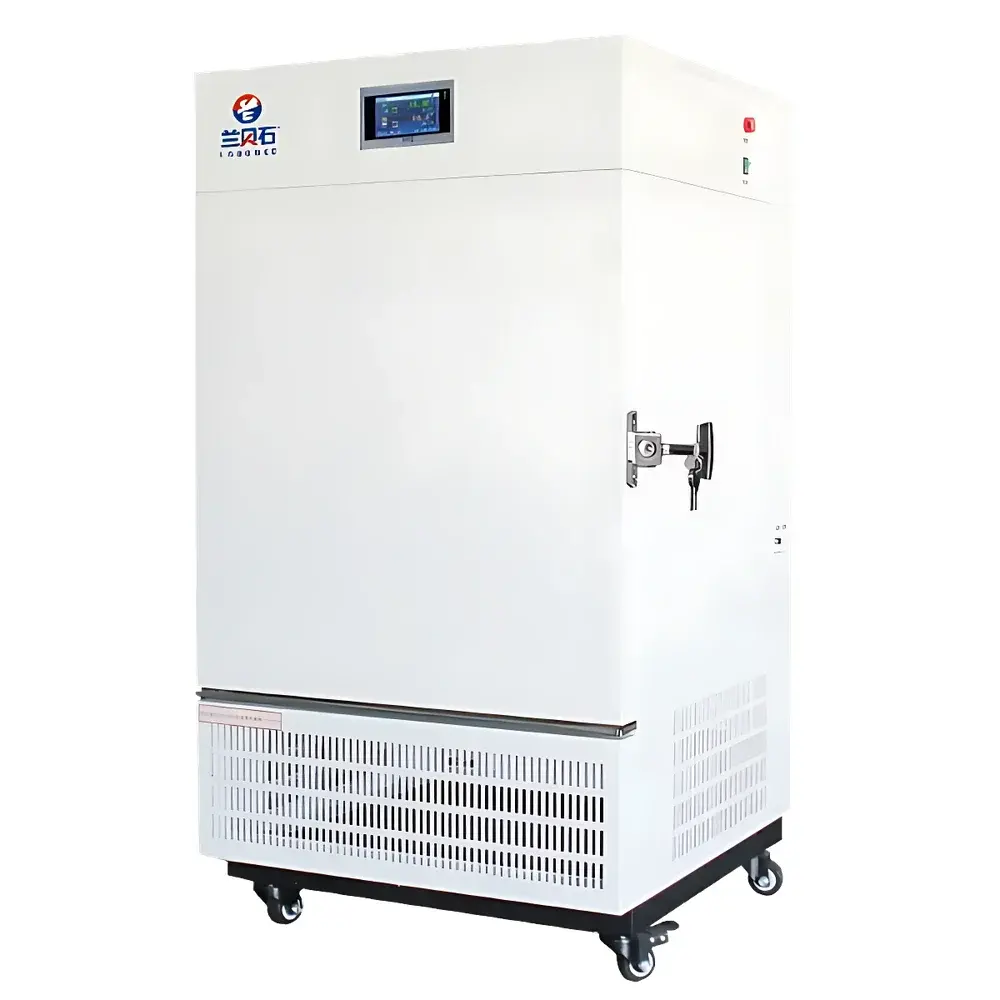
Labonce Labonce-250CH-T Temperature and Humidity Controlled Environmental Test Chamber
| Brand | Labonce |
|---|---|
| Origin | Beijing, China |
| Manufacturer Type | Direct Manufacturer |
| Product Origin | Domestic (China) |
| Model | Labonce-250CH-T |
| Temperature Range | 15–60 °C |
| Humidity Range | 20–95 %RH |
| Internal Volume | 250 L |
| Internal Dimensions (W×D×H) | 600×500×830 mm |
| External Dimensions (W×D×H) | 780×880×1650 mm |
| Power Consumption | 1.8 kW |
| Temperature Uniformity | ≤2.0 °C |
| Temperature Fluctuation | <±0.5 °C |
| Temperature Deviation | <±1.0 °C |
| Humidity Fluctuation | <±3 %RH |
| Humidity Deviation | <±3 %RH |
| Ambient Operating Temperature | +5 to +35 °C |
| Power Supply | AC 220 V ±10%, 50 Hz |
| Standard Shelves | 3 (adjustable), up to 7 total |
| Compliance | GB/T 10586–2006 |
Overview
The Labonce Labonce-250CH-T is a precision-engineered temperature and humidity controlled environmental test chamber designed for rigorous stability testing, accelerated aging studies, material conditioning, and long-term reliability validation in R&D laboratories, quality control departments, and regulatory-compliant manufacturing environments. It operates on the principle of forced-air convection combined with dual-loop PID-controlled refrigeration and steam-based humidification to maintain stable, repeatable climatic conditions across its 250 L working volume. Engineered to meet the technical requirements of GB/T 10586–2006 (“Specifications for Damp Heat Test Chambers”), the chamber delivers high spatial uniformity and temporal stability—critical for applications requiring adherence to ICH Q1, ISO 188, ASTM D3045, or IPC-TM-650 test protocols.
Key Features
- Advanced air circulation system featuring optimized duct geometry and tangential fan placement to ensure uniform temperature and humidity distribution (≤2.0 °C uniformity, <±0.5 °C fluctuation)
- High-density polyurethane foam insulation (≥100 mm thick) with seamless foaming process for minimal thermal bridging and exceptional moisture retention
- Corrosion-resistant interior constructed from electropolished AISI 304 stainless steel (mirror finish); exterior coated with epoxy-polyester powder for chemical and abrasion resistance
- Hermetically sealed, high-efficiency imported compressor with low-noise operation (<62 dB(A)) and extended service life under continuous duty cycles
- Capacitive humidity sensor (imported, factory-calibrated) with drift <0.5 %RH/year and no routine recalibration required
- Programmable 7-inch color touchscreen controller with real-time trend display, multi-segment ramp-soak profiles, and embedded data logging (up to 10,000 data points)
- Dual independent safety layers: overtemperature cut-off (mechanical backup), dry-run protection for humidifier, and audible/visual alarm activation
- Standard equipment includes two 50 mm diameter test ports with silicone rubber plugs, four-position leveling casters with brakes, and three adjustable stainless steel shelves (expandable to seven)
Sample Compatibility & Compliance
The Labonce-250CH-T accommodates a broad range of sample types—including pharmaceutical packaging, polymer films, electronic assemblies, battery cells, adhesives, and biological reference standards—without introducing contamination or catalytic surface reactions. Its 304 stainless steel chamber and absence of volatile organic outgassing materials comply with GLP and GMP preconditions for stability-indicating testing. The unit satisfies mechanical and performance criteria outlined in GB/T 10586–2006 and serves as a validated platform for method development aligned with ICH guidelines. Optional accessories—including calibrated PT100 probe inputs, external data interface modules (RS485/Modbus), and printer output—support audit-ready documentation per FDA 21 CFR Part 11 when integrated with compliant software systems.
Software & Data Management
The embedded controller supports user-defined test programs with up to 99 segments, each configurable for temperature setpoint, humidity setpoint, dwell time, and ramp rate. Logged data—including chamber setpoints, actual readings, alarm events, and runtime status—is timestamped and stored internally with automatic overwrite protection. Export is performed via USB flash drive in CSV format for traceable post-processing in Excel, MATLAB, or LIMS platforms. Optional PC-based software (Labonce EnviroLog Pro) enables remote monitoring, automated report generation (PDF/Excel), and electronic signature functionality compatible with 21 CFR Part 11 Annex 11 requirements when deployed on validated IT infrastructure.
Applications
- Pharmaceutical stability testing per ICH Q1A(R3) and USP under long-term (25 °C/60 %RH) and accelerated (40 °C/75 %RH) conditions
- Electronics reliability assessment including moisture sensitivity level (MSL) preconditioning and solder paste shelf-life validation
- Polymer and composite material conditioning prior to tensile, impact, or dielectric testing per ASTM D618
- Accelerated corrosion testing of coated metals using cyclic humidity exposure per ISO 6270-2
- Seed germination and plant tissue culture environment simulation in agricultural research labs
- Calibration verification of portable hygrometers and thermometers against NIST-traceable references
FAQ
What is the maximum allowable ambient temperature for continuous operation?
The chamber must be installed in an environment maintained between +5 °C and +35 °C; operation outside this range may impair refrigeration efficiency and humidity control accuracy.
Can the Labonce-250CH-T be validated for IQ/OQ/PQ protocols?
Yes—the unit provides accessible calibration ports, documented uncertainty budgets for sensors, and full traceability to national standards; validation templates and FAT/SAT documentation packages are available upon request.
Is remote monitoring supported natively?
The standard controller does not include Ethernet or Wi-Fi; however, optional RS485 Modbus RTU interface enables integration with building management systems (BMS) or SCADA platforms.
How often does the humidity sensor require recalibration?
Under normal operating conditions and with periodic verification using saturated salt solutions, recalibration is recommended every 12–24 months; the capacitive sensor exhibits negligible drift during this interval.
Are custom internal dimensions or door configurations available?
Yes—Labonce offers OEM engineering support for modified chamber geometries, double-door variants, and specialized shelving layouts to meet application-specific throughput or access requirements.



