
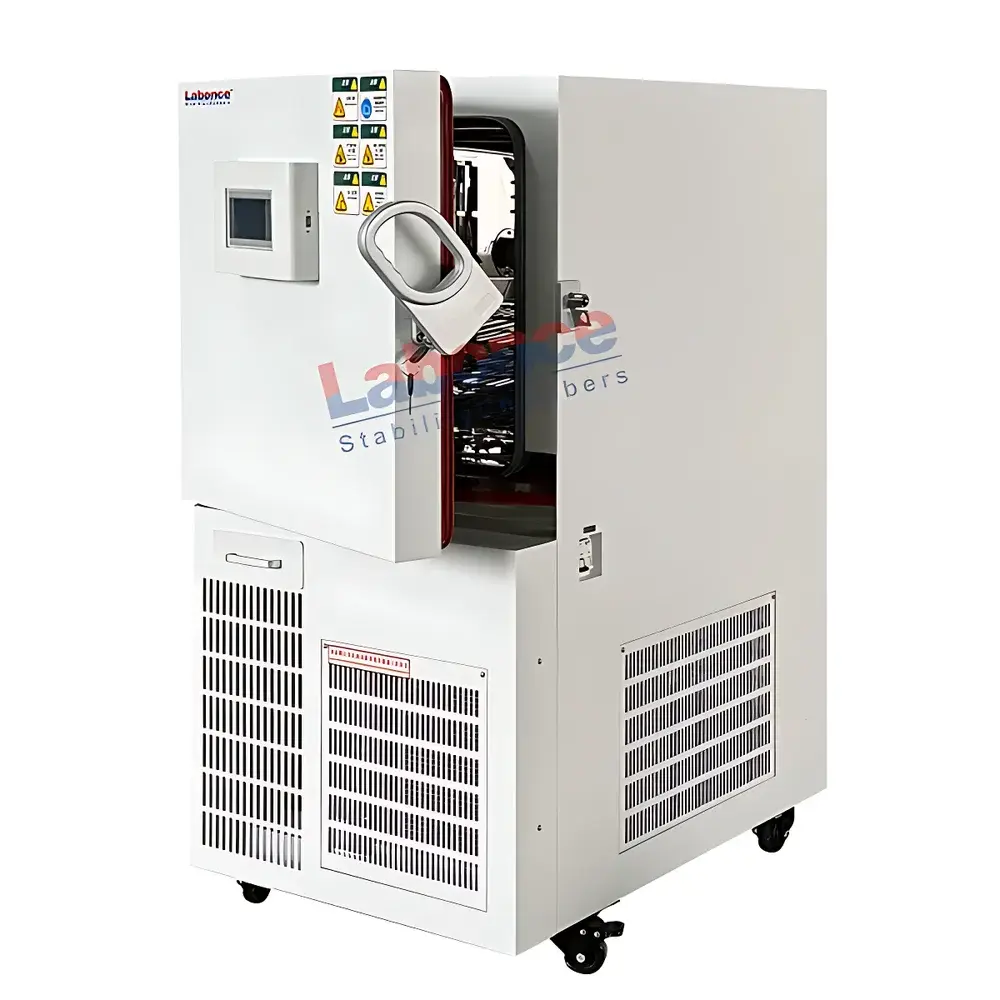
Labonce Labonce-250GDJ High-Low Temperature Alternating Test Chamber
| Brand | Labonce |
|---|---|
| Model | Labonce-250GDJ |
| Temperature Range | -20 °C to 150 °C (Configurable Options: -40 °C / -60 °C to 150 °C) |
| Internal Volume | 250 L |
| Internal Dimensions (W×D×H) | 650 mm × 550 mm × 700 mm |
| External Dimensions (W×D×H) | 930 mm × 1180 mm × 1850 mm |
| Temperature Uniformity | ±2.0 °C |
| Temperature Fluctuation | ±0.5 °C |
| Heating Rate | 1–3 °C/min |
| Cooling Rate | 0.7–1 °C/min |
| Construction | Exterior – Powder-coated steel |
| Control System | Programmable color touchscreen controller with multi-segment ramp-soak profiles and constant-value operation |
| Data Logging | Internal electronic storage with USB export capability |
| Safety Protections | Compressor overheat & high-pressure cut-off, fan overheat protection, independent over-temperature safety cutoff, upper/lower temperature deviation alarm |
| Compliance | GB/T 10592–2008 |
Overview
The Labonce Labonce-250GDJ High-Low Temperature Alternating Test Chamber is an engineered environmental simulation system designed for rigorous thermal stress evaluation of electrical, electronic, and electromechanical components under controlled non-humidified conditions. Unlike combined temperature-humidity chambers, the GDJ series focuses exclusively on precise, repeatable thermal cycling across wide operational ranges—from sub-zero cryogenic exposure (-60 °C option) to elevated thermal aging (up to 150 °C)—without introducing moisture variables. This specialization enables accelerated life testing, qualification validation, and failure mode analysis in accordance with internationally recognized thermal test protocols. The chamber operates on forced-air convection principles, utilizing a balanced air distribution system to maintain spatial uniformity and temporal stability during dynamic temperature transitions. Its architecture supports continuous operation under industrial QA/QC, R&D, and regulatory compliance workflows—including those aligned with IEC 60068-2, MIL-STD-810, and automotive AEC-Q200 thermal cycling requirements.
Key Features
- Robust thermal control architecture featuring dual-stage refrigeration with imported hermetic industrial compressors—optimized for long-term reliability, low acoustic emission (<65 dB(A)), and consistent cooling capacity across ambient temperatures up to 35 °C.
- Advanced air circulation design incorporating asymmetric duct geometry and variable-speed EC fans to minimize thermal stratification; validated temperature uniformity ≤ ±2.0 °C across the full working volume per GB/T 10592–2008.
- High-integrity chamber construction: exterior cold-rolled steel with epoxy-polyester powder coating for corrosion resistance; interior chamber walls, floor, and ceiling fabricated from 1.2 mm thick AISI 304 stainless steel—welded, passivated, and electropolished for chemical inertness and cleanability.
- Intuitive programmable controller with 7-inch TFT color touchscreen interface supporting up to 99 programmable segments, 999 cycles, and real-time graphical display of setpoint vs. actual temperature curves.
- Integrated safety redundancy: independent mechanical over-temperature limiter (non-resettable), compressor discharge temperature monitoring, high-pressure switch, and configurable deviation alarms with relay outputs for external interlock integration.
- Standard data logging module records timestamped temperature values at user-defined intervals (1 s to 60 min); logged data exportable via USB 2.0 port in CSV format compatible with Excel, MATLAB, and LIMS platforms.
Sample Compatibility & Compliance
The Labonce-250GDJ accommodates samples up to 600 mm × 500 mm × 650 mm (W×D×H) on two adjustable 304 stainless steel shelves (load capacity: 25 kg/shelf, uniformly distributed). Its open-chamber configuration permits integration with external instrumentation (e.g., in-situ resistance meters, strain gauges, or optical sensors) via dedicated cable ports. The system conforms to GB/T 10592–2008 “Technical Requirements for High-Low Temperature Test Chambers” and supports traceable calibration using NIST-traceable PT100 reference probes. While not humidity-capable, its thermal performance metrics meet prerequisite thresholds for ISO/IEC 17025-accredited laboratories conducting thermal shock pre-conditioning prior to EMC, vibration, or HALT/HASS testing. Optional accessories include RS485 Modbus RTU interface for SCADA integration and DIN-rail mounted SSR modules for external heater control.
Software & Data Management
The embedded controller firmware includes built-in audit trail functionality compliant with GLP and GMP documentation standards: all parameter changes, program starts/stops, and alarm events are time-stamped and stored with operator ID (if configured with optional user authentication module). Data files retain metadata including chamber serial number, firmware version, and calibration due date. Exported CSV logs contain columns for elapsed time, setpoint temperature, chamber mean temperature, and alarm status flags—enabling automated parsing in statistical process control (SPC) software. For enterprise-level deployment, Labonce provides optional PC-based supervision software (LabView-compatible drivers included) supporting remote monitoring, multi-chamber fleet management, and PDF report generation with digital signature support aligned with FDA 21 CFR Part 11 requirements.
Applications
- Electronics reliability testing: thermal cycling of PCBAs, semiconductors, connectors, and passive components per JEDEC JESD22-A104 and IPC-9701.
- Automotive component validation: ECU thermal endurance, sensor drift characterization, and battery module thermal behavior assessment under simulated under-hood conditions.
- Aerospace hardware qualification: avionics box thermal soak testing per RTCA DO-160 Section 4.4 (Temperature Variation).
- Material science research: polymer crystallinity studies, elastomer compression set evaluation, and solder joint fatigue modeling under cyclic thermal loading.
- Quality assurance: incoming inspection screening, lot acceptance testing, and production line burn-in verification.
FAQ
What temperature ranges are available for the Labonce-250GDJ model?
The standard configuration supports -20 °C to +150 °C; optional low-temperature variants extend the lower limit to -40 °C or -60 °C upon factory configuration.
Is humidity control available on this model?
No—the GDJ series is strictly a dry thermal cycling chamber. For combined temperature-humidity testing, refer to the Labonce-250JS series.
Can the chamber be integrated into an automated test system?
Yes—standard RS485 Modbus RTU communication is provided; optional Ethernet/IP or Profibus-DP gateways are available for industrial network integration.
What is the maximum sample weight capacity per shelf?
Each of the two standard 304 stainless steel shelves supports up to 25 kg when load is evenly distributed; total chamber payload must not exceed 45 kg to preserve airflow integrity.
Does the system include calibration certification?
A factory calibration certificate (traceable to CNAS-accredited standards) is supplied with each unit; annual recalibration services are available through authorized Labonce service centers.



