
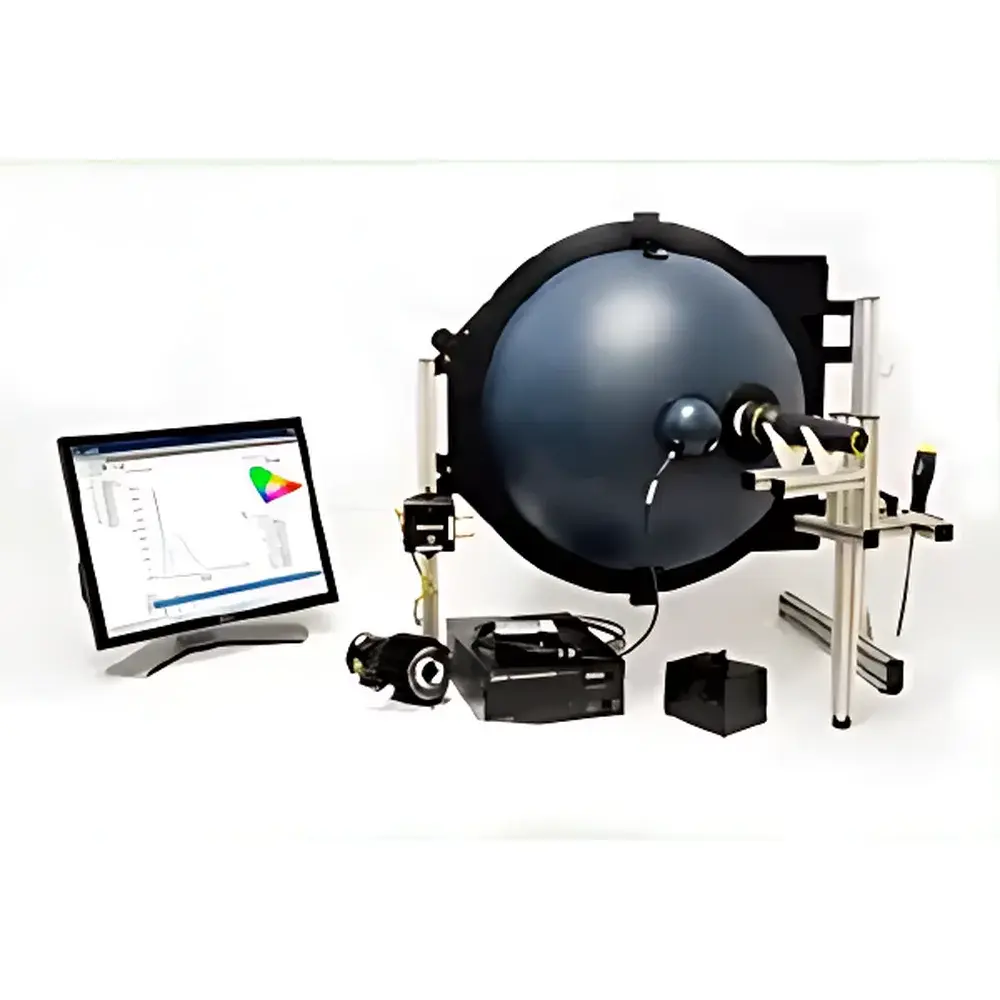
Labsphere FS2 Forward Flux Spectral Measurement System
| Brand | Labsphere |
|---|---|
| Origin | USA |
| Manufacturer Type | Authorized Distributor |
| Product Origin | Imported |
| Model | FS2 |
| Pricing | Upon Request |
Overview
The Labsphere FS2 Forward Flux Spectral Measurement System is a purpose-built optical test platform engineered to perform compliant, repeatable, and traceable photometric and radiometric characterization of directional light sources—including flashlights, headlamps, spotlights, and other portable projection-type luminaires. Designed in alignment with ANSI/NEMA FL1-2009—the internationally recognized standard for performance measurement of portable lighting devices—the FS2 system implements a calibrated integrating sphere-based forward flux methodology. It measures total luminous flux (lm), radiant flux (W), chromaticity coordinates (CIE x,y or u′,v′), correlated color temperature (CCT), color rendering index (CRI/Ra), spectral power distribution (SPD), and efficacy (lm/W) under controlled electrical and thermal conditions. The system’s architecture adheres to fundamental principles of photometry: uniform spatial integration via a high-reflectance (>98% diffuse reflectance) barium sulfate-coated sphere, spectroradiometer-coupled detection, and NIST-traceable calibration hierarchy—ensuring metrological integrity across R&D, production QA, and regulatory verification workflows.
Key Features
- Full compliance with ANSI/NEMA FL1-2009 requirements for beam distance, peak beam intensity, runtime, and light output testing
- Integrated MtrX-SPEC software enabling guided calibration, automated measurement sequences, and real-time spectral visualization
- High-dynamic-range acquisition capable of characterizing sources from sub-lumen LED indicators to multi-thousand-lumen tactical flashlights
- On-site recalibration support using Labsphere FFS-series forward flux reference lamps, each individually certified with NIST-traceable spectral irradiance and luminous flux data
- Pass/fail decision logic configurable per user-defined thresholds for luminous flux, CCT, CRI, or SPD shape conformity
- Modular hardware design accommodating variable source geometries and mounting fixtures—including vertical/horizontal orientation options and thermal management interfaces
Sample Compatibility & Compliance
The FS2 system supports a broad range of directional light sources: single-emitter and multi-emitter LED flashlights, incandescent (halogen/xenon/krypton) handheld lamps, rechargeable headlamps, and battery-powered spotlights. It accommodates physical dimensions up to Ø206 mm × 300 mm (diameter × height), with adjustable internal baffling to minimize stray light and optimize sphere efficiency. All measurements are performed under stabilized thermal and electrical operating conditions—consistent with FL1-2009’s mandated 30-second warm-up and steady-state reporting intervals. The system meets ISO/IEC 17025 requirements for testing laboratory competence when operated within documented procedures and maintained calibration schedules. Data records comply with GLP and GMP documentation expectations, including full audit trails for instrument settings, calibration history, operator ID, and environmental metadata (ambient temperature, humidity).
Software & Data Management
MtrX-SPEC software serves as the central control and analysis engine for the FS2 system. It provides ISO 17025-aligned calibration workflows, including multi-point spectral validation against FFS reference standards. Raw spectral data is stored in industry-standard formats (CSV, XML, CIE 15:2018-compliant .cie files) and supports export to LMS, LightTools, or TracePro for optical simulation integration. Each measurement session generates a timestamped report containing spectral plots, photometric summary tables, conformance flags against FL1-2009 criteria, and digital signatures for data integrity. Software features include configurable pass/fail limits, batch processing for production line throughput, and secure user role management aligned with FDA 21 CFR Part 11 requirements for electronic records and signatures.
Applications
- Design validation and comparative benchmarking of flashlight optical performance during product development
- Production-line quality assurance for luminous flux, color consistency, and runtime-to-output decay profiles
- Third-party certification testing for ANSI/NEMA FL1-2009, IEC 62471 (photobiological safety), and ENERGY STAR® SSL program eligibility
- LED package and driver efficiency optimization through correlated spectral and thermal derating analysis
- Regulatory submission support for CE marking, FCC lighting module compliance, and DoD MIL-STD-810G environmental performance documentation
- Calibration service provision by accredited labs offering NIST-traceable forward flux certification
FAQ
Does the FS2 system require external darkroom infrastructure?
No—its integrated sphere enclosure provides optical isolation; ambient light rejection is achieved via mechanical baffling and synchronized shutter-controlled integration timing.
Can the FS2 measure beam angle or candela distribution?
No—beam photometry (e.g., goniophotometry) requires a separate rotating detector setup; the FS2 measures total forward flux only, per FL1-2009 Section 4.1.
Is NIST traceability provided for every FS2 unit shipped?
Yes—each system includes a certificate of calibration referencing FFS lamp serial numbers and their associated NIST-traceable spectral flux values, valid for 12 months under recommended usage conditions.
What spectroradiometer models are compatible with the FS2?
The system is validated with Labsphere’s own SR-LED and SR-ULR series spectroradiometers; third-party instruments may be integrated subject to spectral responsivity and stray-light characterization validation.
How is thermal management addressed during extended runtime testing?
The FS2 supports optional thermal monitoring via embedded thermocouples and programmable duty-cycle sequencing to replicate real-world thermal transients while maintaining measurement repeatability.



