
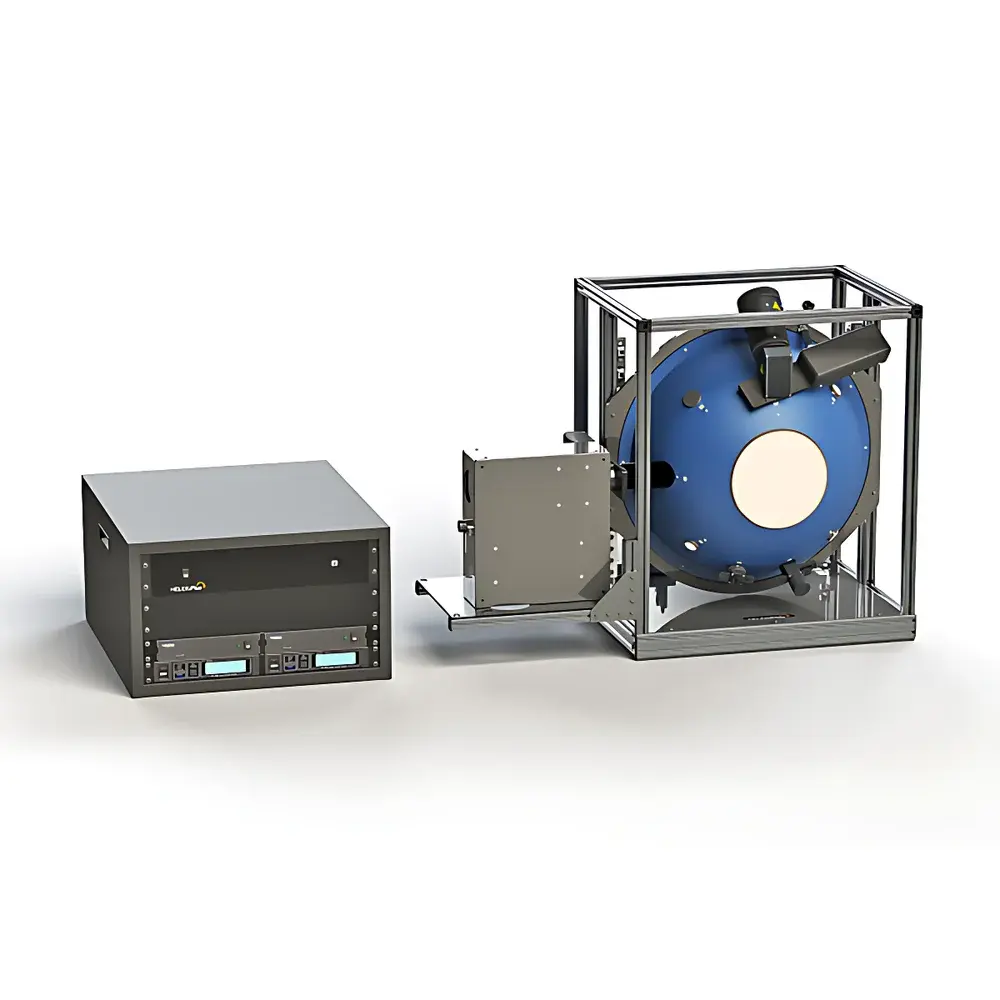
Labsphere Helios-Plus AMA Solar Simulation Integrating Sphere Source
| Brand | Labsphere |
|---|---|
| Origin | USA |
| Model | Helios-Plus AMA |
| Light Source Type | Xenon Arc Lamp |
| Illumination Mode | Internal Illumination |
| CCT Range | 3000 K to 6000 K |
| Spectral Range (Standard) | 350–1000 nm |
| Spectral Range (UV-Optimized) | 200–850 nm |
| Opening Diameter | 4 in or 8 in |
| Max Luminance | Up to 47,300 cd/m² |
| Opening Illuminance | Up to 182,000 lux |
| Field of View Uniformity | ±2.0% over 35° |
| Attenuation Options | Advanced Variable Attenuator (VAA), Dynamic Variable Attenuator (VAD), Manual Micrometer Attenuator (VA-MM) |
| Attenuator Resolution | Up to 2.00E+06 steps |
| Dynamic Range | Up to 152 dB |
| Integrated Spectroradiometer | Yes |
| Calibration Traceability | NIST-traceable |
| Compliance | ASTM E927, ISO 9050, MIL-STD-810G (optical testing), USP <1059>, FDA 21 CFR Part 11 (with optional audit trail) |
Overview
The Labsphere Helios-Plus AMA Solar Simulation Integrating Sphere Source is a precision-engineered optical calibration system designed for high-fidelity radiometric and photometric characterization under controlled, spectrally tunable illumination. Based on the fundamental principle of diffuse multiple-scattering within a highly reflective PTFE-coated integrating sphere, the Helios-Plus AMA delivers spatially uniform irradiance and radiance across its output port—enabling repeatable, geometry-independent calibration of remote sensors, imaging systems, radiometers, and spectral detectors. Unlike conventional broadband sources, this system integrates a stabilized xenon arc lamp (175 W or 300 W) with real-time spectral feedback and closed-loop intensity control to emulate solar spectral irradiance from Air Mass Zero (AM0) to terrestrial AM1.5G conditions, while supporting correlated color temperature (CCT) tuning from 3000 K to 6000 K ±50 K. Its architecture conforms to ASTM E927-22 standards for solar simulator classification and supports traceable calibration to NIST reference standards.
Key Features
- High-spatial-uniformity output: ±2.0% radiance uniformity over a 35° full field-of-view (FOV), validated per ISO 9050 Annex D protocols.
- Multi-mode attenuation architecture: Selectable Advanced Variable Attenuator (VAA), Dynamic Variable Attenuator (VAD), or Manual Micrometer Attenuator (VA-MM) for precise radiant flux control across six orders of magnitude (up to 152 dB dynamic range).
- Integrated spectroradiometric monitoring: Built-in CCD-based spectrometer (350–1000 nm standard; 200–850 nm UV-enhanced option) enables real-time tracking of spectral power distribution (SPD), CCT drift, and temporal stability during extended test sequences.
- Modular sphere configurations: Available in 4-inch and 8-inch output port diameters, with scalable luminance (up to 47,300 cd/m²) and illuminance (up to 182,000 lux) performance depending on lamp type and attenuator selection.
- NIST-traceable calibration suite: Delivered with full spectral radiance, irradiance, and CCT characterization reports at multiple intensity levels, each traceable to NIST Standard Reference Materials (SRMs) and compliant with ISO/IEC 17025 requirements.
- Robust thermal and electrical management: Active cooling and regulated DC power supply ensure lamp stability, spectral fidelity, and long-term repeatability (>1,000 hours rated lamp life under continuous operation).
Sample Compatibility & Compliance
The Helios-Plus AMA is engineered for compatibility with optical components and sensor assemblies requiring high-accuracy, low-uncertainty illumination—including focal plane arrays (FPAs), multispectral imagers, star trackers, Earth observation radiometers, and night-vision devices. Its internal illumination design eliminates external stray light interference and supports direct coupling to collimators, integrating spheres, or custom optical benches. The system meets critical aerospace and defense testing requirements outlined in MIL-STD-810G Method 505.6 (solar radiation exposure) and supports validation per ECSS-E-ST-10-04C (spacecraft optical calibration). For pharmaceutical and medical device applications, it aligns with USP guidance on light source qualification and supports 21 CFR Part 11-compliant data integrity when paired with optional HELOISEns® software audit trail modules. All configurations comply with GLP/GMP documentation standards for regulated laboratories.
Software & Data Management
HELIOSense® GUI serves as the unified control and analysis interface for the Helios-Plus AMA platform. Built upon Labsphere’s LSAPI (Labsphere Software Application Programming Interface), it provides hardware-agnostic recognition of all integrated components—including lamps, attenuators, spectrometers, and auxiliary detectors. The software supports scripted automation via Python API integration, enabling fully programmable “Hunt & Seek” feedback loops for spectral stabilization, intensity ramping, and multi-point calibration routines. Raw spectral data is exported in industry-standard formats (CSV, HDF5, CIE XYZ), with embedded metadata including timestamp, lamp hours, ambient temperature, and calibration certificate ID. Optional modules provide electronic signature support, user access controls, and full audit trail logging compliant with FDA 21 CFR Part 11 and ISO 13485 quality management systems.
Applications
- Aerospace & Defense: Radiometric calibration of satellite-based Earth observation sensors (e.g., VIIRS, OLI, MSI), solar array efficiency testing, and flight-hardware environmental stress screening under simulated solar flux conditions.
- Remote Sensing: Validation of atmospheric correction algorithms using controlled spectral reflectance and bidirectional reflectance distribution function (BRDF) targets illuminated under AM0–AM1.5G spectra.
- Automotive ADAS: Testing and verification of camera-based driver-assistance systems under variable daylight CCT and irradiance conditions—from dawn/dusk (3000 K) to midday sun (6000 K).
- Photovoltaic R&D: Spectral mismatch correction and quantum efficiency measurement of novel cell architectures under tunable solar spectra.
- Medical Imaging: Characterization of low-light CMOS/CCD detectors used in endoscopic and fluoroscopic systems, including near-IR sensitivity validation.
- Materials Science: Accelerated aging studies of optical coatings, filters, and polymers under controlled UV–VIS–NIR irradiance profiles.
FAQ
What spectral ranges are supported by the Helios-Plus AMA system?
The standard configuration covers 350–1000 nm; a UV-optimized variant extends coverage to 200–850 nm using quartz-transmissive optics and enhanced xenon lamp spectral output.
Is NIST traceability included with the system?
Yes—each unit ships with a comprehensive calibration certificate documenting spectral radiance, irradiance, CCT, and uniformity measurements, all traceable to NIST SRM 1930, 2010, and 2243.
Can the system simulate extraterrestrial (AM0) solar spectra?
Yes—the xenon arc lamp’s intrinsic spectral profile, combined with calibrated filter sets and real-time spectroradiometric feedback, enables accurate AM0 spectral emulation across the 200–2400 nm band.
How is angular uniformity verified and maintained?
Uniformity is characterized using a goniometric scanning radiometer per ISO 9050 Annex D; PTFE sphere coating stability and lamp positioning are validated quarterly per Labsphere’s preventive maintenance protocol.
Does the system support automated compliance testing per ASTM E927?
Yes—HELIOSense includes preconfigured test sequences for spatial non-uniformity, temporal instability, and spectral match classification (Class A/B/C), generating PDF reports aligned with ASTM E927-22 reporting requirements.





