
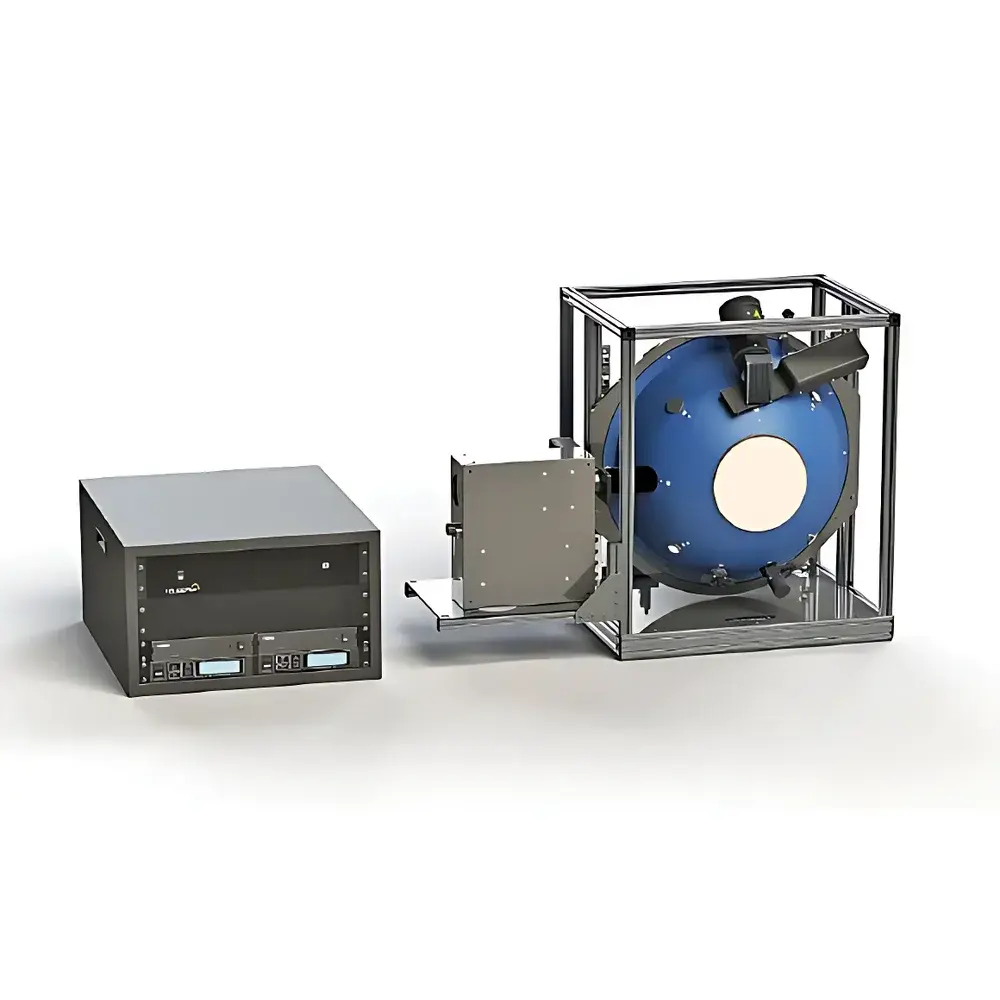
Labsphere HELIOS-A Solar Simulator with Integrating Sphere Uniform Light Source
| Brand | Labsphere |
|---|---|
| Model | HELIOS-A |
| Origin | USA |
| Light Source Technology | Electrodeless Plasma Lamp (Primary), Halogen & Xenon Options |
| Spectral Range | 250–2500 nm |
| Color Temperature Range | 3000 K–5300 K (Plasma), 3000 K–6500 K (Xenon), Customizable |
| UV Coverage | Yes (<380 nm) |
| Output Stability | <±0.5% over 1 hour (typical) |
| Dynamic Range | >150 dB (23-bit effective) |
| Calibration Traceability | NIST-traceable spectral irradiance |
| Trigger Mode | Continuous (Steady-State) |
| Compliance | ASTM E927-23, ISO 9022-11, IEC 60904-9 Ed. 3, MIL-STD-810H optical testing sections |
Overview
The Labsphere HELIOS-A Solar Simulator with Integrating Sphere Uniform Light Source is an engineered optical calibration platform designed for high-fidelity spectral and radiometric simulation of extraterrestrial and terrestrial solar irradiance. Based on the fundamental principle of integrating sphere homogenization—where light from multiple sources undergoes diffuse multiple reflections to achieve spatial uniformity and angular isotropy—the HELIOS-A delivers spectrally tunable, spatially uniform illumination across a broad 250–2500 nm range. Unlike conventional steady-state simulators relying solely on xenon arc lamps, the HELIOS-A integrates a proprietary electrodeless plasma lamp as its primary source, offering superior long-term spectral stability (10,000 hours), and reduced thermal load on test samples. Complementary halogen and xenon modules provide validated reference spectra for AM0 (air mass zero, space-simulated) and AM1.5G conditions, enabling traceable validation per ASTM E927-23 and IEC 60904-9 Ed. 3 standards. This architecture supports both laboratory-grade sensor characterization and mission-critical flight hardware verification under controlled, repeatable photonic conditions.
Key Features
- Electrodeless plasma lamp core source with NIST-traceable spectral output and minimal aging-induced drift
- Triple-source flexibility: plasma (3000–5300 K), halogen (2500–3200 K), and xenon (3000–6500 K), each independently selectable and spectrally characterized
- Integrating sphere geometry (standard 12″ or customizable up to 36″ diameter) ensures ≥98% spatial uniformity (per ISO 9022-11 Annex D)
- Built-in CCD-based spectroradiometer enables real-time monitoring of spectral irradiance, correlated color temperature (CCT), and UV content (<380 nm)
- 150 dB dynamic range (23-bit effective resolution) supports simultaneous low-light night-vision sensor testing and high-flux solar array calibration
- Steady-state trigger mode optimized for integration with lock-in amplifiers, frame-grabbers, and automated test sequences compliant with GLP/GMP data acquisition protocols
Sample Compatibility & Compliance
The HELIOS-A accommodates optical sensors, photovoltaic cells, multispectral imagers, star trackers, and electro-optical payloads requiring calibrated irradiance exposure. Its modular port configuration supports collimated beam extraction, fiber-coupled output, or direct sphere viewing—enabling adaptation to MIL-STD-810H optical environmental test procedures and NASA GSFC-STD-7000A radiometric verification workflows. All factory calibrations are performed against NIST-traceable reference detectors and include full spectral irradiance uncertainty budgets (k=2). The system complies with ISO/IEC 17025 requirements for accredited calibration laboratories and supports audit-ready documentation for FDA 21 CFR Part 11–compliant environments when paired with optional secure software logging.
Software & Data Management
HELIOS Control Suite v4.x provides deterministic instrument control via Ethernet (TCP/IP) or USB 2.0, supporting LabVIEW™, Python (PyVISA), and MATLAB® APIs. Spectral data is exported in standardized HDF5 and CSV formats with embedded metadata (wavelength, irradiance units, timestamp, calibration certificate ID). The software enforces role-based access control, electronic signature capture, and immutable audit trails—including parameter changes, calibration events, and spectral acquisition logs—to satisfy GLP, GMP, and DoD DI-IPSC-81475 requirements. Optional IQ/OQ documentation packages are available for regulated aerospace and defense qualification programs.
Applications
- Radiometric and spectral responsivity calibration of spaceborne Earth observation sensors (e.g., VIIRS, OLI, MSI)
- Photovoltaic device certification under IEC 61215 and UL 1703, including spectral mismatch correction
- EO/IR system testing across day/night cycles using programmable irradiance ramps (0.001–135,000 W/m² equivalent)
- UV degradation studies of optical coatings and polymer encapsulants per ASTM G154
- Validation of autonomous vehicle camera response curves under variable solar angles and atmospheric conditions
- Reference standard development for national metrology institutes requiring AM0–AM2 spectral fidelity
FAQ
Is the HELIOS-A compliant with ASTM E927-23 Class AAA requirements?
Yes—the system achieves Class A spectral match (±12.5% deviation from AM1.5G reference), Class A spatial uniformity (≤2%), and Class A temporal stability (≤0.5% variation over 10 s), meeting full AAA classification when configured with plasma + xenon dual-source mode.
Can the system be used for UV-accelerated aging tests?
Yes—its verified output below 380 nm, combined with real-time spectral monitoring, enables quantitative UV dose delivery per ISO 4892-2 and ASTM G154 protocols.
Does Labsphere provide NIST-traceable calibration certificates with each unit?
Yes—each HELIOS-A ships with a full spectral irradiance calibration certificate traceable to NIST SRM 1930 and 2030, including uncertainty analysis per ISO/IEC 17025 guidelines.
What is the recommended recalibration interval?
Annual recalibration is recommended for ISO/IEC 17025 compliance; however, built-in spectroradiometric self-checks allow in-house verification between formal calibrations.
Is remote operation supported for unattended testing campaigns?
Yes—Ethernet-based control, watchdog timers, and automatic error logging enable 72+ hour无人值守 operation with email/SNMP alerting on fault conditions.





