
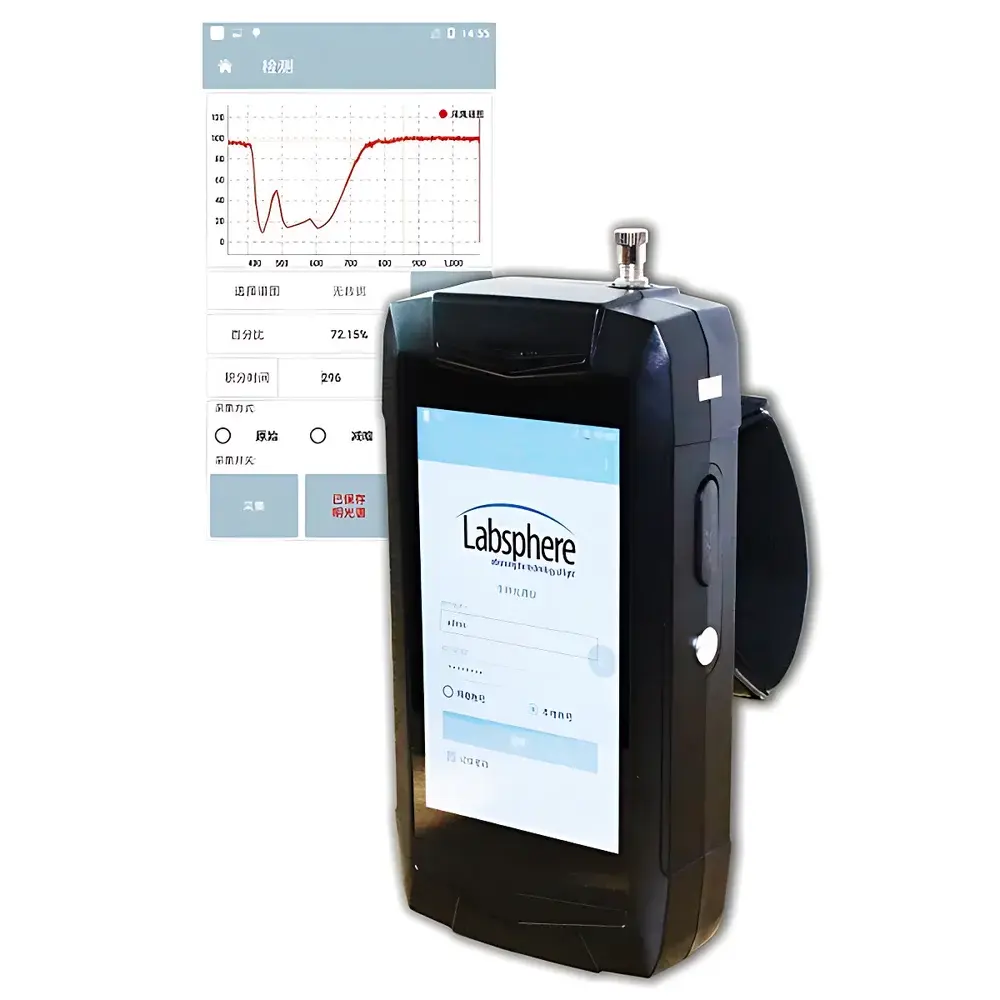
Labsphere LFHH-1000 Handheld Spectral Reflectance Analyzer
| Brand | Labsphere |
|---|---|
| Model | LFHH-1000 |
| Origin | Shanghai, China |
| Wavelength Range | 350–1050 nm |
| Spectral Resolution | ~1.5 nm |
| Signal-to-Noise Ratio | 300:1 |
| Detector | Hamamatsu S11639 CCD |
| Pixel Count | 2048 × 1 |
| Wavelength Accuracy | <0.2 nm |
| A/D Conversion | 16-bit |
| Acceptance Angle | 25° |
| Standard Reference Panel | 30 × 30 cm Spectralon® (99% reflectance, NIST-traceable options available) |
| Integration Time | 10–65 ms |
| Power Supply | Internal rechargeable Li-ion battery |
| Dimensions (L×W×H) | 17.5 × 9 × 3.5 cm |
| Weight | 1.0 kg |
| GPS Module | Integrated |
| Fiber Interface | SMA 905 compatible |
| Operating System | Android-based embedded platform |
Overview
The Labsphere LFHH-1000 Handheld Spectral Reflectance Analyzer is a field-deployable, Android-powered spectroradiometric instrument engineered for rapid, quantitative measurement of spectral reflectance across the visible and near-infrared (VIS-NIR) spectrum (350–1050 nm). Unlike conventional benchtop integrating sphere systems, the LFHH-1000 implements a direct-illumination, single-beam reflectance geometry with a fixed 25° acceptance angle optical head—optimized for high photon collection efficiency in ambient or outdoor environments. It integrates a Hamamatsu S11639 linear CCD array detector (2048 pixels, 16-bit digitization) with real-time dark-current subtraction, temperature-stabilized acquisition, and on-device spectral processing. Reflectance is computed relative to a calibrated Spectralon® reference standard (30 × 30 cm, 99% nominal reflectance), traceable to NIST via Labsphere’s ISO/IEC 17025-accredited calibration laboratory. The system operates without external PCs or laptops, delivering fully processed reflectance spectra (R(λ)) within seconds of measurement—enabling immediate interpretation in situ.
Key Features
- Embedded Android OS platform with intuitive touchscreen interface—no training required; operation mimics consumer smartphone workflows.
- Integrated GPS module geotags every spectral measurement, enabling spatial correlation in environmental, agricultural, or remote-sensing applications.
- Dual optical coupling options: built-in 25° field-of-view collimator for direct surface measurement, plus SMA 905 port for flexible fiber-optic probe integration (e.g., contact probes, cosine correctors, or custom illumination geometries).
- On-device spectral processing pipeline: automatic dark-frame subtraction, wavelength calibration correction, and reflectance ratio computation against user-selected Spectralon® reference data.
- Rechargeable lithium-ion battery supports ≥6 hours of continuous operation under typical integration settings (10–65 ms), with USB-C charging and status monitoring.
- Robust mechanical design: aluminum-magnesium alloy housing rated for field use; IP54-rated against dust and water splashes; operating temperature range: 0–40 °C.
Sample Compatibility & Compliance
The LFHH-1000 is validated for non-contact, non-destructive reflectance characterization of planar and moderately textured surfaces—including painted panels, textiles, soil substrates, vegetation canopies, coatings, and architectural materials. Its 25° acceptance angle ensures consistent sampling area geometry independent of minor surface topography or operator distance variation (working distance: 5–15 cm). All optical components comply with IEC 61000-4 electromagnetic compatibility standards. Spectralon® reference panels are supplied with full NIST-traceable calibration certificates (per ISO/IEC 17025), and optional GMP/GLP-compliant audit trails are available via optional software license for regulated environments (e.g., ASTM E308, ISO 11664-4, CIE 15:2018). Device firmware adheres to Android Enterprise Recommended (AER) security protocols, supporting encrypted local storage and secure cloud export.
Software & Data Management
The proprietary Android application provides full control over acquisition parameters (integration time, averaging, ROI selection), real-time spectral preview, and export-ready data packaging. Measured spectra are saved in industry-standard formats: CSV (wavelength vs. R(λ)), JSON (metadata-rich), and optionally CIE XYZ/Lab values per measurement. Local storage supports >10,000 spectra; data syncs via Wi-Fi or USB to Windows/macOS platforms using Labsphere’s SpectraSuite Desktop Companion (v3.2+), which enables batch analysis, spectral library matching, PCA clustering, and report generation compliant with ISO/IEC 17025 documentation requirements. Audit log functionality records user ID, timestamp, GPS coordinates, instrument serial number, and calibration status—meeting FDA 21 CFR Part 11 electronic record integrity criteria when enabled.
Applications
- Agricultural monitoring: NDVI, PRI, and other vegetation indices derived directly from raw reflectance spectra.
- Soil science: organic matter estimation, moisture content inference, and mineral composition screening via spectral absorption feature analysis (e.g., Fe-oxide bands near 850 nm).
- Color quality control: spectral colorimetry for paints, plastics, and printed materials per ISO 12647 and ASTM D2244.
- Remote sensing validation: ground-truthing of satellite or UAV-based hyperspectral imagery.
- Conservation science: pigment identification and degradation assessment in cultural heritage objects.
- Building material evaluation: solar reflectance index (SRI) calculation per ASTM E1980 for cool roof certification.
FAQ
What spectral calibration standards are included with the LFHH-1000?
The system ships with a 30 × 30 cm Spectralon® reference panel (99% nominal reflectance), certified with NIST-traceable data. Additional panels (e.g., 50%, 20%, or 5% reflectance) and custom sizes are available upon request.
Can the LFHH-1000 operate under direct sunlight?
Yes—the optical design incorporates ambient light rejection through temporal gating and spectral post-processing; however, optimal SNR is achieved under diffuse daylight or controlled artificial illumination.
Is the device suitable for regulatory submissions?
When configured with audit-trail-enabled firmware and paired with NIST-traceable calibration documentation, the LFHH-1000 meets foundational data integrity requirements for GLP, GMP, and ISO/IEC 17025 workflows.
How is wavelength accuracy maintained over time and temperature?
The Hamamatsu detector includes on-chip thermal stabilization; factory wavelength calibration is verified daily using internal mercury-argon reference lines, with drift compensation applied in real time during acquisition.
Does the system support third-party spectral libraries?
Yes—CSV-formatted spectral libraries (e.g., USGS, ECOSTRESS, or custom databases) can be imported into SpectraSuite Desktop for spectral matching and classification algorithms.



