
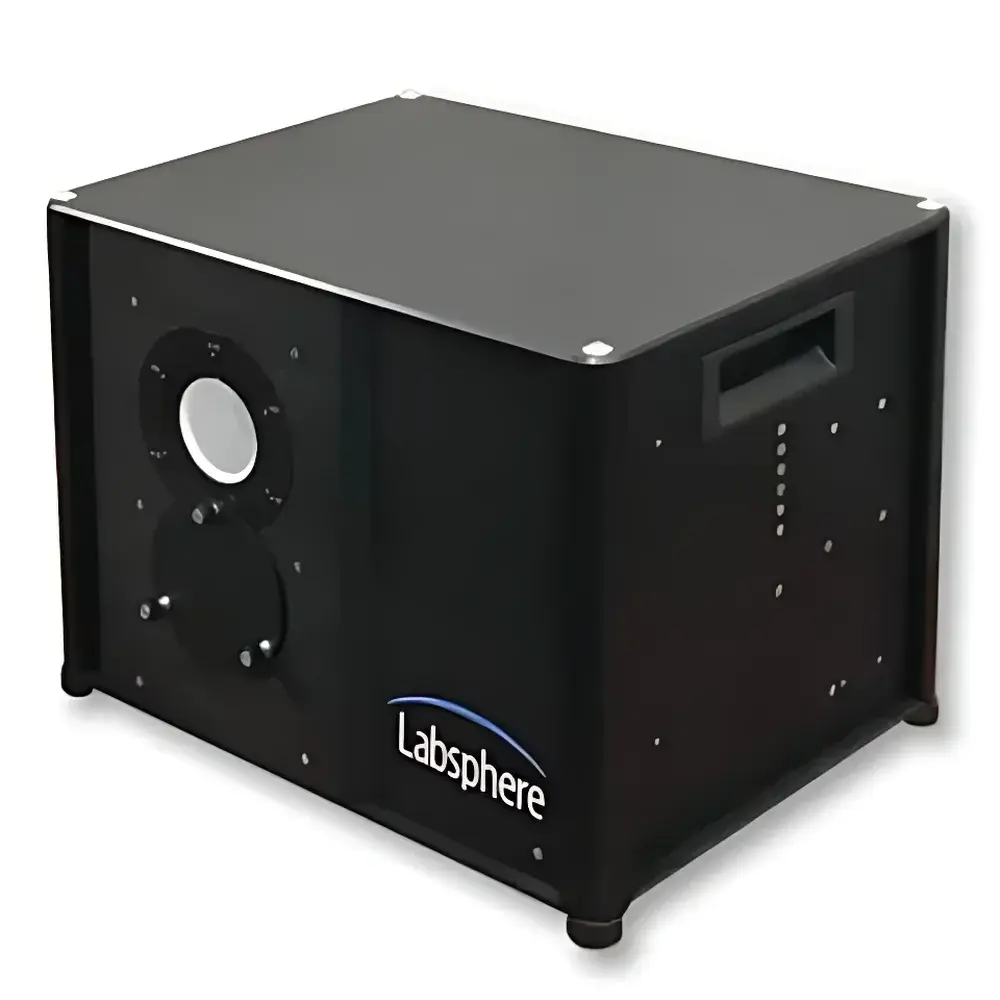
Labsphere Spectra-PT Adjustable Power Calibration Light Source
| Brand | Labsphere |
|---|---|
| Model | Spectra-PT |
| Origin | USA |
| Light Source Type | Integrating Sphere-Based Uniform Radiance/Luminance Source |
| Sphere Diameter | 13.5 cm |
| Output Port Diameter | 5 cm |
| Variable Aperture | Motorized, Precision Automatic (VA) |
| Built-in Reference Photodetector | Yes |
| Luminance Range | 0.01–50,000 cd/m² (continuous, programmable) |
| Spectral Output | Broadband (Xenon or Mercury-based, configurable) |
| Calibration | NIST-traceable spectral radiance and luminance |
| Compliance | ISO/IEC 17025-accredited calibration certificate included |
| Software Interface | LabVIEW-compatible, USB/Ethernet control, GUI for preset definition and real-time monitoring |
| Form Factor | Integrated benchtop enclosure with mobility handles |
| Optional Configuration | Wide-Angle Field-of-View (WAF) version available for >180° FOV imaging systems |
Overview
The Labsphere Spectra-PT Adjustable Power Calibration Light Source is a precision-engineered integrating sphere-based radiometric and photometric standard designed for traceable, repeatable, and spatially uniform illumination in optical testing and sensor characterization. Operating on the principle of multiple diffuse reflections within a Spectralon®-coated integrating sphere, the system delivers Lambertian emission with exceptional spatial uniformity (>99.5% over output port) and temporal stability (<0.2% drift over 8 hours). It serves as a primary reference source for absolute responsivity calibration, flat-field correction, and linearity verification across visible and near-visible spectral bands (typically 350–1000 nm, depending on lamp configuration). Unlike broadband lamps used in qualitative illumination, the Spectra-PT integrates closed-loop feedback via its built-in calibrated photodetector to maintain setpoint accuracy under varying ambient conditions and aging effects—ensuring metrological integrity throughout its service life.
Key Features
- Motorized precision variable aperture (VA) enabling continuous, stepless luminance adjustment from 0.01 to 50,000 cd/m² with <±1.5% full-scale repeatability
- NIST-traceable spectral radiance and luminance calibration delivered with each unit; certificates include uncertainty budgets per ISO/IEC 17025 requirements
- Spectralon® coating (≥99% reflectance, 350–2500 nm) ensures long-term reflectance stability and minimal spectral shift over >10,000 operating hours
- Integrated benchtop architecture with ergonomic handles, EMI-shielded electronics, and industrial-grade thermal management for lab and production-line deployment
- USB 2.0 and Ethernet (TCP/IP) connectivity supporting remote automation via SCPI commands or LabVIEW, Python, and MATLAB APIs
- Optional Wide-Angle Field-of-View (WAF) configuration with extended baffle geometry and optimized port optics for calibration of fisheye, hemispherical, and panoramic imagers
Sample Compatibility & Compliance
The Spectra-PT is compatible with a broad class of optoelectronic devices requiring spatially uniform, spectrally stable irradiance or radiance stimuli. This includes monochrome and RGB CMOS/CCD image sensors, scientific cameras (sCMOS, EMCCD), medical endoscopes (Class IIa/IIb per IEC 62304), automotive ADAS cameras, environmental light sensors (ALS), and security-grade surveillance modules. All factory calibrations adhere to ASTM E308 (computing colorimetric quantities), CIE S 023 (photometric standards), and ISO 15739 (electronic still-picture imaging noise measurement), ensuring alignment with international test protocols. The system supports GLP-compliant audit trails when operated with validated software configurations and meets essential requirements for ISO 9001-certified QA environments.
Software & Data Management
The Spectra-PT ships with SpectraControl™ GUI—a platform-independent application enabling intuitive brightness profiling, preset library management, ramp/step sequence programming, and real-time photodetector readout logging. Raw data export is supported in CSV and HDF5 formats, preserving metadata such as timestamp, integration time, aperture position, and detector gain settings. For regulated environments, optional 21 CFR Part 11 compliance packages are available, including electronic signatures, role-based access control, and immutable audit logs. Integration into automated test stands is facilitated through command-line interface (CLI) mode and native support for NI TestStand and Keysight PathWave.
Applications
- Flat-field correction and pixel response non-uniformity (PRNU) mapping for machine vision and remote sensing payloads
- Dynamic range and saturation threshold characterization of high-speed and low-light imaging systems
- Linearity verification of photometric response curves per ISO 15739 Annex D
- Validation of auto-exposure algorithms in consumer electronics and automotive camera modules
- Calibration of spectral radiance meters and imaging colorimeters against primary standards
- Functional testing of ambient light sensors in smartphones, wearables, and smart building controllers
FAQ
What lamp options are supported in the Spectra-PT system?
The base configuration uses a stabilized DC-driven xenon arc lamp; mercury-xenon hybrid and deuterium options are available upon request for UV-enhanced applications.
Can the Spectra-PT be used for spectral irradiance calibration?
Yes—when paired with an external calibrated spectroradiometer and appropriate optical fiber coupling, it serves as a stable uniform source for relative spectral responsivity testing.
Is firmware upgradable in the field?
Yes—firmware updates are distributed via Labsphere’s secure customer portal and applied using the SpectraControl™ utility without hardware modification.
How often does the system require recalibration?
Annual recalibration is recommended for ISO/IEC 17025 compliance; NIST-traceable certificates include recalibration due dates and uncertainty propagation guidance.
Does the WAF version compromise luminance uniformity?
No—the WAF variant maintains >99.0% spatial uniformity across its extended angular output distribution, verified per CIE 122-2022 methodology.




