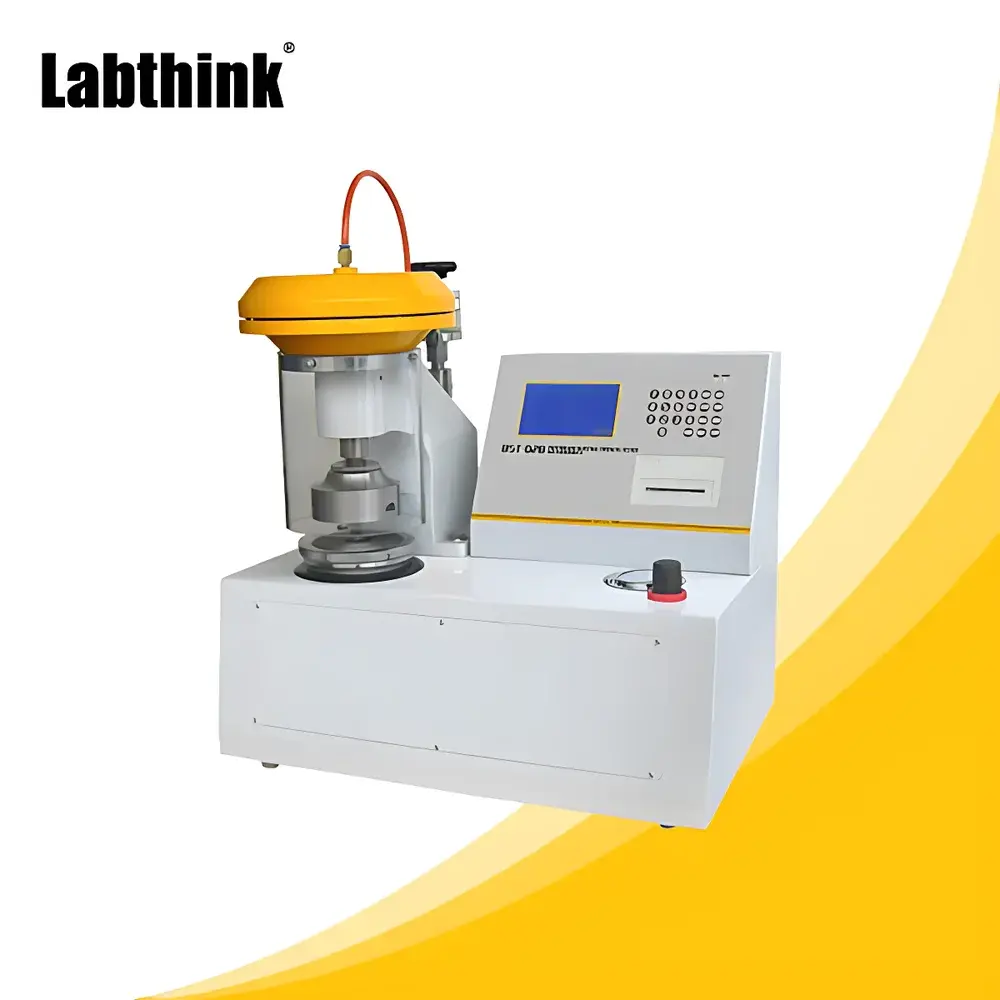
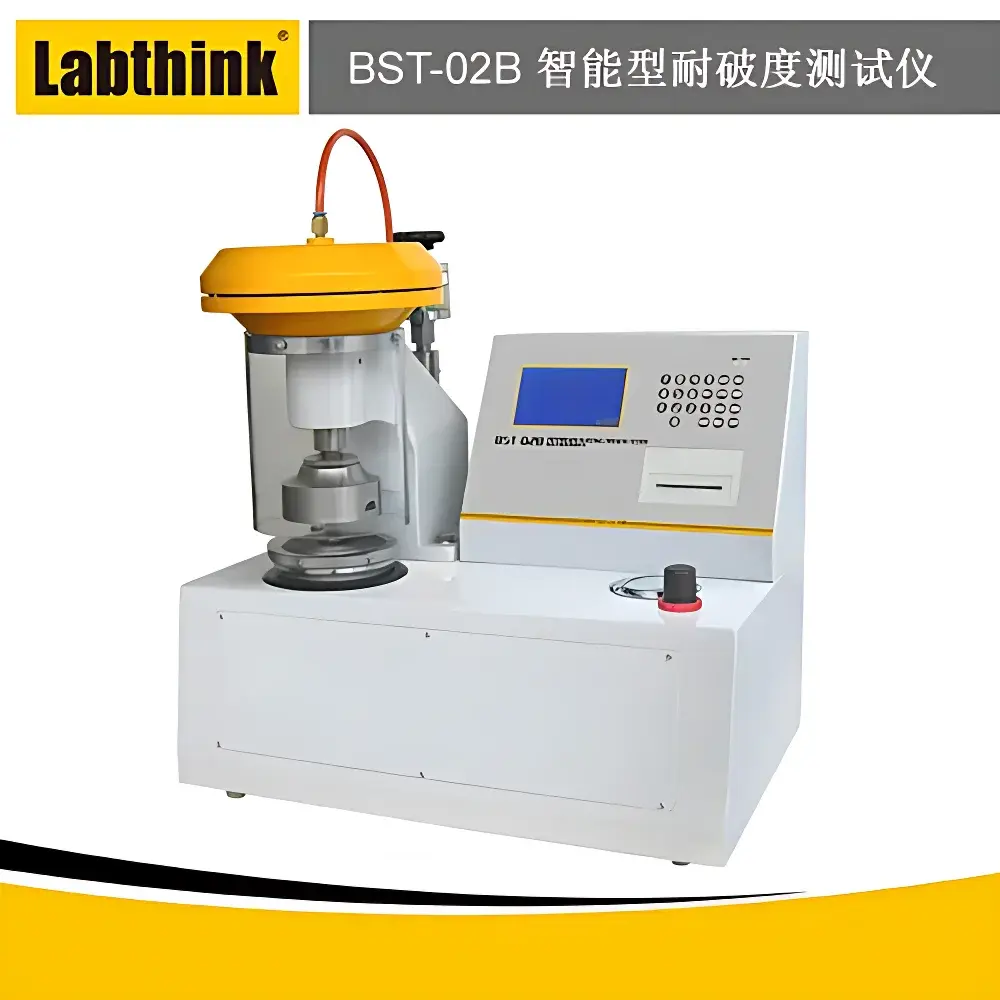
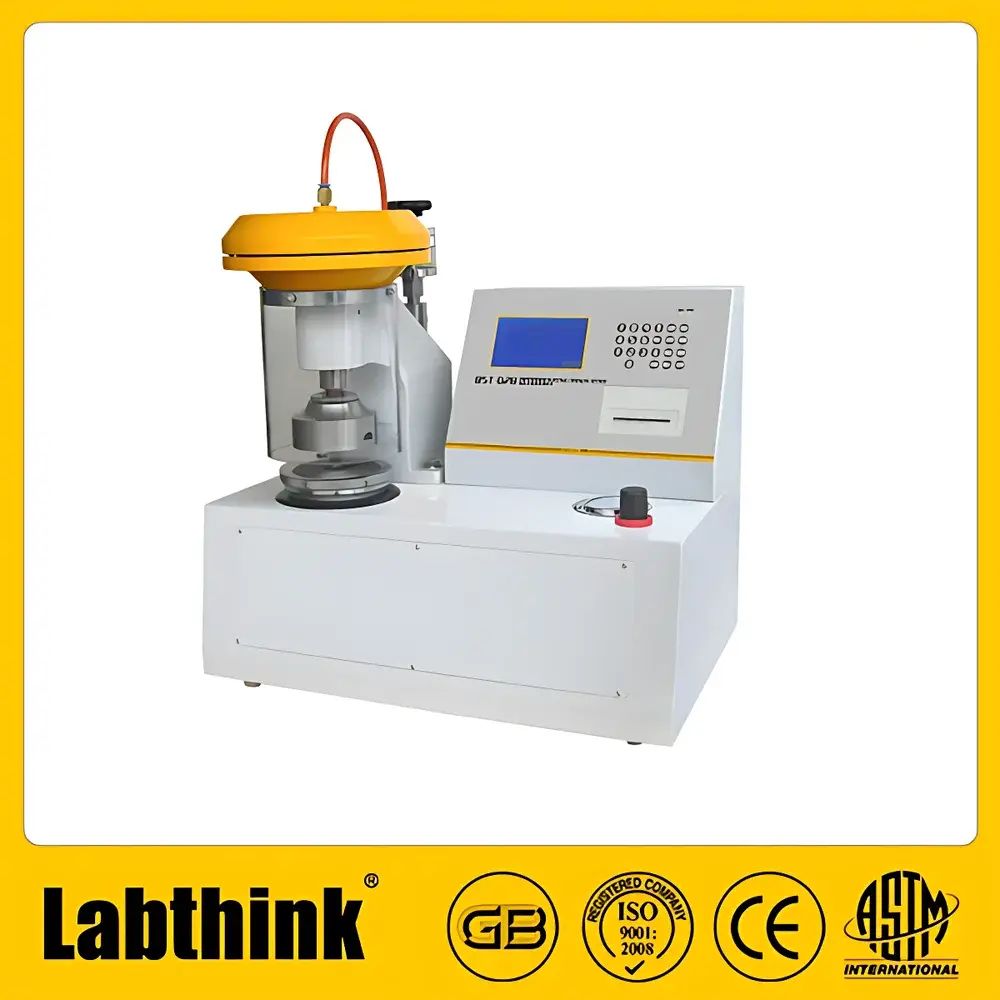
Labthink BST-02B Intelligent Bursting Strength Tester
| Brand | Labthink |
|---|---|
| Model | BST-02B |
| Measurement Range | 250–5600 kPa |
| Accuracy | ≤0.5% FS |
| Resolution | 0.1 kPa (low range) / 1 kPa (high range) |
| Diaphragm Resistance | 170–220 kPa (10 mm dome height), 250–250 kPa (18 mm dome height) |
| Clamp Pressure | >690 kPa (adjustable) |
| Clamp Ring Inner Diameter | Φ31.5 ± 0.05 mm (upper & lower) |
| Hydraulic Oil Flow Rate | 170 ± 15 mL/min (methyl silicone oil) |
| Power Supply | AC 220 V, 50 Hz |
| Dimensions | 530 × 350 × 600 mm |
| Weight | 85 kg |
| Compliance | GB/T 1539, GB/T 6545, ISO 2759 |
Overview
The Labthink BST-02B Intelligent Bursting Strength Tester is a precision-engineered instrument designed for the quantitative evaluation of bursting strength in corrugated board, solid fiberboard, cartons, and other packaging substrates. It operates on the standardized hydraulic diaphragm method—compliant with ISO 2759, GB/T 1539, and GB/T 6545—in which a clamped specimen is uniformly deformed by a flexible rubber diaphragm under controlled hydraulic pressure until rupture occurs. The peak pressure recorded at failure constitutes the bursting strength value, expressed in kilopascals (kPa), kilograms-force per square centimeter (kgf/cm²), or pounds-force per square inch (lbf/in²). This principle ensures high reproducibility across laboratories and aligns with international quality assurance frameworks used in packaging R&D, production QC, and third-party certification testing.
Key Features
- Microprocessor-based control system with integrated circuitry for stable signal acquisition and real-time load monitoring;
- 5-inch LCD display with intuitive Chinese interface (English firmware optional) supporting dynamic curve visualization of force vs. time;
- Automatic peak-hold functionality with digital locking of maximum burst pressure upon specimen failure;
- Multi-unit conversion capability: seamless switching between kPa, kgf/cm², and lbf/in² with on-screen unit labeling;
- Pneumatic sample clamping mechanism delivering ≥690 kPa clamping pressure (adjustable) to prevent slippage during pressurization;
- Integrated thermal-printer module for immediate hardcopy output of test ID, timestamp, individual results, max/min/mean values, coefficient of bursting strength, and statistical summaries;
- Data retention during power interruption with non-volatile memory protection;
- RS232 serial interface enabling bidirectional communication with external PCs for data export and remote diagnostics;
- Diaphragm calibration compensation algorithm correcting for inherent nonlinearity in sensor response across the full measurement span;
- Self-diagnostic alerts for mechanical faults, pressure anomalies, and out-of-tolerance diaphragm performance.
Sample Compatibility & Compliance
The BST-02B accommodates standard circular specimens (Φ31.5 ± 0.05 mm) cut from flat or formed paperboard materials—including single- and double-wall corrugated board, chipboard, kraft linerboard, and recycled fiber composites. Its rigid dual-ring clamp geometry ensures uniform radial constraint and eliminates edge effects that compromise measurement fidelity. All operational parameters—including hydraulic flow rate (170 ± 15 mL/min using methyl silicone oil), diaphragm dome height specification (10 mm or 18 mm), and pressure ramp profile—are traceably aligned with ISO 2759 Annex A and GB/T 6545 Clause 6. The instrument meets metrological requirements for Class 1 accuracy per ISO 7500-1 and supports audit-ready documentation for GLP-compliant environments. Optional software modules provide electronic records compliant with FDA 21 CFR Part 11 when configured with user authentication, audit trail, and electronic signature capabilities.
Software & Data Management
An optional PC-based application—compatible with Windows OS—enables comprehensive test management: batch creation, parameter templating, automated report generation (PDF/Excel), and long-term database archiving. Raw force-time datasets are exported in CSV format for post-test analysis in MATLAB, Origin, or Minitab. The software implements role-based access control, configurable pass/fail thresholds, and trend charting across multiple lots or suppliers. Audit logs record all user actions—including method edits, calibration events, and result overrides—with timestamps and operator IDs. When deployed in regulated settings, the system supports electronic signatures and secure data encryption consistent with GMP Annex 11 and ISO/IEC 17025 documentation integrity standards.
Applications
- Quality conformance testing of incoming raw materials (e.g., linerboard, medium fluting) against supplier specifications;
- In-process verification of corrugated board lamination integrity during converting operations;
- Design validation of shipping containers subjected to static stacking loads and dynamic compression;
- Comparative analysis of recycled content impact on structural robustness across fiber blends;
- Correlation studies linking bursting strength to other mechanical properties (e.g., edge crush test, compression strength, puncture resistance);
- Supporting ISTA 3A/3E and ASTM D642 test protocols where burst resistance informs overall package durability assessment;
- Regulatory submission dossiers requiring ISO-aligned mechanical test evidence for pharmaceutical or food-grade packaging compliance.
FAQ
What type of hydraulic fluid is required for operation?
Methyl silicone oil meeting ISO VG 10 viscosity grade is specified—non-corrosive, low-volatility, and free of sediment or additives that could degrade diaphragm elastomer integrity.
Is an air compressor included with the instrument?
No—the BST-02B requires an externally supplied compressed air source with 0.02–0.3 m³/min flow capacity and 0.6–0.7 MPa regulated output pressure; users must procure and maintain this utility separately.
Can test reports be exported in formats compatible with LIMS integration?
Yes—via RS232, the instrument transmits ASCII-formatted data packets; the optional software supports HL7 and ASTM E1384-compliant structured export for direct ingestion into laboratory information management systems.
How frequently should diaphragm calibration be performed?
Labthink recommends quarterly verification using certified reference pressure standards traceable to NIM (China) or NIST (USA); full recalibration is advised after 10,000 test cycles or any observed deviation exceeding ±0.3% FS.
Does the instrument support multi-language firmware beyond English and Chinese?
Currently, only English and Simplified Chinese interfaces are validated and supported; custom localization requires OEM firmware development engagement with Labthink’s engineering team.