
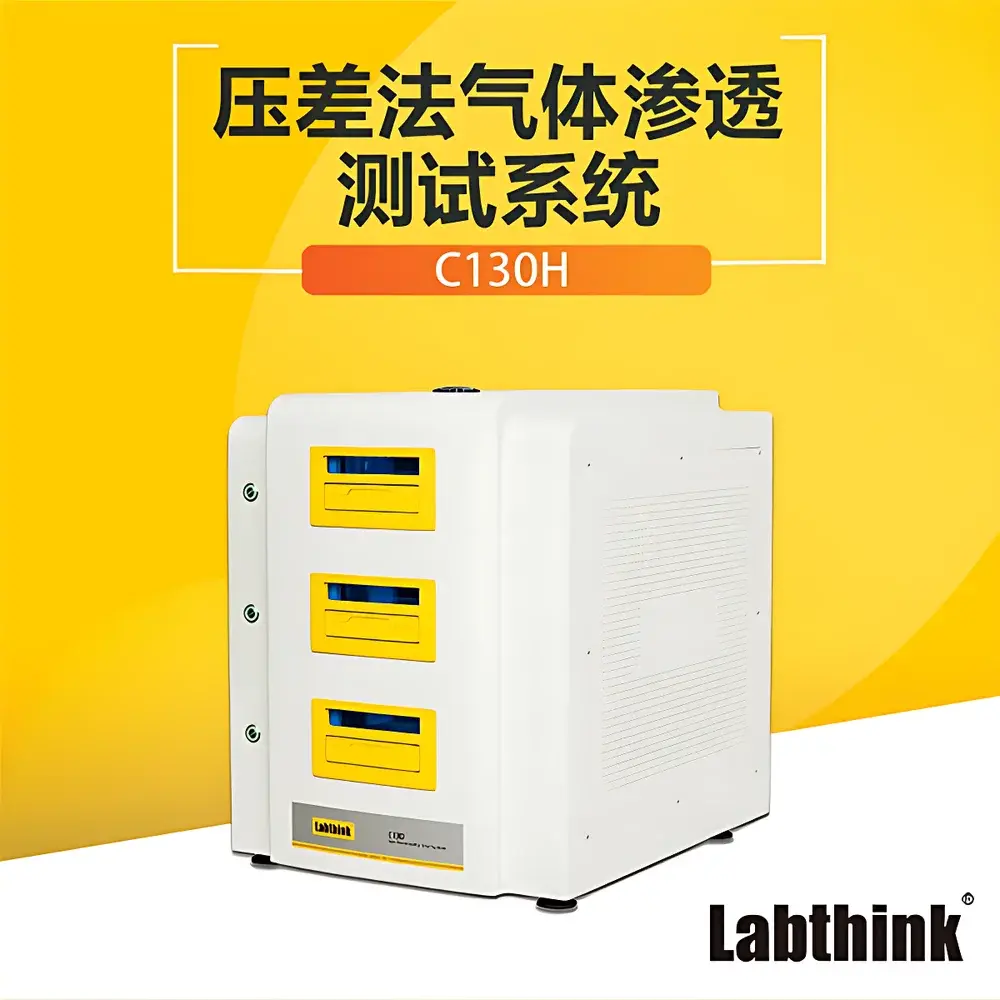
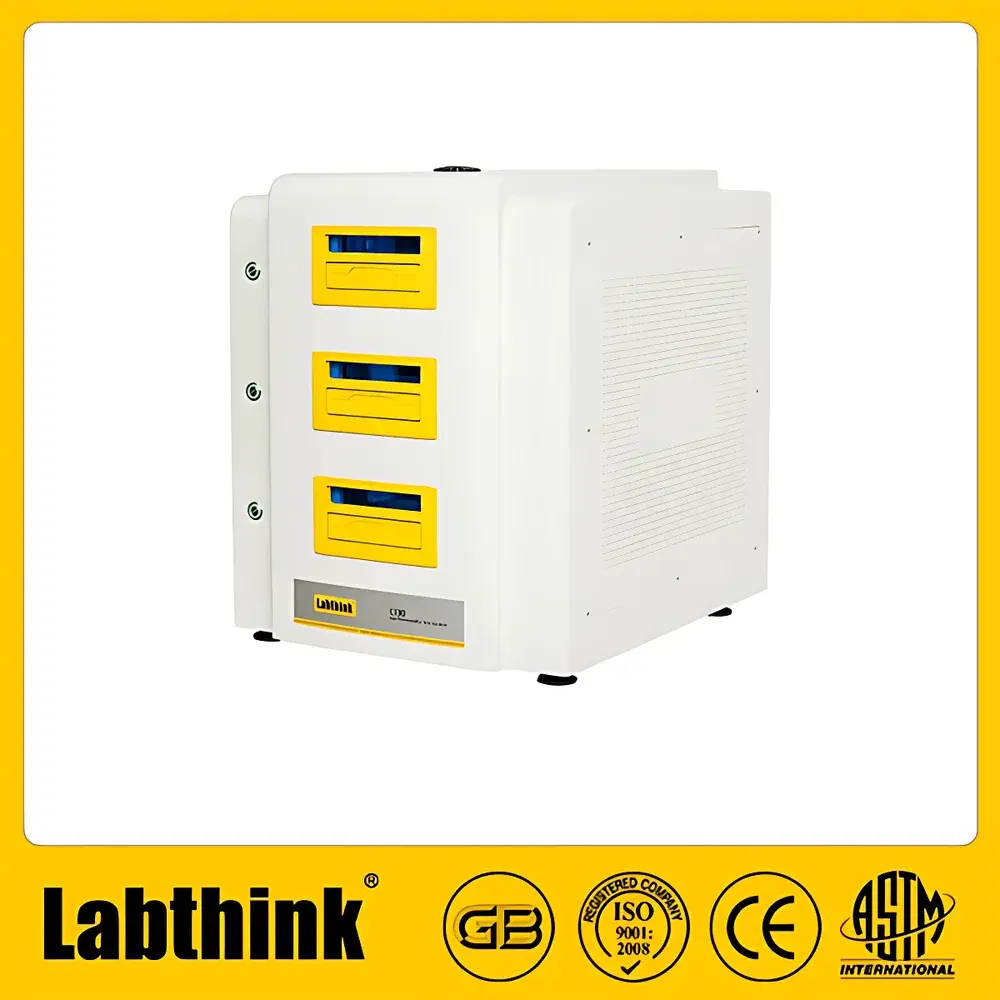
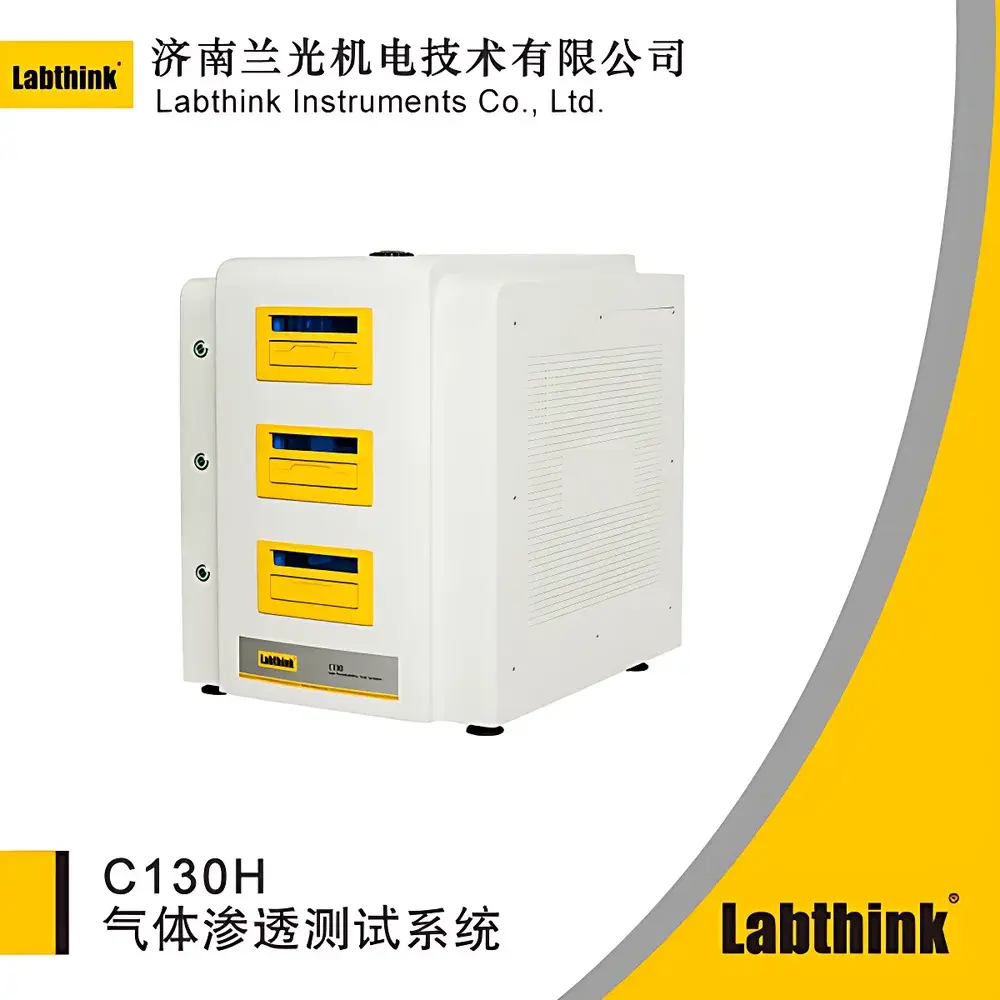
Labthink C130H Tri-Chamber Differential Pressure Gas Permeability Analyzer
| Brand | Labthink |
|---|---|
| Model | C130H |
| Measurement Principle | Differential Pressure (ASTM D1434 / ISO 15105-1) |
| Test Gases | O₂, N₂, CO₂, Air, He (customizable for flammable/toxic gases) |
| Test Range | 0.01–50,000 cm³/m²·24h·0.1MPa |
| Resolution | 0.001 cm³/m²·24h·0.1MPa |
| Temperature Range | 10–50 °C (±0.05 °C stability) |
| Vacuum Capability | <10 Pa base pressure, 0.01 Pa resolution |
| Pressure Control | 10–210 kPa (adjustable, ±0.2 kPa stability) |
| Sample Capacity | 3 independent chambers (Φ97 mm, 38.48 cm² effective area) |
| Compliance | GB/T 1038–2000, ISO 2556, JIS K7126-1, YBB 00082003, FDA 21 CFR Part 11 (optional), GMP Annex 11 (optional) |
Overview
The Labthink C130H Tri-Chamber Differential Pressure Gas Permeability Analyzer is an engineered solution for precise, reproducible determination of gas transmission rates (GTR), permeability coefficients (P), diffusion coefficients (D), and solubility coefficients (S) in flexible packaging materials and high-barrier substrates. It operates on the standardized differential pressure method—where a controlled pressure gradient is established across a conditioned specimen sealed between two isolated chambers, and gas flux through the material is quantified by real-time monitoring of pressure rise in the downstream (low-pressure) chamber using high-stability vacuum transducers. This principle conforms to ISO 15105-1, ASTM D1434, and GB/T 1038–2000, ensuring metrological traceability and regulatory acceptability across global pharmaceutical, food, aerospace, and advanced materials laboratories.
Key Features
- Tri-chamber architecture with fully independent pneumatic and vacuum control per chamber—enabling concurrent testing of three distinct samples under identical or divergent conditions (e.g., varying temperature, pressure, or gas type).
- Automated drawer-style test chamber with servo-assisted clamping—eliminates manual torque variability, ensures uniform sealing force (>250 N), and reduces operator-induced error.
- High-fidelity vacuum subsystem: UK-sourced dual-stage vacuum pump (ultimate vacuum <0.2 Pa), combined with German-made piezoresistive vacuum sensors (0.01 Pa resolution, ±0.2% full-scale accuracy), enabling reliable quantification of ultra-high-barrier materials down to 0.01 cm³/m²·24h·0.1MPa.
- 360° circumferential air-circulation thermal management system—maintains temperature stability within ±0.05 °C across the entire test zone, validated via internal calibration port (±0.3 °C accuracy at reference point).
- Dynamic pressure compensation: closed-loop feedback control actively maintains constant upstream pressure (10–210 kPa range) during test duration, limiting deviation to <0.2 kPa—even during extended measurements up to 8 hours.
- Embedded Windows-based computing platform with integrated display, keyboard, and mouse—designed to meet IEC 62304 software lifecycle requirements; eliminates external PC dependencies and associated cybersecurity or OS compatibility risks.
Sample Compatibility & Compliance
The C130H accommodates a broad spectrum of planar specimens—including monolayer and multilayer polymer films (e.g., PET/AlOx, PE/EVOH/PE), metallized foils (Al, SiOₓ), paperboard laminates, rubber sheets (e.g., butyl, EPDM), biodegradable matrices (PLA, starch-based films), fluoropolymer-coated fabrics (PTFE, FKM), and aerospace-grade composites (e.g., helium-barrier bladders). All tests are executed in strict adherence to ISO 15105-1 (gas transmission rate), ISO 2556 (oxygen transmission), and ASTM D1434 (gas permeability of plastics). Optional configurations support GLP/GMP-compliant operation: audit-trail-enabled DataShield™ data management, 21 CFR Part 11 electronic signature readiness, and hardware-integrated temperature/pressure calibration ports traceable to NIST-certified standards.
Software & Data Management
The embedded Labthink PermeTest™ v5.2 software provides both Standard Mode (single-parameter GTR reporting per ASTM/ISO) and Research Mode (full kinetic modeling of P, D, and S via Fickian regression). Real-time visualization includes synchronized pressure-vs.-time, permeation rate-vs.-time, and temperature-vs.-time plots—with automatic endpoint detection based on slope convergence criteria. Raw data export supports CSV, PDF, and XML formats; all metadata (operator ID, calibration status, environmental logs) are immutably embedded. Optional DataShield™ integration enables centralized database synchronization, role-based access control, and automated report generation compliant with ISO/IEC 17025 documentation requirements.
Applications
- Pharmaceutical packaging validation: blister foil integrity, cold-forming aluminum barrier performance, and child-resistant pouch permeation under accelerated aging protocols.
- Food packaging development: shelf-life modeling of modified atmosphere packaging (MAP) films using O₂/CO₂/N₂ permeability interdependence analysis.
- Aerospace component qualification: helium leak rate assessment of inflatable structures and composite fuel bladders per MIL-STD-810.
- Sustainable materials R&D: comparative oxygen transmission kinetics of compostable films under variable RH (with optional humidification module) and elevated temperature stress.
- Automotive elastomer testing: air retention evaluation of tire innerliners and fuel hose laminates per SAE J1708.
- Electronics encapsulation: moisture vapor transmission rate (MVTR) proxy analysis via nitrogen permeation in conformal coatings and flexible PCB barriers.
FAQ
What gases can be tested without customization?
Standard configuration supports O₂, N₂, CO₂, air, and He. Other gases—including H₂, CH₄, and SF₆—require custom gas-handling modules and safety interlocks.
Is humidity control available as a factory-installed option?
Yes. The optional integrated humidity generator enables precise RH control (10–90% RH, ±2% RH accuracy) in the upstream gas stream, with automatic dew-point stabilization and condensate management.
How is system calibration verified?
The instrument includes dedicated temperature and pressure calibration ports aligned with ISO/IEC 17025 procedures. Certified standard reference films (e.g., SRM 1472 from NIST-equivalent providers) are supplied for periodic GTR verification.
Can test data be exported to LIMS or ERP systems?
Yes. Through the optional DataShield™ interface, structured test records—including raw sensor outputs, calibration certificates, and operator annotations—are transmitted via secure HTTPS or OPC UA protocols.
What maintenance intervals are recommended?
Vacuum pump oil replacement every 3,000 operating hours; O-ring inspection and grease reapplication (USP-grade vacuum grease) every 6 months; annual sensor recalibration recommended for ISO 17025 accreditation.




