
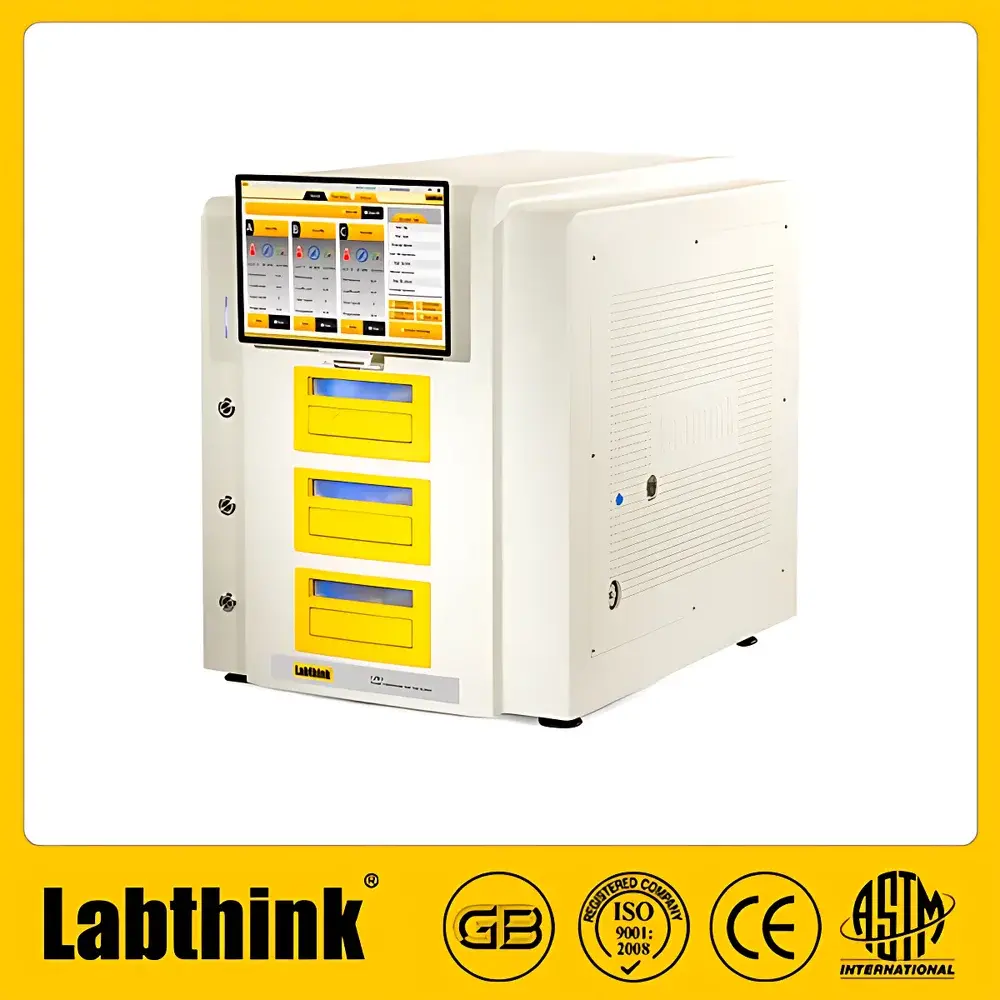
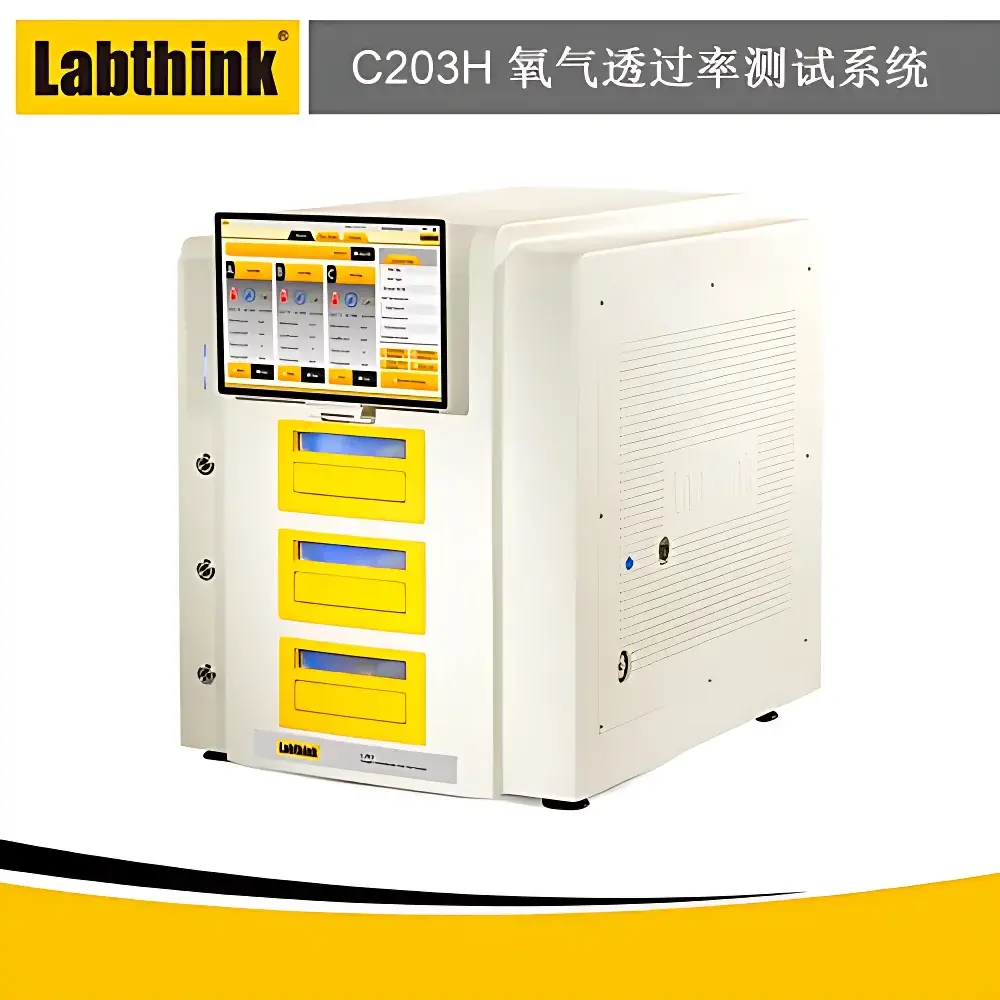
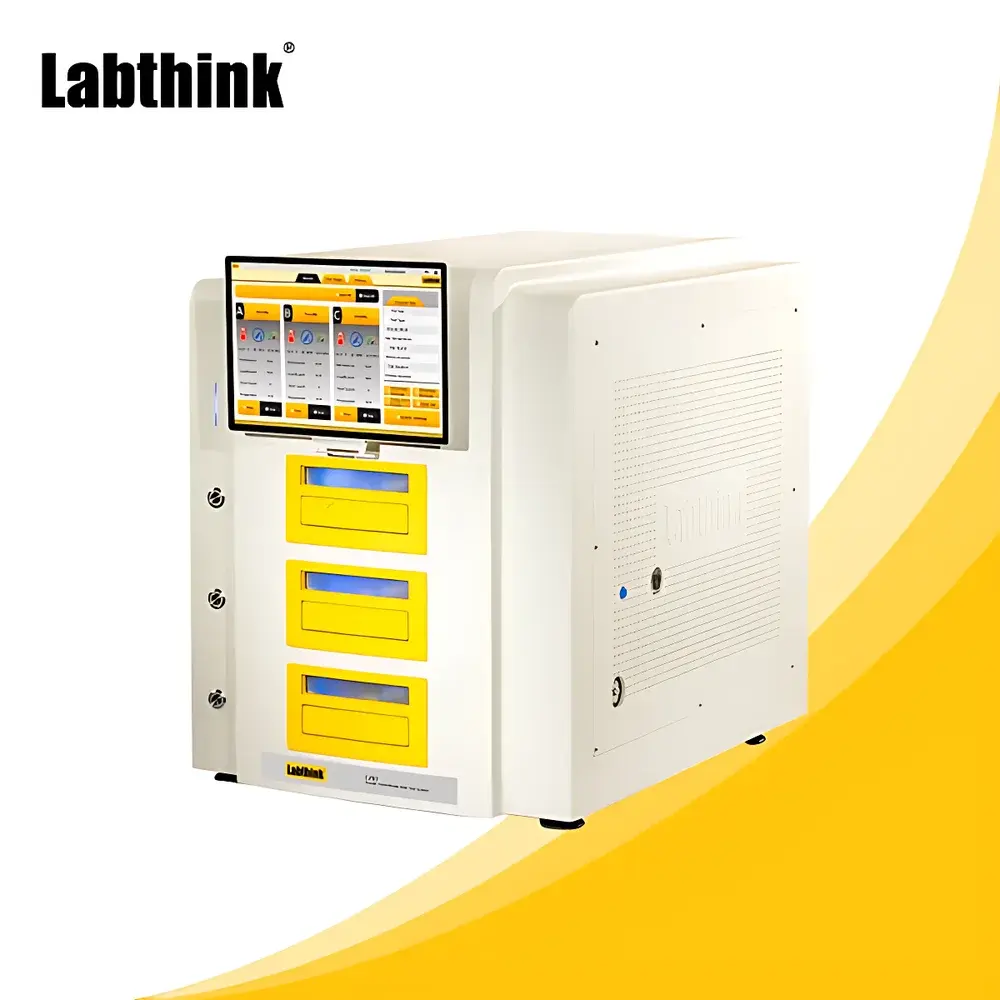
Labthink C203H Coulometric Oxygen Transmission Rate (OTR) Analyzer
| Brand | Labthink |
|---|---|
| Model | C203H |
| Measurement Principle | Coulometric Sensor + Isobaric Method |
| Standards Compliance | ASTM D3985, ASTM F1307, GB/T 19789, ISO 15105-2 (implied), JIS K7126-2-B |
| Test Area | 50 cm² (standard, triple independent chambers) |
| OTR Range | 0.01–200 cc/(m²·day) (50 cm²) |
| Resolution | 0.0001 cc/(m²·day) |
| Repeatability | ±0.01 cc/(m²·day) or ±1%, whichever is greater |
| Temperature Control | 15–50 °C (±0.05 °C stability) |
| RH Control | 0–90% RH (±1% for O₂ side, ±2% for carrier gas side) |
| Sensor Lifetime | ≥3× conventional coulometric sensors |
| Sample Thickness Limit | ≤3 mm |
| Power Supply | 120 VAC ±10% / 60 Hz or 220 VAC ±10% / 50 Hz |
| Net Weight | 100 kg |
| Dimensions | 600 × 500 × 700 mm |
Overview
The Labthink C203H Coulometric Oxygen Transmission Rate (OTR) Analyzer is an engineered solution for precise, trace-level oxygen permeation measurement in flexible barrier materials. It operates on the isobaric coulometric detection principle: oxygen molecules permeating through a conditioned test specimen are swept by ultra-high-purity nitrogen (≥99.999%) across the downstream side of the diffusion cell and quantitatively oxidized at a ppb-grade electrochemical sensor. The resulting current—directly proportional to oxygen molar flux—is converted into OTR values in standardized units (cc/(m²·day)) without reliance on calibration standards. This absolute measurement methodology aligns with ASTM D3985 and ASTM F1307, eliminating drift-related recalibration and ensuring long-term metrological integrity. Designed for laboratories requiring GLP-compliant, audit-ready data generation, the C203H integrates hardware-level temperature and humidity stabilization, real-time environmental logging, and deterministic flow control—enabling reproducible results under tightly defined test conditions.
Key Features
- Triple independent 50 cm² test chambers enabling simultaneous, statistically independent OTR measurements on three specimens—increasing throughput by 50% versus dual-chamber systems while maintaining full compliance with ASTM D3985 sample area requirements.
- Proprietary ppb-level coulometric oxygen sensor with ≥3× extended operational lifetime versus conventional sensors, reducing maintenance frequency and total cost of ownership over multi-year deployment.
- 360° circumferential air circulation thermal management system achieving ±0.05 °C temperature stability across the entire test zone—critical for minimizing thermal gradients that induce permeation artifacts in polymeric films.
- Integrated high-accuracy capacitive RH sensors (±1% RH on O₂ side) and PID-controlled humidity generators, enabling precise, programmable conditioning of both upstream (O₂ or air) and downstream (N₂) gas streams per ISO 15105-2 Annex A recommendations.
- Automated specimen loading via drawer-style test chamber with motorized clamping—ensuring uniform sealing pressure (≥350 kPa), eliminating operator-induced variability in gasket compression and edge leakage.
- Embedded industrial-grade computing platform (Windows OS, 12″ capacitive touchscreen) with local data storage, firmware-locked architecture, and no external USB/ethernet ports—mitigating cybersecurity risks and ensuring uninterrupted operation in regulated environments.
Sample Compatibility & Compliance
The C203H accommodates a broad spectrum of planar barrier materials up to 3 mm thickness and 11.2 cm × 11.2 cm dimensions. Validated applications include multilayer coextrusions, metallized PET and OPP, AlOx- and SiOx-coated films, laminated pharmaceutical blisters (PVC/PVDC, cold-forming foils), photovoltaic backsheet substrates, and elastomeric packaging for sterile medical devices. All hardware and software functions comply with FDA 21 CFR Part 11 requirements when configured with the optional CFR21Part11 module—including electronic signatures, audit trails with immutable timestamps, role-based access control, and data encryption at rest. Test reports conform to ISO/IEC 17025 documentation standards and support direct integration into LIMS via CSV or XML export. Regulatory alignment extends to YBB 00082003-2015 (China Pharmacopoeia), DIN 53380-3 (Germany), and JIS K7126-2-B (Japan).
Software & Data Management
Labthink’s proprietary OTRControl™ v5.2 software provides full lifecycle test management—from method definition (temperature, RH, gas composition, duration) to real-time permeation curve visualization and automated pass/fail evaluation against user-defined specifications. Each test generates a tamper-evident digital record containing raw sensor output, environmental logs (T/RH/flow), chamber pressure traces, and metadata (operator ID, calibration history, instrument firmware version). DataShield™ optional module enforces AES-256 encryption, automatic backup to network drives, and configurable retention policies aligned with GMP Annex 11. All exported datasets include embedded digital signatures verifiable via public key infrastructure (PKI), satisfying ALCOA+ principles (Attributable, Legible, Contemporaneous, Original, Accurate, Complete, Consistent, Enduring, Available).
Applications
- Pharmaceutical packaging validation: Quantifying OTR of blister lidding foils, sachet laminates, and cold-chain transport pouches to ensure shelf-life stability of oxygen-sensitive APIs (e.g., biologics, nitroglycerin, ferrous sulfate).
- Food packaging R&D: Benchmarking high-barrier structures (e.g., EVOH, PVDC, SiOx) for snack, dairy, and coffee applications where <1 cc/(m²·day) performance is required.
- Medical device sterilization packaging: Verifying microbial barrier integrity of Tyvek®/polyester pouches and thermoformed trays per ISO 11607-1.
- Photovoltaic encapsulant qualification: Measuring OTR of EVA, POE, and TPO films to predict delamination risk and potential PID (potential-induced degradation) in solar modules.
- Electronics moisture barrier testing: Assessing OTR of thin-film encapsulation layers for OLED displays and flexible PCBs where sub-10⁻³ cc/(m²·day) performance is critical.
FAQ
What gases are required for operation?
High-purity nitrogen (≥99.999%) as carrier gas and ambient air or 99.5% oxygen as upstream gas. Compressed air (≥550 kPa) is required only if the GP-01 gas purification option is installed.
Is calibration required before each test?
No. The coulometric sensor provides absolute oxygen quantification per ASTM D3985 Section 8.1; zero-point verification is performed automatically during system initialization using nitrogen purge.
Can the instrument test non-standard sample sizes?
Yes. Optional mask fixtures (1 cm² and 5 cm²) enable low-permeability material testing (e.g., metal foils, glass) with enhanced signal-to-noise ratio, though results must be reported with explicit area notation per ISO 15105-2 Clause 9.3.
How is data integrity ensured during power interruption?
The embedded industrial computer maintains volatile memory via supercapacitor backup, preserving active test state and sensor readings for ≥120 seconds—sufficient to complete graceful shutdown and recover unsaved data upon reboot.
Does the system support remote monitoring?
Local network access is enabled via Ethernet port (optional); however, remote desktop or cloud connectivity is intentionally disabled to maintain 21 CFR Part 11 security posture unless deployed behind validated corporate firewalls with documented risk assessment.






