
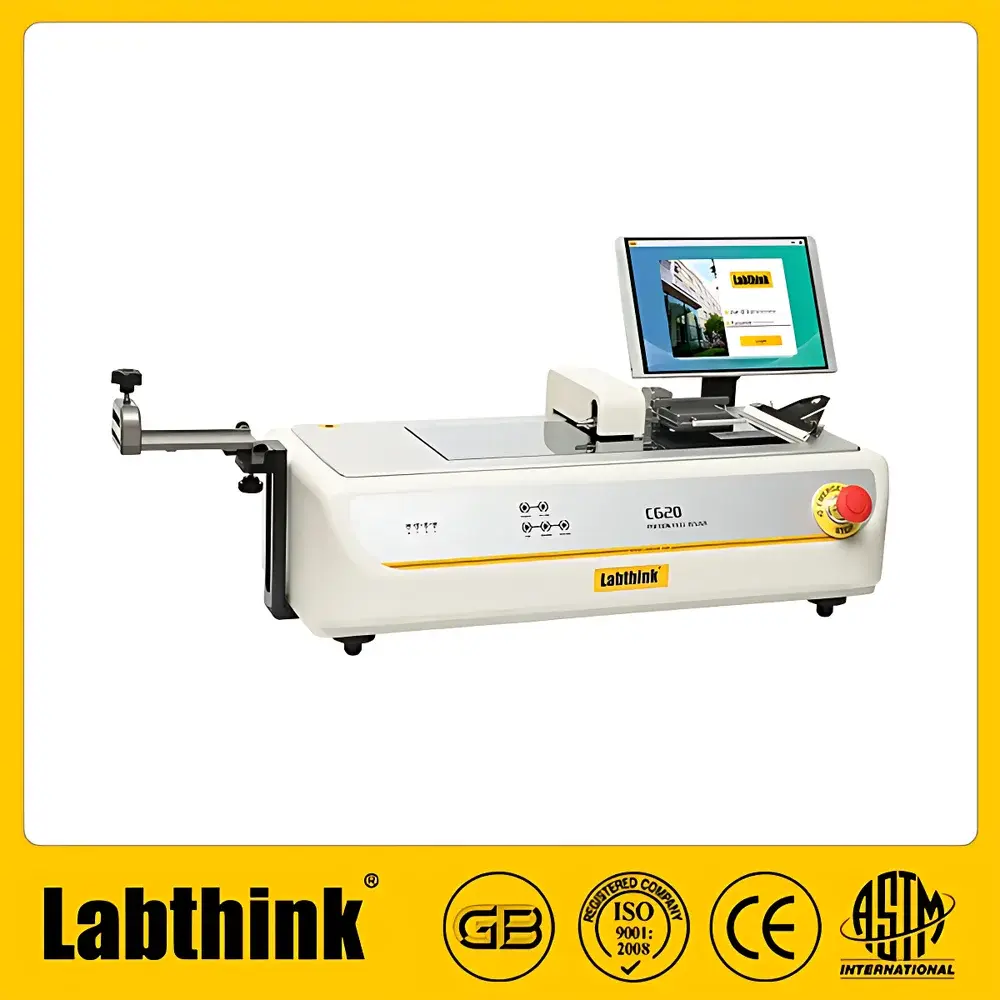
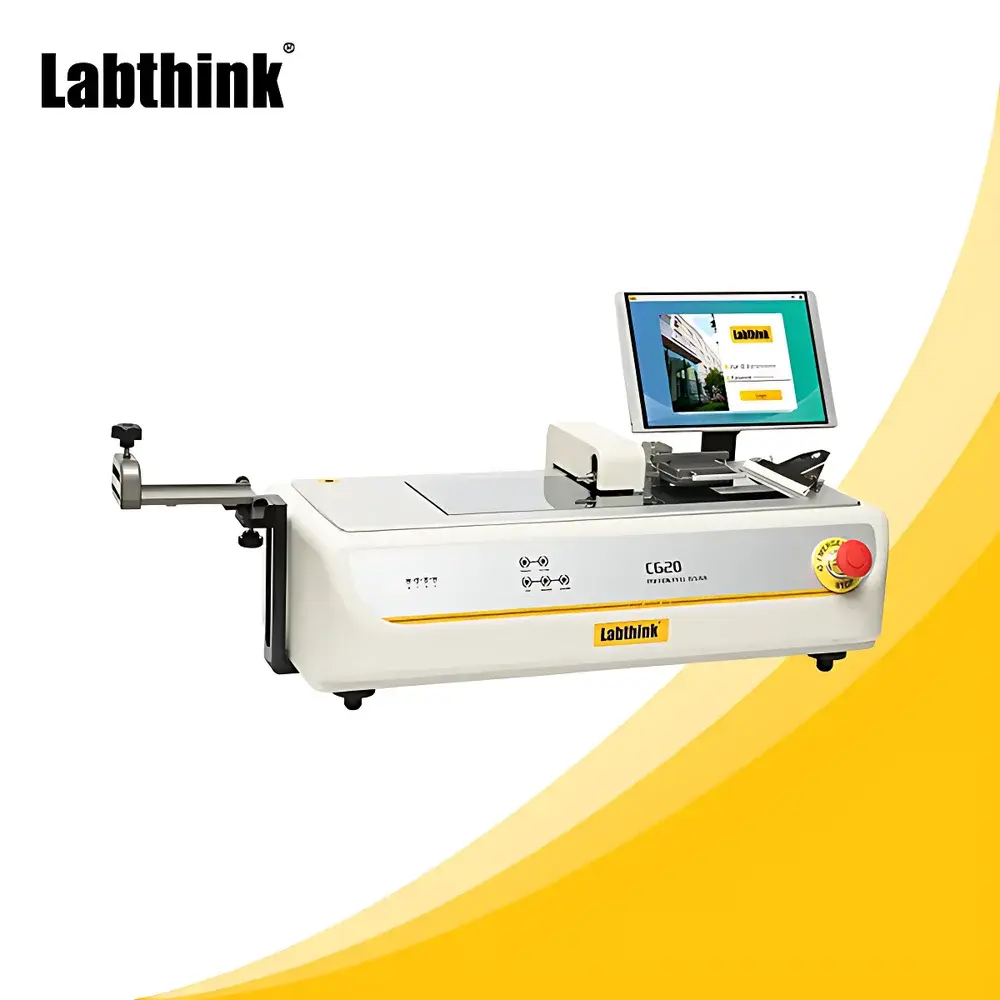
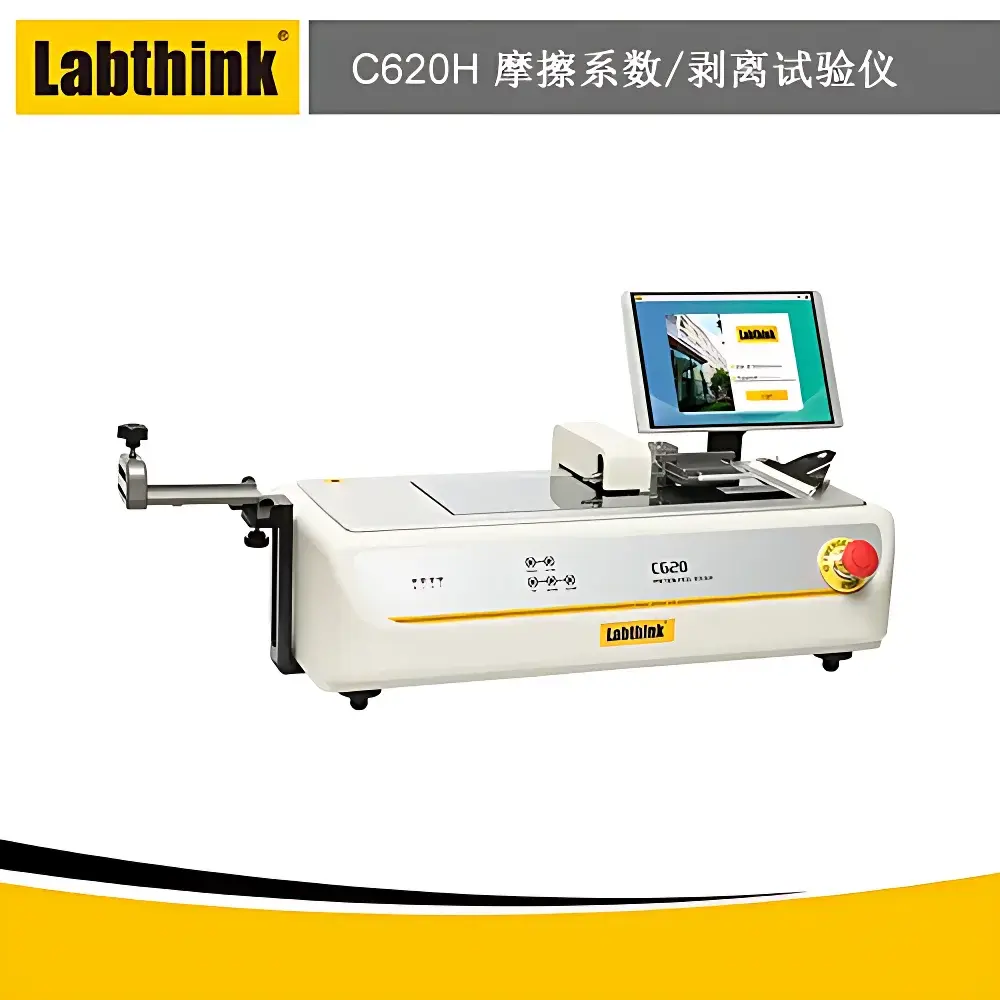
Labthink C620H Coefficient of Friction and Peel Strength Tester
| Brand | Labthink |
|---|---|
| Model | C620H |
| Force Capacity | 5 N (standard) |
| Force Accuracy | ±0.5% of reading (10–100% FS) |
| Force Resolution | 0.001 N |
| Test Speed | 0–500 mm/min (integer setting only) |
| Speed Accuracy | ±0.5% of set value (1–100% of max speed) |
| Travel Range | 10–300 mm |
| Displacement Resolution | 0.01 mm |
| Test Temperature Range | Ambient to 100 °C |
| Temperature Stability | ±0.2 °C |
| Temperature Accuracy | ±2 °C (single-point calibration, effective area of test platform) |
| Test Platform Dimensions | 400 mm × 150 mm |
| Specimen Thickness Limit | ≤2 mm |
| Sled Dimensions | 63.5 mm × 63.5 mm |
| Sled Mass | 200 g (custom sleds available) |
| Power Supply | 220 VAC ±10%, 50 Hz or 120 VAC ±10%, 60 Hz |
| Dimensions (L×W×H) | 635 mm × 300 mm × 250 mm |
| Net Weight | 25 kg |
Overview
The Labthink C620H Coefficient of Friction and Peel Strength Tester is an electromechanical precision instrument engineered for quantitative measurement of static and kinetic coefficients of friction (COF) and peel strength in flexible packaging, thin-film, and laminated materials. It operates on the fundamental principle of horizontal tensile traction: a standardized sled is pulled across a stationary specimen at controlled velocity and normal load, while a high-fidelity load cell records the instantaneous force required to initiate motion (static COF) and maintain sliding (kinetic COF). For peel testing, the instrument applies a consistent angular separation (typically 90° or 180°) between adhered layers under uniaxial tension, enabling quantification of interfacial adhesion energy per unit width (N/25 mm or N/mm). Designed for laboratory environments in R&D, QC, and regulatory compliance settings, the C620H meets the mechanical and metrological requirements of international standards governing material surface interaction and bond integrity.
Key Features
- Automated sled lift-and-lower mechanism ensures precise dwell time control prior to motion initiation—critical for reproducible static COF determination per ISO 8295 and ASTM D1894.
- Demagnetized test platform and sled assembly, verified via residual magnetism inspection, eliminate magnetic interference with force transduction—essential for low-force measurements below 0.1 N.
- Thermally stabilized test platform with PID-controlled heating (ambient to 100 °C), ±0.2 °C stability, and calibrated accuracy of ±2 °C enables temperature-dependent COF profiling per ISO 8510-2 and GB/T 2790.
- High-accuracy load cell system certified to better than 0.5% full-scale accuracy (10–100% FS), with extended-range options up to 100 N to accommodate rigid substrates and high-adhesion laminates.
- Precision servo-driven crosshead with recirculating ball screw delivers speed control within ±0.5% over the full 0–500 mm/min range, supporting both low-velocity creep studies and high-speed packaging line simulation.
- Integrated safety architecture includes mechanical end-stop limit switches, overload cutoff, automatic return-to-home, and real-time force monitoring—compliant with IEC 61000-6-2 EMC and ISO 12100 functional safety principles.
Sample Compatibility & Compliance
The C620H accommodates a broad spectrum of planar specimens ≤2 mm thick, including polymer films (BOPP, PET, PE), coated papers, aluminum foils, metallized laminates, nonwovens, rubber sheets, printed substrates, and medical-grade pressure-sensitive adhesives. Its modular fixture system supports standardized sleds (63.5 mm × 63.5 mm, 200 g), custom sled geometries, 90°/180° peel jaws, and auxiliary tools such as standard rollers (per ASTM D3330) and specimen conditioning clamps. The instrument is validated for conformance with ISO 8295 (plastic film friction), ISO 8510-2 (peel of flexible materials), GB 10006 (Chinese national COF standard), GB/T 2790–2792 (peel strength series), ASTM D1894 (COF of plastic film), ASTM D4917 (peel of tapes), TAPPI T816 (paper friction), and TAPPI T549 (paperboard slip resistance). Optional GMP-compliant software modules support 21 CFR Part 11 audit trails, electronic signatures, and ALCOA+ data integrity principles.
Software & Data Management
Embedded Linux-based control software runs on a 10.1-inch industrial touchscreen with capacitive multi-touch interface. The application provides guided workflow navigation, real-time force–displacement curve visualization, automatic peak detection for static COF, and slope-based kinetic COF calculation. Raw data (force, displacement, time, temperature) are stored in encrypted binary format with timestamping and operator ID logging. Export formats include CSV, PDF reports, and XML metadata compliant with LIMS integration protocols. Optional DataShield™ module enables centralized database synchronization, role-based access control, and automated backup to network-attached storage (NAS) or cloud endpoints—meeting pharmaceutical quality system requirements for data traceability, retention, and retrieval per Annex 11 and EU GMP Chapter 4.
Applications
- Primary packaging qualification: COF optimization of shrink sleeves, pouch laminates, and blister foil to prevent jamming in high-speed fillers.
- Medical device packaging validation: Peel strength verification of sterile barrier systems (e.g., Tyvek®/PET–PE pouches) per ISO 11607-2.
- Adhesive formulation development: Quantitative comparison of acrylic, silicone, and rubber-based PSAs under variable humidity and temperature.
- Surface treatment efficacy assessment: Correlation of corona or plasma treatment intensity with measured COF reduction on polyolefin films.
- Regulatory submission support: Generation of GLP-compliant test reports for FDA 510(k), CE marking, and China NMPA registration dossiers.
- Material substitution studies: Benchmarking of bio-based films (PLA, PHA) against conventional polymers in friction and delamination performance.
FAQ
What standards does the C620H natively support without software add-ons?
The base firmware implements ISO 8295, ASTM D1894, GB 10006, and GB/T 2792 with preconfigured test parameters, zero manual calibration steps, and auto-generated report templates.
Can the instrument perform simultaneous COF and peel testing on the same sample batch?
Yes—via rapid fixture exchange using standardized mounting interfaces; no recalibration is required between modes due to shared load cell and motion control architecture.
Is temperature calibration traceable to national standards?
Yes—optional NIST-traceable temperature probe calibration kits are available, with certificate of calibration issued per ISO/IEC 17025 accredited procedures.
How is data integrity ensured during power interruption?
All active test sessions write to non-volatile flash memory at 100 Hz; unsaved data is automatically recovered upon reboot with checksum-verified integrity validation.
Does the system support multi-user permission levels?
Yes—administrator, operator, and reviewer roles can be assigned with configurable access to method editing, test execution, and report approval functions.
Related Products







