
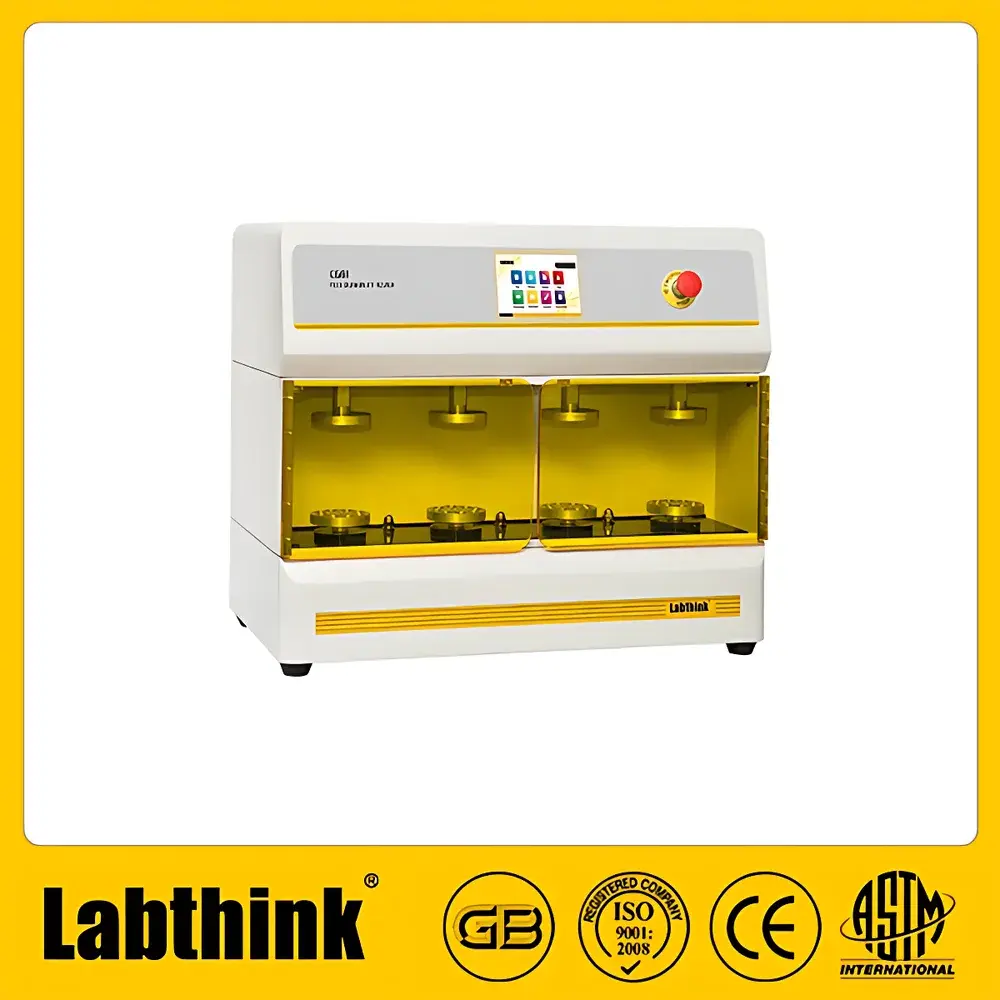
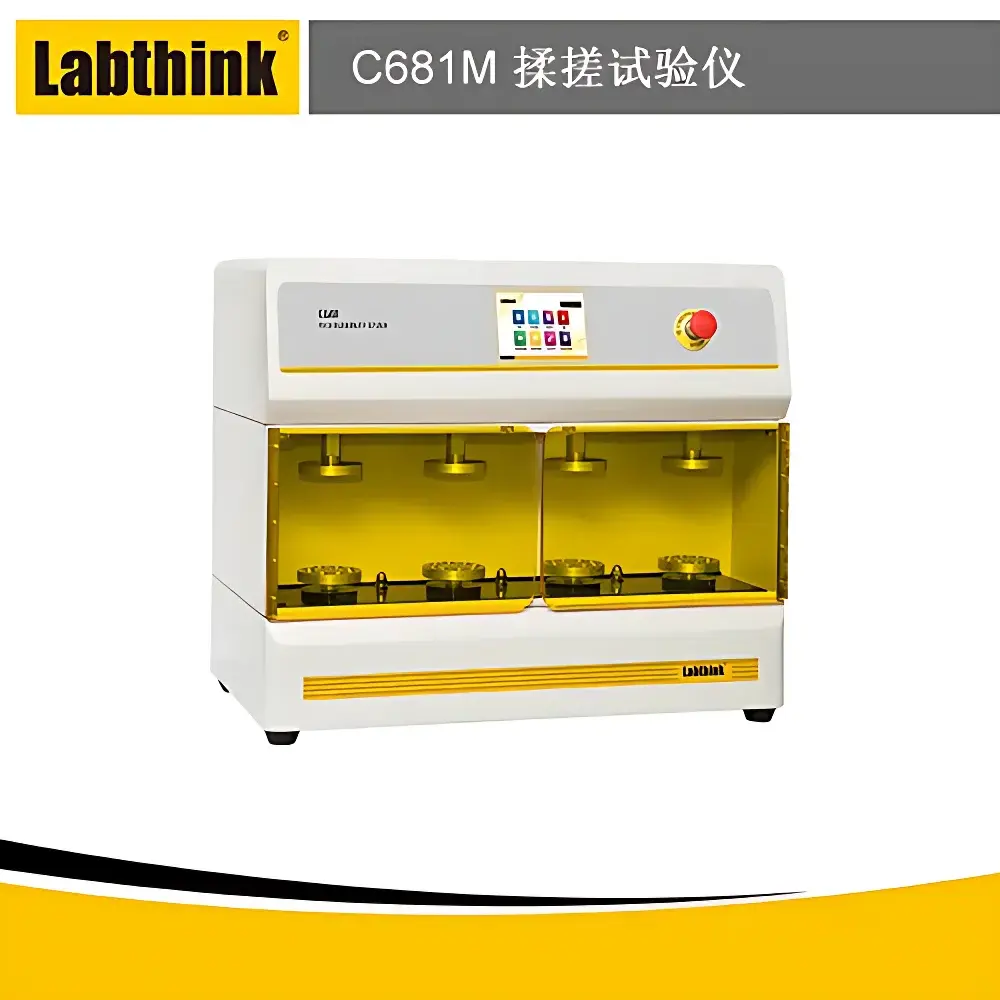
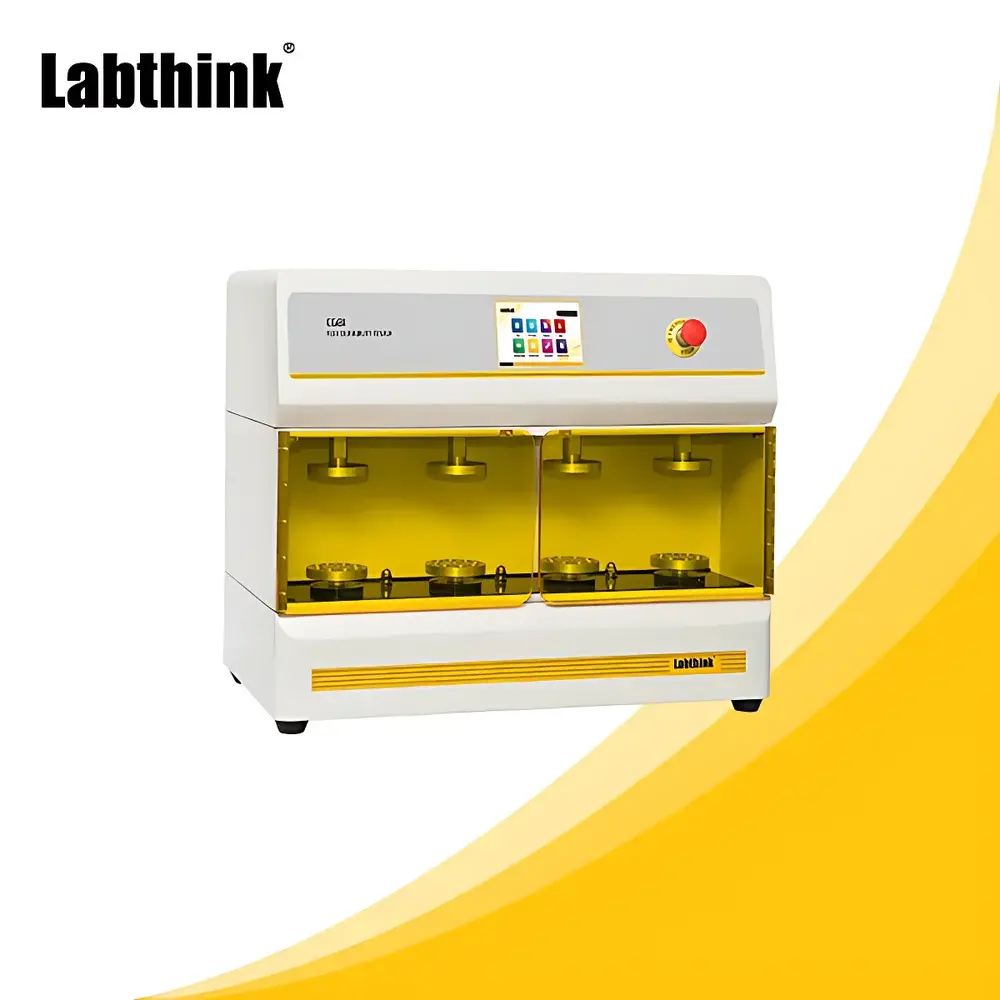
Labthink C681M Flexible Packaging Film Rubbing Tester for Metallized Films
| Brand | Labthink |
|---|---|
| Origin | Shandong, China |
| Manufacturer Type | Manufacturer |
| Country of Origin | China |
| Model | C681M |
| Price | Upon Request |
| Rubbing Frequency | 45 cycles/min |
| Test Modes | Mode A (2700 cycles), Mode B (900 cycles), Mode C (270 cycles), Mode D (20 cycles), Mode E (20 short-stroke cycles), Mode F (0–20,000 cycles, user-defined) |
| Applied Load | 300 N |
| Rotational Torque | 2 N·m |
| Max Sample Thickness | ≤2.5 mm (custom fixtures available for thicker specimens) |
| Rubbing Angle | 440° or 400° |
| Horizontal Stroke | 155 mm or 80 mm |
| Number of Stations | 4 |
| Sample Quantity per Test | 1–4 |
| Sample Size | 280 mm × 200 mm |
| Dimensions (L×W×H) | 760 mm × 410 mm × 650 mm |
| Power Supply | 220 VAC ±10%, 50 Hz OR 120 VAC ±10%, 60 Hz |
| Net Weight | 85 kg |
Overview
The Labthink C681M Flexible Packaging Film Rubbing Tester is an engineered solution for quantifying the mechanical durability of flexible barrier materials under repeated flexural stress—specifically simulating real-world handling conditions such as folding, crumpling, and compression encountered during packaging manufacturing, filling, transportation, and storage. Based on the principle of controlled cyclic torsional and translational motion, the instrument subjects planar specimens to standardized rubbing actions that induce microstructural damage—including microcracks, delamination, and pinhole formation—in metallized layers, polymer coatings, and laminated structures. The resulting degradation in barrier integrity—measured via post-test pinhole count (per ASTM F392-93(2004)) or oxygen/water vapor transmission rate (WVTR/OVTR) change—is directly correlated with functional shelf-life performance. This test method is critical for validating material robustness in high-value applications including pharmaceutical blister packaging, retort pouches, aseptic cartons, and vacuum-sealed food packaging.
Key Features
- Multi-mode standardized testing: Five preconfigured ASTM/GB-compliant protocols (Modes A–E) plus fully programmable Mode F (0–20,000 cycles) enable precise replication of industry-specific stress profiles—from high-cycle production-line simulation (Mode A) to low-cycle handling validation (Mode E).
- Four independent test stations: Simultaneous evaluation of up to four specimens under identical environmental and mechanical conditions ensures statistical reliability and throughput efficiency without cross-contamination or positional bias.
- Precision servo-driven actuation: Industrial-grade servo motor system delivers repeatable angular displacement (±0.5° accuracy), consistent stroke length (155 mm / 80 mm selectable), and stable 45-cycle-per-minute frequency—ensuring inter-laboratory reproducibility per ISO/IEC 17025 requirements.
- Integrated environmental monitoring: Real-time temperature and relative humidity logging synchronized with test execution supports GLP-compliant documentation and enables correlation of barrier degradation with ambient condition fluctuations.
- Full-touch industrial HMI: IP65-rated capacitive touchscreen interface with dual-language (English/Chinese) support, multi-level user authentication, automatic power-fail recovery, and onboard storage for ≥1,200 test records—fully compliant with FDA 21 CFR Part 11 audit trail requirements when paired with optional Labthink Lystem™ software.
- Modular mechanical design: Quick-change fixture system accommodates samples up to 2.5 mm thick; optional accessories—including stainless-steel hose clamps (91–114 mm), precision sampling cutter, and thermal-printed data output module—extend adaptability across R&D, QC, and regulatory submission workflows.
Sample Compatibility & Compliance
The C681M is validated for use with single-layer and multilayer flexible substrates including but not limited to: metallized polyester (PET-Al), aluminum foil laminates, nylon-based coextrusions, ethylene-vinyl alcohol (EVOH) barrier films, polypropylene (PP) and polyethylene (PE) coatings, paperboard composites, and functional barrier-coated papers. It conforms to ASTM F392-93(2004) Standard Test Method for Flexing Durability of Flexible Barrier Materials and the national standard GB/T 41347–2022 Testing Method for Rubbing Resistance of Flexible Packaging Materials. Test outputs are routinely accepted by regulatory bodies for packaging qualification dossiers under ICH Q5C, USP , and EU Annex 1 guidelines for primary packaging integrity assessment.
Software & Data Management
When interfaced with Labthink’s Lystem™ Enterprise Software (optional), the C681M supports automated test sequence definition, remote parameter configuration, encrypted data export (CSV/PDF/XML), electronic signature capture, and full 21 CFR Part 11 compliance—including time-stamped audit trails, role-based access control, and immutable record archiving. All locally stored test logs include metadata such as operator ID, environmental readings, cycle count verification, and pass/fail status against user-defined pinhole thresholds—enabling seamless integration into enterprise quality management systems (QMS) like TrackWise or MasterControl.
Applications
- Quantitative evaluation of pinhole generation in aluminum-coated films after mechanical stress
- Comparative durability screening of alternative barrier architectures (e.g., SiOx-coated vs. AlOx-coated PET)
- Validation of adhesive bond strength in laminated pharmaceutical foils
- Accelerated aging correlation studies linking rubbing cycles to OTR/WVTR increase rates
- Supplier qualification testing per ISO 22000 and BRCGS Packaging Standards
- Root cause analysis of seal integrity failures in form-fill-seal operations
FAQ
What standards does the C681M comply with?
It meets ASTM F392-93(2004) and GB/T 41347–2022 for flexing durability and rubbing resistance testing.
Can the instrument test non-metallized films?
Yes—it is designed for all flexible barrier materials, including plain polymers, coated papers, and multilayer laminates.
Is environmental monitoring mandatory during testing?
While optional for basic operation, real-time T/RH logging is required for GLP/GMP-compliant reporting and regulatory submissions.
How is data integrity ensured during power interruption?
The system features non-volatile memory with auto-save and resume functionality, preserving all active test parameters and cycle counts.
What sample preparation tools are recommended?
A precision die-cutting tool (optional accessory) ensures consistent 280 mm × 200 mm specimen geometry; stainless-steel hose clamps maintain uniform tension across variable-thickness substrates.
Related Products






