
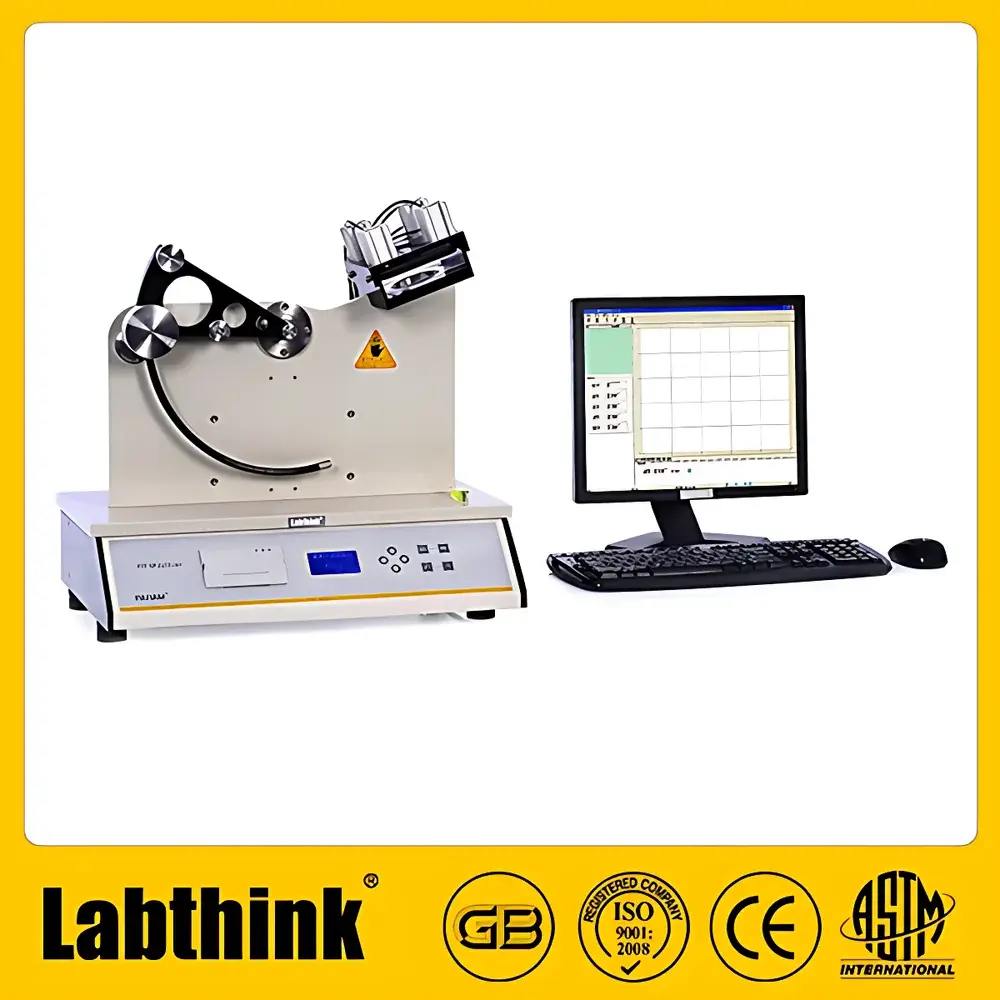
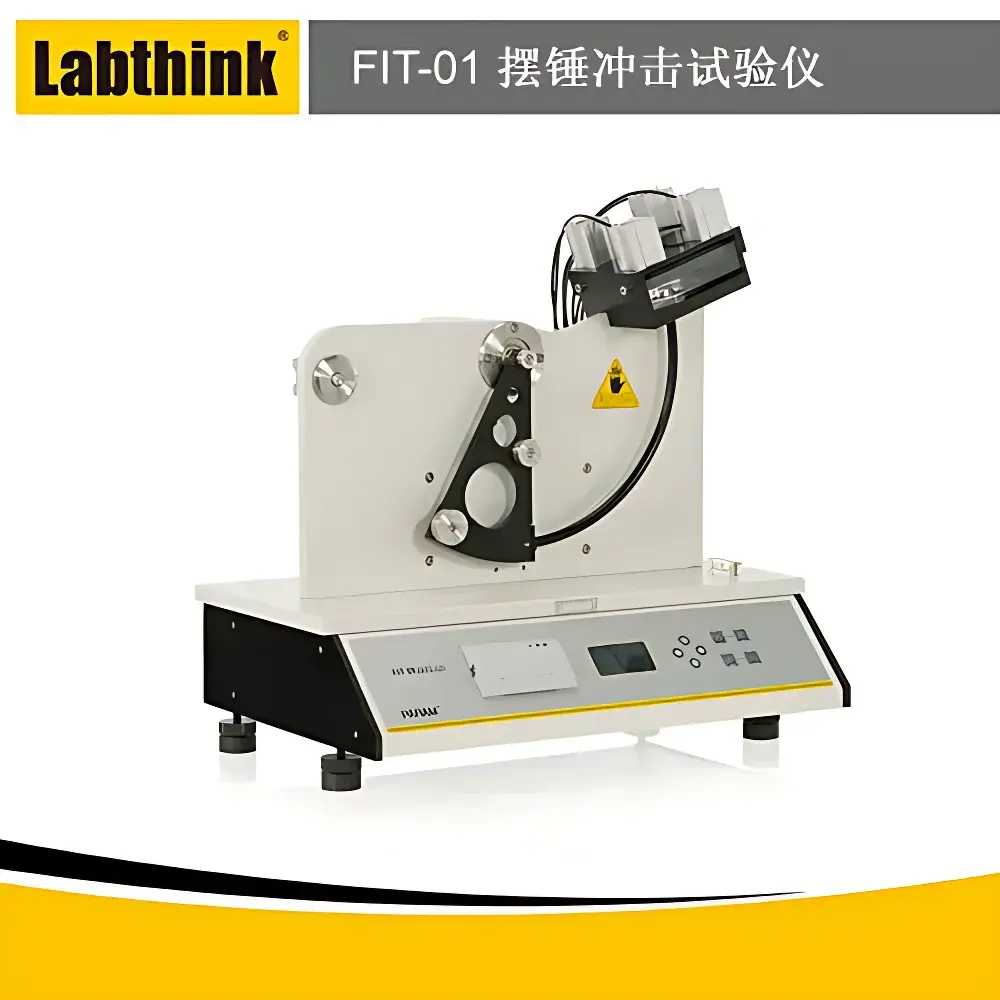
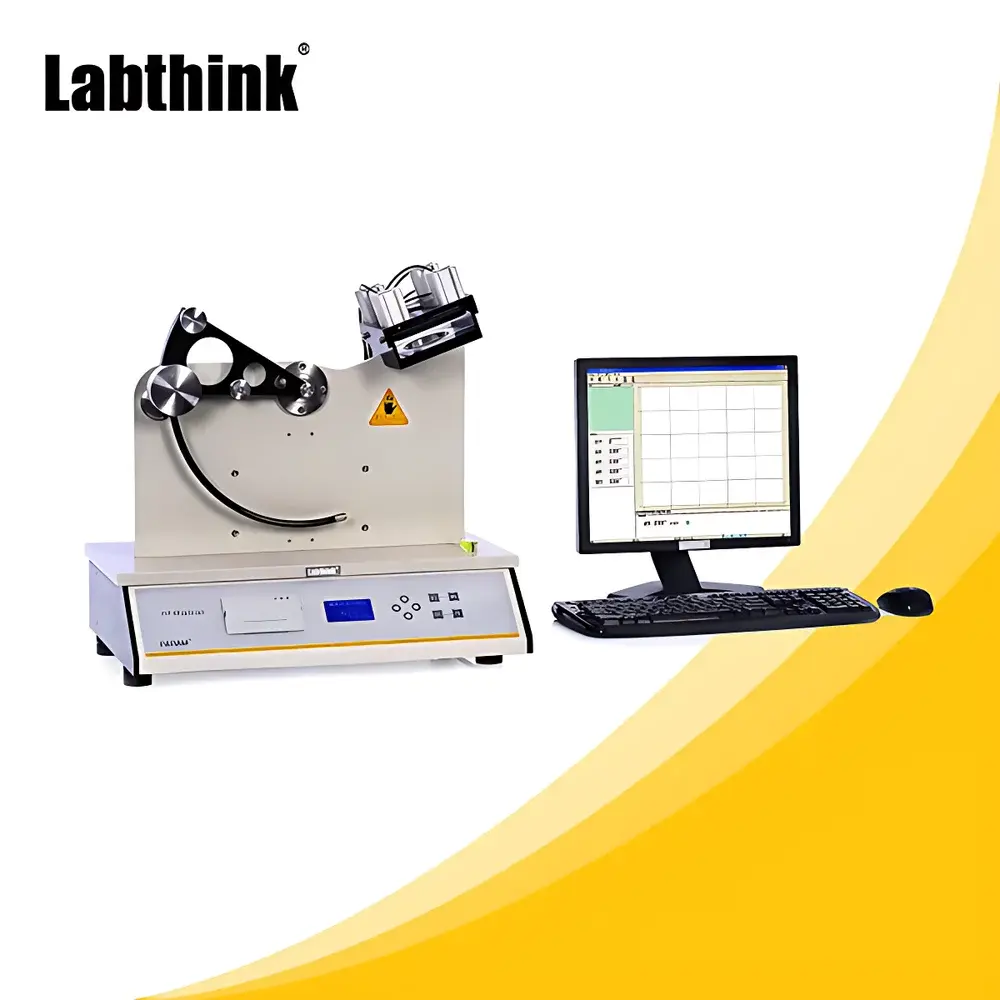
Labthink FIT-01 GB8809 Pendulum Impact Tester for Plastic Films and Laminates
| Brand | Labthink |
|---|---|
| Origin | Shandong, China |
| Manufacturer | Labthink Instruments Co., Ltd. |
| Model | FIT-01 |
| Instrument Type | Pendulum Impact Testing Machine |
| Impact Energy | 1 J, 2 J, 3 J (standard) |
| Impact Velocity | Determined by pendulum drop height per ISO/GB standards (pneumatic release at 0.6 MPa air supply, user-provided) |
| Pendulum Moment (Impact Constant) | Configurable via interchangeable pendulum arms with nominal diameters Φ25.4 mm, Φ19 mm, Φ12.7 mm |
| Force Sensor Range | 1 J / 2 J / 3 J full-scale |
| Maximum Lift Height | Φ89 mm and Φ60 mm test clamp configurations |
| Sample Holder Diameter | Φ89 mm and Φ60 mm |
| Sample Size | 100 mm × 100 mm or Φ100 mm circular |
| Resolution | 0.001 J |
| Air Supply Interface | Φ6 mm polyurethane tubing (external 0.6 MPa source required) |
| Dimensions (L×W×H) | 600 mm × 390 mm × 600 mm |
| Net Weight | 64 kg |
| Compliance | GB/T 8809–1988, ASTM D3420–2008a, NF T54-116–1973 |
Overview
The Labthink FIT-01 GB8809 Pendulum Impact Tester is an engineered solution for quantitative assessment of puncture resistance and energy absorption capacity in thin polymeric materials—including plastic films, laminated structures, metal foils, and coated substrates—under controlled pendulum impact conditions. Based on the classical pendulum impact principle defined in GB/T 8809–1988, the instrument operates by releasing a calibrated pendulum arm carrying a hemispherical striker (available in Φ25.4 mm, Φ19 mm, and Φ12.7 mm profiles) from a fixed angular elevation. The striker impacts a clamped specimen at a reproducible velocity, and the residual kinetic energy is measured via high-resolution load cell feedback. The difference between initial potential energy and post-impact residual energy yields the absorbed impact energy (in joules), directly correlating to material toughness under dynamic localized stress. This method provides a standardized, non-destructive comparative metric for quality control, formulation optimization, and regulatory conformance across packaging R&D and production environments.
Key Features
- Three standard impact energy ranges (1 J, 2 J, 3 J) selectable via interchangeable pendulum masses and calibrated arm geometries, ensuring adaptability across low- to medium-toughness film grades.
- Pneumatically actuated specimen clamping (0.6 MPa air supply required) and pendulum release mechanism eliminate manual variability, enhancing repeatability and operator safety.
- Dual-diameter test fixture system (Φ89 mm and Φ60 mm clamping apertures) accommodates both standard square (100 mm × 100 mm) and circular (Φ100 mm) specimens per GB/T 8809 and ASTM D3420 protocols.
- Microprocessor-based control unit with backlit LCD interface and tactile PVC membrane keypad enables intuitive parameter setup, real-time test monitoring, and immediate result display without external software dependency.
- Integrated thermal printer outputs hard-copy reports including date/time stamp, sample ID, energy value, and test configuration; RS232 serial port supports bidirectional data exchange with Lystem™ Laboratory Data Management System (LDMS) for centralized audit trails and GLP-compliant record retention.
- Modular mechanical architecture with precision-machined pendulum shaft, hardened steel striker tips, and O-ring-sealed clamping plates ensures long-term dimensional stability and minimal hysteresis over extended service life.
Sample Compatibility & Compliance
The FIT-01 is validated for use with flexible planar specimens up to 1 mm thickness, including mono-layer PE/PP/PET films, aluminum-laminated pouch materials, metallized CPP, PVDC-coated substrates, and pharmaceutical blister lidding foils. Its mechanical design conforms to the geometric and dynamic constraints specified in GB/T 8809–1988 (Chinese National Standard), ASTM D3420–2008a (Standard Test Method for Impact Resistance of Plastic Film by the Pendulum Method), and NF T54-116–1973 (French standard for puncture resistance of plastic sheets). All calibration procedures follow traceable metrological practices aligned with ISO/IEC 17025 requirements. The system supports routine verification using certified reference impact specimens and meets essential criteria for inclusion in GMP-regulated packaging validation protocols where mechanical integrity testing is mandated.
Software & Data Management
While standalone operation requires no PC, optional Lystem™ LDMS software extends functionality to multi-user laboratory networks. It enforces role-based access control, electronic signatures, and automated metadata tagging (operator ID, environmental conditions, instrument calibration status). Audit logs record every test initiation, parameter modification, and report export event in immutable format compliant with FDA 21 CFR Part 11 requirements. Raw sensor output (force vs. time) is archived alongside processed energy values, enabling retrospective root-cause analysis during deviation investigations. Export formats include CSV, PDF/A-2, and XML for integration into enterprise QMS platforms such as TrackWise or MasterControl.
Applications
- Quantifying seal integrity and delamination resistance in heat-sealed flexible packaging laminates.
- Evaluating cold-temperature brittleness of frozen-food pouches per ASTM F1921.
- Comparing impact performance of bio-based films (e.g., PLA, PHA) versus conventional polyolefins.
- Validating shelf-life stability of barrier-coated pharmaceutical blisters subjected to distribution vibration and drop scenarios.
- Supporting ISO 11607–2 Annex C mechanical testing requirements for sterile barrier systems.
- Generating input data for finite element modeling (FEM) of film deformation behavior under transient loading.
FAQ
What air pressure is required for pneumatic operation?
A stable 0.6 MPa (6 bar) compressed air supply is mandatory for consistent clamp actuation and pendulum release timing. Users must provide a clean, dry, oil-free source connected via Φ6 mm polyurethane tubing.
Can the FIT-01 be used for rigid plastics or thick boards?
No. The instrument is strictly designed for flexible, planar specimens ≤1 mm thick and ≥20 µm. Rigid materials exceeding 1.5 mm thickness or exhibiting yield strength >100 MPa fall outside its validated operating envelope.
Is calibration traceable to national standards?
Yes. Load cell calibration is performed using NIST-traceable deadweight standards. Annual recalibration is recommended, and certificate documentation includes uncertainty budgets per ISO/IEC 17025.
Does the system support custom striker geometries?
Custom hemispherical or flat-tip strikers can be manufactured upon request, subject to mechanical compatibility verification and updated calibration certification.
How is compliance with 21 CFR Part 11 ensured?
When operated with Lystem™ LDMS, the system implements electronic signature workflows, audit trail encryption, and data integrity safeguards meeting all technical and procedural requirements of FDA 21 CFR Part 11 Subpart B.



