
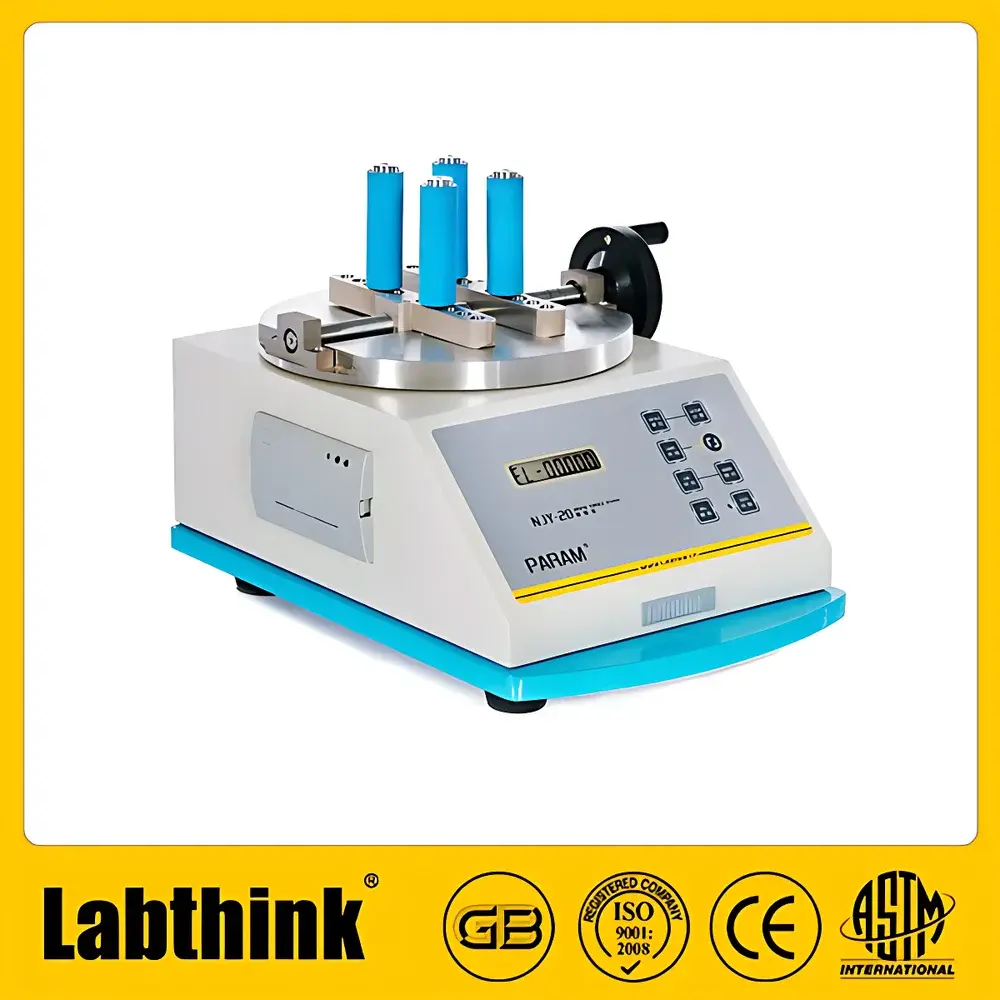
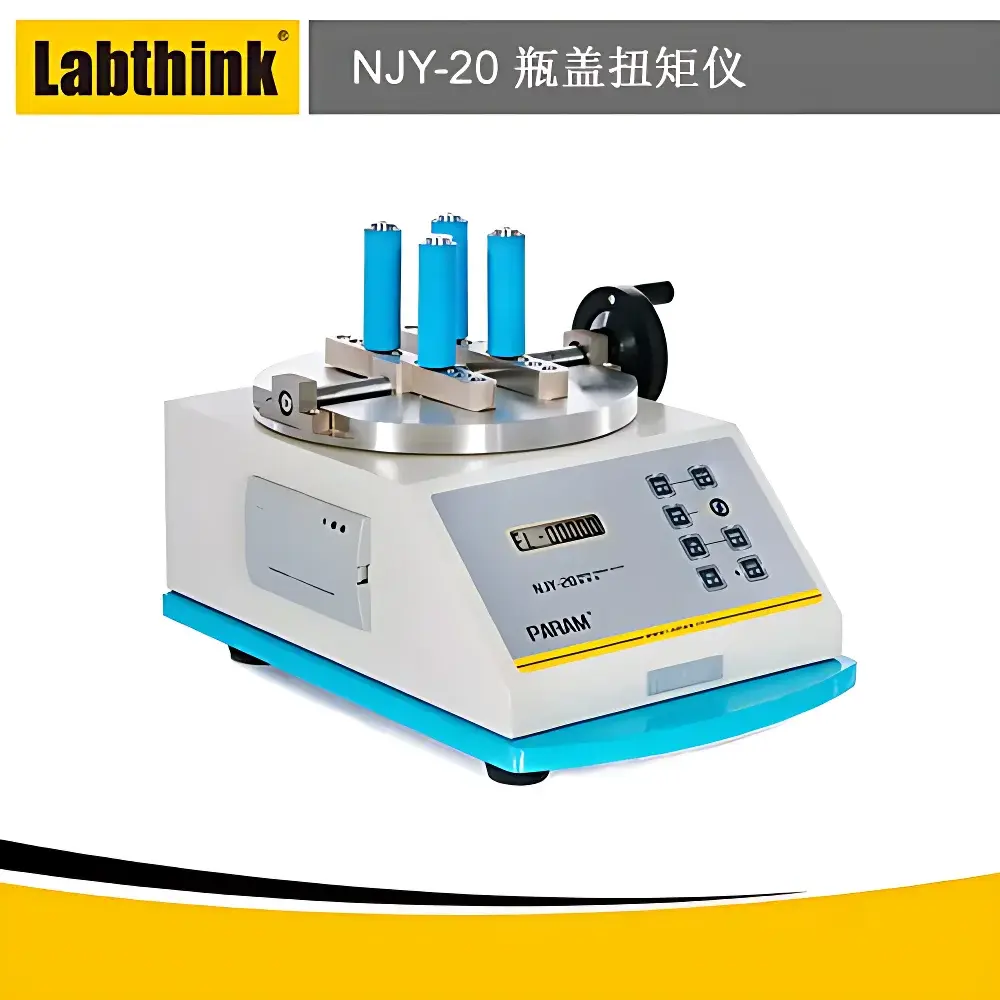
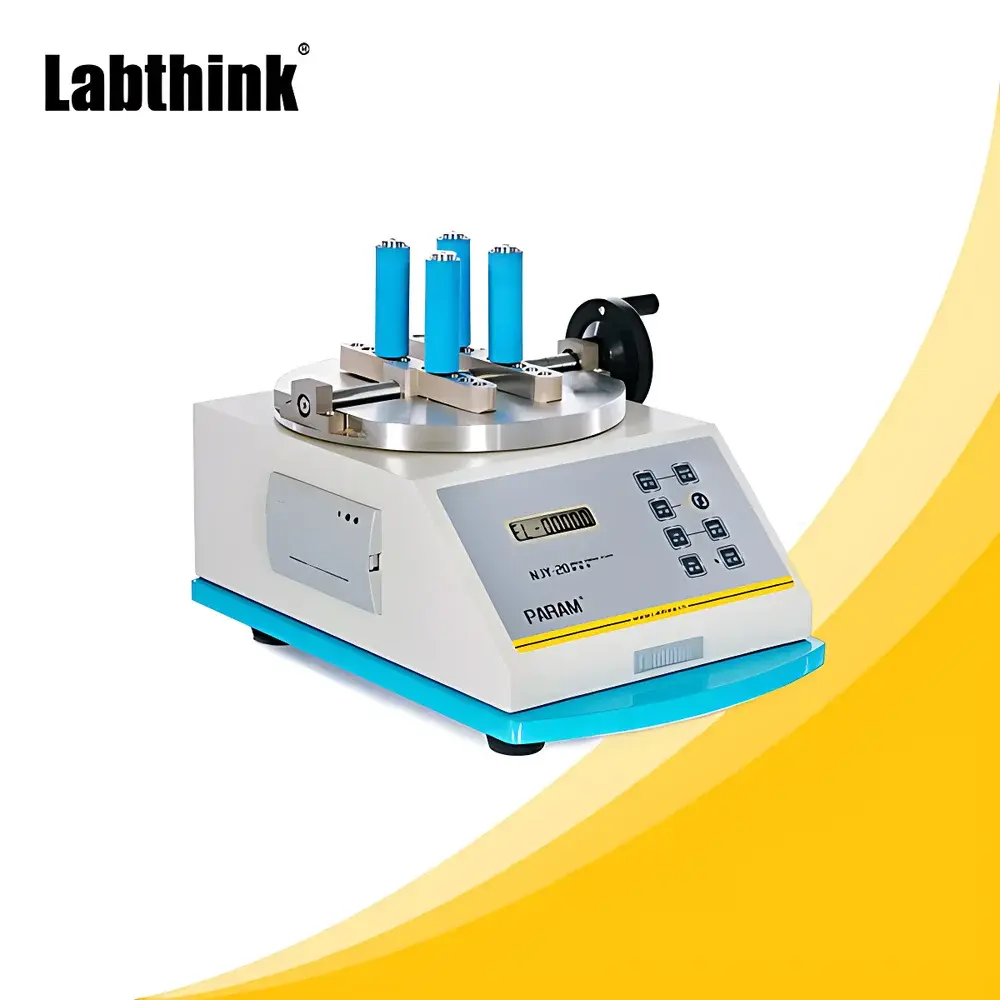
Labthink NJY-20 Digital Cap Torque Tester
| Brand | Labthink |
|---|---|
| Model | NJY-20 |
| Measurement Range | 20 Nm (standard), optional 40 Nm / 50 Nm |
| Accuracy Class | Grade 1 |
| Resolution | 0.001 Nm |
| Clamp Diameter Range | Φ5–Φ170 mm |
| Test Count Memory | 1–9 samples (expandable via Lystem™ software) |
| Dimensions | 350 × 240 × 140 mm (L×W×H) |
| Weight | 19 kg |
| Power Supply | AC 220 V, 50 Hz |
| Compliance Standards | GB/T 17876, ASTM D2063, ASTM D3198, ASTM D3474, BB/T 0025, BB/T 0034 |
Overview
The Labthink NJY-20 Digital Cap Torque Tester is a precision-engineered rotational force measurement instrument designed for quantifying the sealing and opening torque of closure systems used in rigid and semi-rigid packaging. It operates on the principle of controlled angular displacement with real-time torsional load acquisition, utilizing a calibrated strain-gauge transducer and closed-loop microprocessor control to deliver repeatable, traceable torque measurements in both clockwise (tightening) and counterclockwise (opening) directions. This device is purpose-built for quality assurance laboratories, packaging R&D centers, and production line validation environments where compliance with international packaging integrity standards—particularly those governing child-resistant, senior-friendly, and tamper-evident closures—is mandatory. Its compact benchtop architecture supports both offline batch verification and periodic in-process checks without requiring integration into automated packaging lines.
Key Features
- Microprocessor-controlled operation with backlit LCD display and intuitive PVC membrane keypad for standalone use
- Dual-mode testing: programmable tightening torque (sealing force) and opening torque (removal force) protocols
- Auto-hold peak torque capture ensures full retention of maximum measured value during transient events
- Standardized SI unit output (Nm) with selectable decimal resolution down to 0.001 Nm
- Integrated overload protection, automatic zero calibration, and system fault diagnostics
- Onboard thermal mini-printer for immediate hard-copy reporting and RS232 serial interface for external data logging
- Native compatibility with Labthink’s Lystem™ Laboratory Data Management System for centralized test result archiving, audit trail generation, and cross-instrument report consolidation
Sample Compatibility & Compliance
The NJY-20 accommodates a broad spectrum of closure geometries—including screw caps, snap-on lids, push-pull dispensers, and flip-top spouts—across plastic bottles, stand-up pouches with spout nozzles, flexible sachets, and laminated tube ends. Its adjustable chuck mechanism accepts closures ranging from 5 mm to 170 mm in outer diameter, enabling evaluation of infant formula jars, pharmaceutical vials, beverage containers, and personal care tubes without fixture modification. The instrument is validated per GB/T 17876 (Chinese national standard for plastic cap torque testing), ASTM D2063 (standard test method for torque removal of closures), ASTM D3198 (performance specification for screw-type plastic closures), ASTM D3474 (torque tester calibration), and China’s packaging industry standards BB/T 0025 and BB/T 0034. These alignments support GLP-compliant documentation and facilitate regulatory submissions requiring metrological traceability and inter-laboratory reproducibility.
Software & Data Management
While functional as a stand-alone tester, the NJY-20 achieves full data governance capability when paired with Labthink’s Lystem™ platform. This cloud-ready software enables role-based user access control, electronic signature workflows, and 21 CFR Part 11–compliant audit trails—including operator ID, timestamp, environmental metadata (if linked to ambient sensors), and raw torque-vs.-angle curve export. Statistical analysis functions generate mean, standard deviation, CV%, min/max, and histogram visualization across configurable sample sets. Reports conform to ISO/IEC 17025 formatting requirements and may be exported in PDF, Excel, or XML formats for integration into enterprise QMS (e.g., TrackWise, MasterControl). All firmware updates and calibration certificate uploads are managed centrally through the Lystem™ dashboard.
Applications
- Verification of torque specifications during formulation trials of new closure materials (e.g., PP, HDPE, TPE blends)
- Validation of capping machine settings prior to production ramp-up
- Stability assessment of torque retention after accelerated aging (e.g., 40°C/75% RH for 3 months)
- Comparative evaluation of liner compression behavior under varying tightening speeds
- Root cause analysis of consumer complaints related to over-tightening (difficult opening) or under-tightening (leakage, contamination)
- Supporting FDA pre-submission testing for OTC drug packaging dossiers
- Internal QC release testing per SOPs aligned with USP Packaging Integrity Evaluation
FAQ
What torque ranges does the NJY-20 support out of the box?
The base configuration is rated for 0–20 Nm. Optional high-capacity transducers extend the range to 40 Nm or 50 Nm—each requiring factory recalibration and updated firmware mapping.
Can the NJY-20 test non-circular or asymmetric closures?
Yes, provided the closure has a concentric rotational axis and fits within the 5–170 mm clamping diameter envelope; irregular shapes require custom collet fixtures ordered separately.
Is the instrument suitable for ISO 17025-accredited laboratories?
Yes—when operated with documented calibration certificates (traceable to NIM or equivalent NMIs), validated Lystem™ software configurations, and defined uncertainty budgets per GUM guidelines.
Does it meet FDA 21 CFR Part 11 requirements for electronic records?
Full compliance is achieved only when deployed with Lystem™ configured with audit trail enforcement, electronic signatures, and permission-level controls—standalone mode does not satisfy Part 11.
How often must the torque sensor be recalibrated?
Labthink recommends annual recalibration; however, frequency should be risk-assessed based on usage intensity, environmental conditions, and internal QA policy—many users schedule biannual verification using certified reference standards.



