
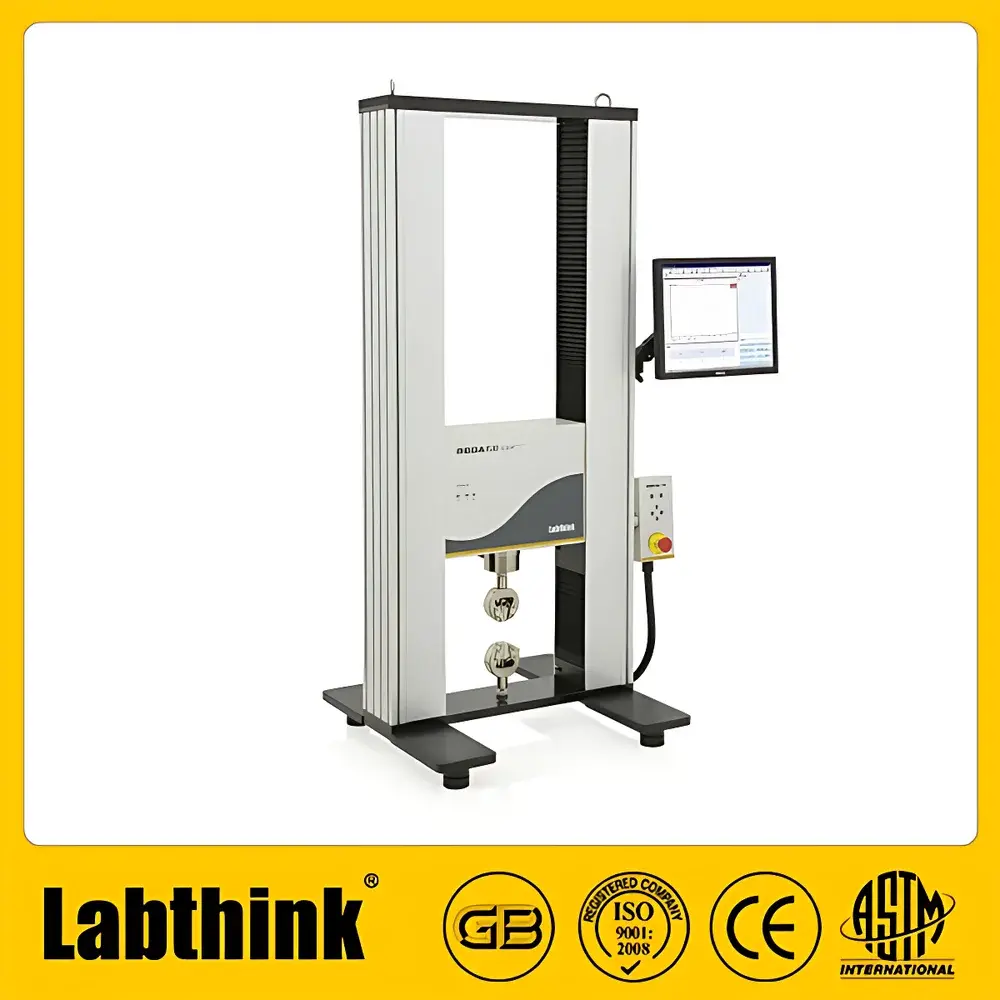
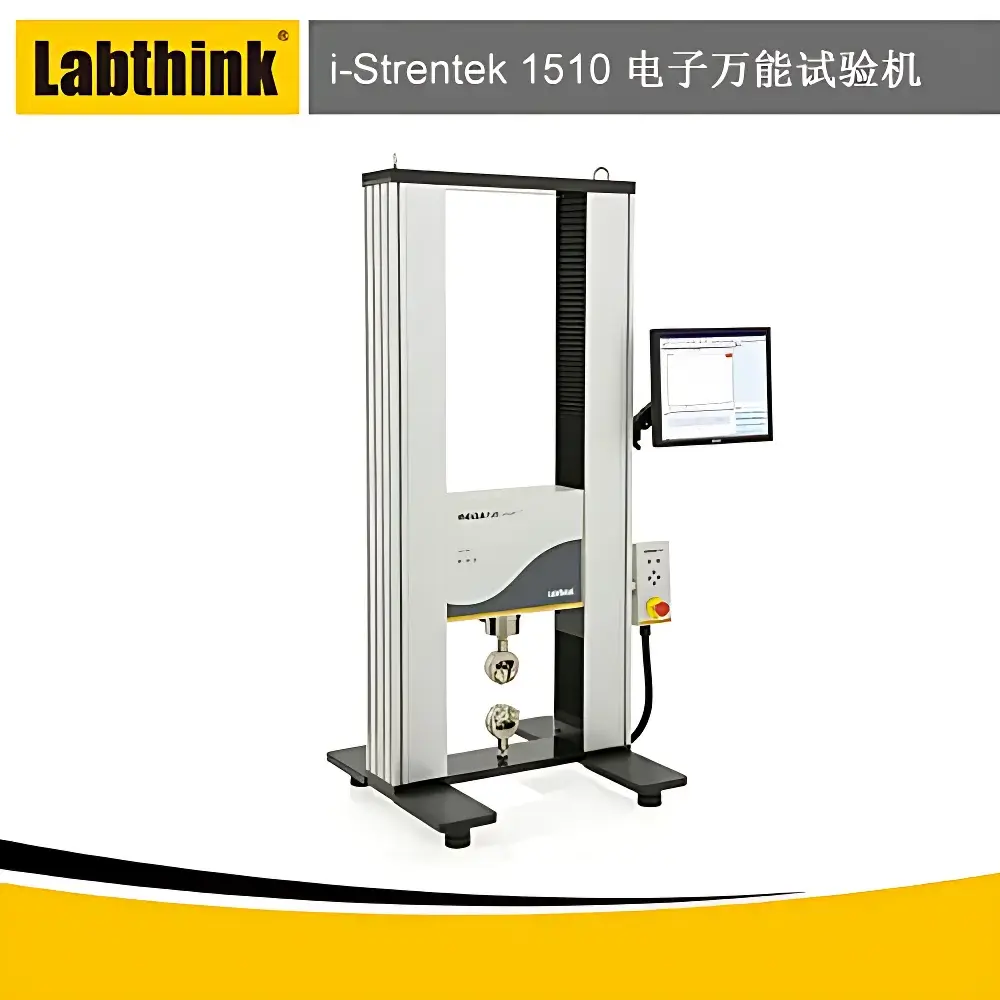
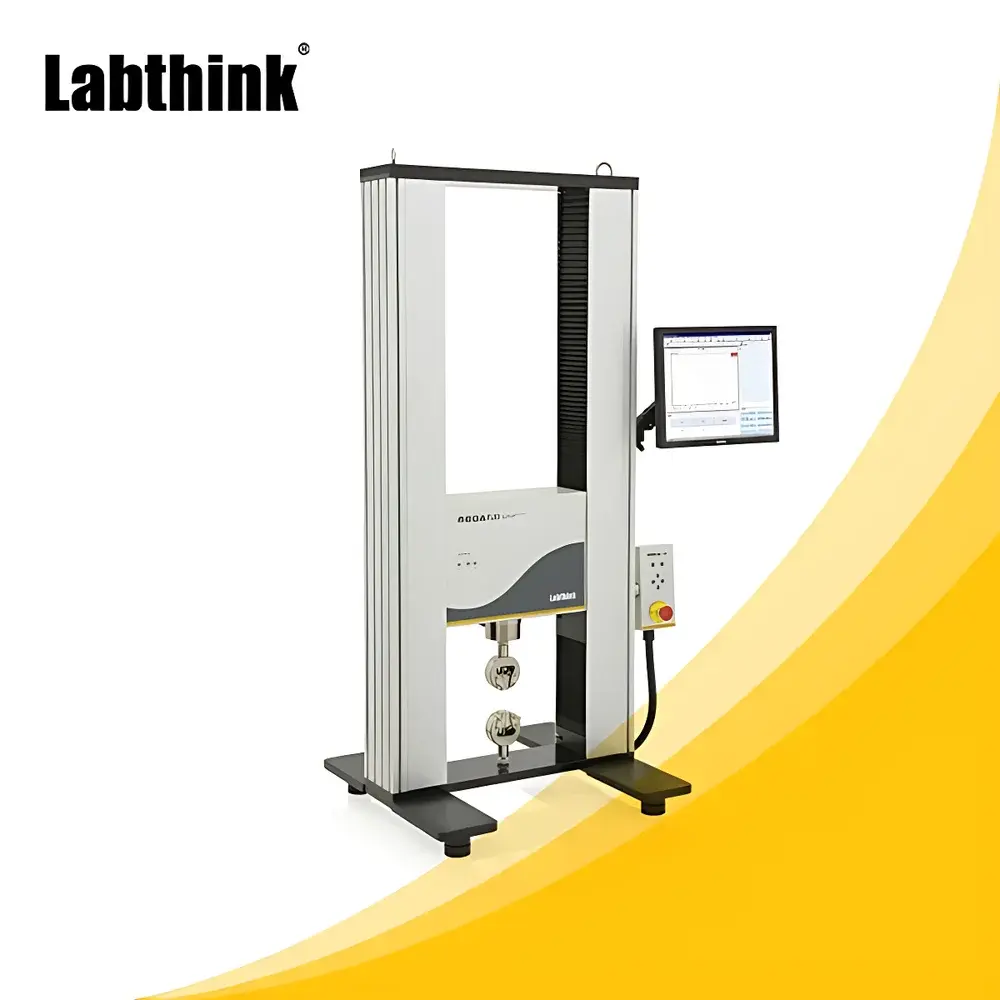
Labthink i-Strentek 1510 Universal Testing Machine
| Brand | Labthink |
|---|---|
| Origin | Shandong, China |
| Manufacturer | Labthink Instruments Co., Ltd. |
| Model | i-Strentek 1510 |
| Instrument Type | Electromechanical Universal Testing Machine |
| Load Capacity Options | 50 N, 100 N, 250 N, 500 N (standard), 1,000 N, 2,000 N, 5,000 N, 10,000 N |
| Accuracy Class | Class 1 per ISO 7500-1 / ASTM E4 |
| Test Speed Range | 1–500 mm/min (infinitely variable) |
| Maximum Travel | 800 mm |
| Test Station | Single |
| Grip Types | Pneumatic or manual clamping |
| Air Supply Requirement | 0.5–0.7 MPa (user-provided, Ø6 mm polyurethane tubing) |
| Dimensions (L×W×H) | 850 × 700 × 1630 mm |
| Weight | 150 kg |
| Power Supply | 220 VAC 50 Hz / 120 VAC 60 Hz |
Overview
The Labthink i-Strentek 1510 Universal Testing Machine is an electromechanical force-testing system engineered for high-reproducibility mechanical characterization of soft and semi-rigid materials across research, quality control, and regulatory compliance environments. It operates on the principle of controlled uniaxial displacement between two parallel grips — one fixed to the base and the other mounted on a motor-driven crosshead — while simultaneously measuring applied load via a calibrated load cell and axial displacement via a high-resolution encoder-based position sensor. This dual-sensor architecture enables precise derivation of stress–strain curves, tensile strength, elongation at break, Young’s modulus, yield point, tear resistance, peel adhesion, compression stiffness, and bending rigidity. Designed in accordance with international mechanical testing standards including ISO 7500-1 (static calibration), ISO 37 (rubber tensile properties), ASTM D882 (thin plastic sheeting), ASTM F88 (seal strength), and GB/T 1040 series (plastics tensile testing), the i-Strentek 1510 delivers traceable, audit-ready data suitable for GLP, GMP, and FDA 21 CFR Part 11–compliant workflows when configured with optional DataShield™.
Key Features
- Modular multi-function platform supporting standardized tensile, peel (90°/180°), tear (trouser, Elmendorf, puncture), compression (flat crush, edge crush, ring crush), flexural, and seal strength tests — all within a single instrument architecture.
- Class 1 accuracy certified per ISO 7500-1 and ASTM E4, ensuring metrological reliability for internal QC and external certification reporting.
- High-precision ball-screw drive system with dual-column rigid frame design minimizes deflection and ensures axial alignment stability across full travel (800 mm).
- Infinitely variable speed control (1–500 mm/min) enables strict adherence to material-specific test protocols — from slow creep analysis to rapid burst testing.
- Integrated pneumatic clamping system (0.5–0.7 MPa) with quick-change fixture interface supports repeatable specimen engagement without operator-induced preload variability.
- Embedded real-time control system with industrial-grade touchscreen interface and tactile membrane keypad reduces software dependency and improves operational robustness in production-lab settings.
- Four USB 2.0 ports and dual Ethernet interfaces facilitate seamless integration with LIMS, MES, or centralized data archival systems; supports networked firmware updates and remote diagnostics.
Sample Compatibility & Compliance
The i-Strentek 1510 accommodates a broad spectrum of specimen geometries and mechanical behaviors through over 100 interchangeable grip and fixture configurations — including wedge-action, roller, pneumatic parallel-jaw, peel mandrel, compression platens, ring crush fixtures, and custom-engineered solutions for pharmaceutical closures, medical device components, and flexible packaging structures. It is routinely deployed for testing per ISO 11607-2 (sterile barrier systems), ASTM D3330 (adhesive tape peel), ASTM D1894 (coefficient of friction), GB/T 2792 (peel strength of pressure-sensitive tapes), YBB 00042005 (pharmaceutical packaging), and JIS P8113 (paper tensile strength). All test methods are implemented using pre-validated parameter templates aligned with standard test procedures, enabling direct comparability with historical datasets and inter-laboratory reference values.
Software & Data Management
The embedded control software provides intuitive test setup, real-time curve visualization, automatic peak detection, and post-test statistical analysis — including mean, standard deviation, coefficient of variation, min/max, and group-wise curve superposition. Raw force–displacement data is exported in CSV and XML formats compliant with ASTM E1447 and ISO/IEC 17025 documentation requirements. Optional DataShield™ software adds role-based access control, electronic signatures, full audit trail (per FDA 21 CFR Part 11), encrypted database storage, and automated report generation with customizable templates. All test logs include timestamped metadata: operator ID, environmental conditions (if linked to optional climate chamber), calibration status, and instrument configuration history.
Applications
Primary applications include tensile property evaluation of polymer films, laminates, foils, nonwovens, and elastomers; peel strength assessment of heat seals, cold seals, and adhesive bonds; tear propagation analysis of pouches and labels; compression resistance of corrugated containers, IBC totes, and folding cartons; and functional performance testing of medical packaging (e.g., vial stopper extraction force, syringe plunger break-loose force, IV bag port pull-off strength). Extended use cases cover consumer product testing such as yogurt cup film peel, toothpaste tube cap torque-to-open, cosmetic brush filament tensile fatigue, and transdermal patch adhesion quantification under hydrated conditions.
FAQ
What load cell capacities are available for the i-Strentek 1510?
Standard configuration includes a 500 N load cell; optional ranges extend from 50 N to 10,000 N, selected based on expected force magnitude and required resolution.
Is the system compliant with FDA 21 CFR Part 11 requirements?
Yes — when equipped with DataShield™ software, the system provides full electronic record and signature functionality, including audit trail, user authentication, and data integrity safeguards.
Can the machine perform compression testing on large-format packages like IBC totes?
Yes — with optional compression platens and reinforced support frames, it meets ASTM D642 and ISO 12048 for container compression testing up to 10 kN.
Does the system support automated batch testing with pass/fail criteria?
Yes — the software allows definition of acceptance thresholds for force, elongation, or energy absorption; results are color-coded and flagged automatically upon deviation.
What environmental conditions are recommended for optimal test repeatability?
Testing should be conducted per ISO 291 and ASTM D618 — i.e., 23 ± 2 °C and 50 ± 5 % RH — with optional integration into temperature- and humidity-controlled chambers.



